How Voice Cloning Is Used Responsibly in AI Music
Explore how voice cloning in AI music is done ethically using Soundverse’s transparent framework.
How Voice Cloning Is Used Responsibly in AI Music
In 2026, voice cloning in AI music has evolved from a creative novelty into a core part of modern production workflows. Musicians, AI developers, and record labels increasingly rely on synthetic vocals to streamline recording processes, create multilingual versions of songs, or preserve vocal styles for future projects. However, these advancements raise significant ethical questions about consent, attribution, and the protection of human artistry. This article explores how voice cloning in AI music can be used responsibly and how Soundverse is leading the charge with transparent, artist-centered technology.
Why is voice cloning in AI music important in 2026?
Voice cloning enables producers and engineers to recreate vocal performances that sound indistinguishably human. In 2026, this technology helps artists experiment with voice synthesis for artists across multiple genres, from pop to jazz. It’s not just about mimicking voices—it’s about capturing emotional nuance, unique tone, and cultural identity in a digital format.
For example, independent artists who want to reach global audiences can use AI-generated vocals to translate performances across languages without losing expressiveness. Similarly, brands in advertising and gaming integrate synthetic voices to maintain consistent vocal characters. Yet, as technology advances, so does the need for responsible AI voice technology that safeguards the rights of original performers. To learn how this technology powers multilingual AI songs and global content localization, explore Voice Cloning for Multilingual Songs and Global Content in 2026.
What are the main ethical challenges of AI-generated vocals?
The main challenges surrounding ethical AI music and voice cloning fall into three categories:
- Consent and Ownership – Who owns the data used to train voice synthesis models? Without clear licensing and artist approval, training on unauthorized samples becomes an ethical violation.
- Attribution and Recognition – Many artists worry that AI-generated vocals could replace human work without proper credit. Transparent attribution mechanisms are essential.
- Recurring Compensation – Beyond one-time payments, artists should benefit financially from ongoing use of their voice in AI models. Sustainable monetization must be embedded in the system itself.
Throughout 2024 and 2025, the music industry saw numerous debates around these issues, but 2026 marks a turning point—responsible AI music creation is now becoming standardized through frameworks like Soundverse’s Ethical AI Music Framework. Artists and developers also look at resources like Voice Cloning and Copyright: What Creators Should Know in 2026 to navigate copyright laws and AI voice rights.
How can voice cloning be used responsibly in music production?
Responsible voice cloning doesn’t mean avoiding AI—it means designing with artists in mind. A responsible approach includes:
- Obtaining explicit consent from artists before using their voice data.
- Using licensed datasets rather than scraped content.
- Embedding attribution metadata directly into generated outputs.
- Tracking the lifecycle of cloned voices to ensure transparency.
- Enabling recurring compensation when cloned voices generate revenue.
These principles ensure that ethical AI music supports rather than exploits human creativity. Learn more about how to protect your voice from AI cloning using Soundverse Trace and advanced vocal security tactics in 2026.
How to make responsible voice cloning in AI music with Soundverse The Ethical AI Music Framework
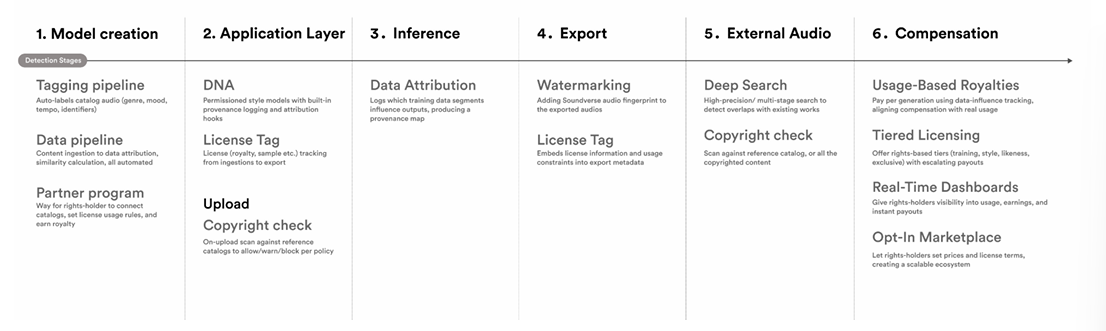
Soundverse’s Ethical AI Music Framework is a six-stage infrastructure that bridges innovation with artist integrity. Instead of functioning as a black-box system, it introduces transparency across every level of AI music creation.
Stage 1: Licensed Data Sourcing
All voice and music data used for training are fully licensed. There’s no scraping or unauthorized sampling, ensuring artists are part of the process from the beginning.
Stage 2: Permissioned Models (DNA)
Soundverse DNA allows artists to define and monetize their unique sonic identity. Each trained model represents the artist’s own “voice DNA,” enabling ethical voice synthesis for artists while protecting intellectual property.
Stage 3: Explainable Inference (Attribution)
When AI generates vocals, the framework provides explainable inference. Every output can be traced back to the source, making attribution transparent.
Stage 4: Traceable Export (Watermarking)
Generated tracks include embedded watermarks, ensuring that any distribution—streaming, licensing, or sampling—can be traced. This protects creators from misuse and guarantees accountability.
Stage 5: Deep Search (External Scanning)
This capability scans external databases and streaming platforms to detect where AI-generated vocals appear, allowing continuous monitoring of voice use and rights compliance.
Stage 6: Recurring Compensation (Partner Program)
Artists benefit through recurring compensation models whenever their voice DNA or vocal synthesis contributes to AI music creations. This helps foster a sustainable creative economy.
By integrating these capabilities, Soundverse ensures that voice cloning in AI music promotes cultural respect, creative collaboration, and long-term equity between artists and AI developers. You can also watch our Soundverse Tutorial Series - 9. How to Make Music for more insight into responsible and creative AI music workflows.
What are current trends shaping responsible AI voice technology?
Several 2026 trends reflect the wider adoption of ethical frameworks in voice cloning:
- Collective Licensing Coalitions – Major labels and AI developers are forming coalitions to license large vocal data sets with consent-based agreements.
- Watermarked AI Outputs – Transparent watermarking is becoming standard practice, ensuring attribution and anti-plagiarism tracking.
- Cross-Platform Recognition Tools – Tools like Soundverse Trace integrate cross-platform detection for unauthorized voice use.
- Creator Incentive Programs – Recurring royalty systems incentivize artists to participate in AI model training.
To better understand how generative tools are reshaping music creation, explore articles like how AI-generated music is transforming the music industry and AI music generator and human composers—A future together.
How does Soundverse ensure music production ethics in AI workflows?
Soundverse applies strict verification methods at each stage of production. When users upload vocal samples, they must confirm consent or identify licensed material. Generation workflows remain asynchronous—users provide input and wait for processed results; there’s no live filter or real-time preview.
This model supports compliance across enterprise-grade pipelines and independent musician use cases alike. Soundverse Trace and Soundverse DNA complement the framework by delivering transparent metadata tracking and ethical sound generation.
For artists exploring AI music genres, you can check guides like How to Create Jazz Music with Soundverse AI or How to Create Country Music with Soundverse AI, both of which illustrate how ethical AI music tools enhance creative freedom while maintaining integrity. For a hands-on introduction, check our guide on creating Deep House music from the Soundverse Tutorial Series.
How can musicians and developers work together on ethical AI?
Collaboration between artists and technologists is fundamental to responsible innovation. Musicians share cultural and emotional depth, while developers bring technical precision. Together, they can:
- Co-design voice synthesis models with transparent data sourcing.
- Set explicit attribution standards.
- Integrate watermarking APIs into distribution channels.
- Build smart contracts for recurring royalties.
This cross-disciplinary cooperation helps define modern music production ethics, making voice cloning a force for empowerment rather than exploitation.
Start Creating Music Responsibly with AI
Experience the power of AI music creation while keeping ethics and originality at the forefront. Soundverse empowers artists to craft authentic, high-quality tracks using secure and responsible voice technologies.
Get Started Free
Related Articles
- How AI-Generated Music Is Transforming the Music Industry: Discover how AI innovations are driving massive shifts in how music is composed, produced, and distributed worldwide.
- AI Music Generator and Human Composers: A Future Together: Learn how AI tools complement human creativity, opening new paths for collaboration and musical exploration.
- Soundverse Introduces Stem Separation AI Magic Tool: Explore how Soundverse’s Stem Separation AI helps artists isolate vocals and instruments effortlessly for remixing and mastering.
- AI Ranks Soundverse’s AI Singer #1: The Ultimate AI Singing Platform Dominating 2025: Find out why Soundverse’s AI Singer leads the way in responsible voice synthesis and artistic collaboration.
Here's how to make AI Music with Soundverse
Video Guide

Here’s another long walkthrough of how to use Soundverse AI.
Text Guide
- To know more about AI Magic Tools, check here.
- To know more about Soundverse Assistant, check here.
- To know more about Arrangement Studio, check here.
Soundverse is an AI Assistant that allows content creators and music makers to create original content in a flash using Generative AI. With the help of Soundverse Assistant and AI Magic Tools, our users get an unfair advantage over other creators to create audio and music content quickly, easily and cheaply. Soundverse Assistant is your ultimate music companion. You simply speak to the assistant to get your stuff done. The more you speak to it, the more it starts understanding you and your goals. AI Magic Tools help convert your creative dreams into tangible music and audio. Use AI Magic Tools such as text to music, stem separation, or lyrics generation to realise your content dreams faster. Soundverse is here to take music production to the next level. We're not just a digital audio workstation (DAW) competing with Ableton or Logic, we're building a completely new paradigm of easy and conversational content creation.
TikTok: https://www.tiktok.com/@soundverse.ai
Twitter: https://twitter.com/soundverse_ai
Instagram: https://www.instagram.com/soundverse.ai
LinkedIn: https://www.linkedin.com/company/soundverseai
Youtube: https://www.youtube.com/@SoundverseAI
Facebook: https://www.facebook.com/profile.php?id=100095674445607
Join Soundverse for Free and make Viral AI Music
 We are constantly building more product experiences. Keep checking our Blog to stay updated about them!