Voice Cloning for Multilingual Songs and Global Content in 2026
Explore how voice cloning technology powers multilingual AI songs and global content localization in 2026.
Voice Cloning for Multilingual Songs and Global Content
The Rise of Voice Cloning Technology in Global Music Creation
As 2026 continues to push the boundaries of sound synthesis, voice cloning technology has become a cornerstone of the new global music ecosystem. What started as an AI experiment in vocal mimicry a few years ago has evolved into a robust toolset that redefines how creators, developers, and localization teams manage multilingual songs and cross-cultural content. From re-creating a singer’s voice in a different language to producing global campaigns that sound organic and regionally accurate, voice cloning is transforming how we think about artistic and localized expression.
AI developers and music producers in 2026 are leveraging multilingual AI voice systems to scale their projects beyond language barriers. Artists can now record in English while listeners in Japan, Brazil, and Germany hear the same track with localized vocals — all without losing emotional nuance or phrasing. These technology shifts have positioned voice cloning as a critical innovation within global content localization strategies.
What Is Voice Cloning Technology and Why Does It Matter in 2026?
Voice cloning technology refers to the use of AI to digitally replicate a person’s voice, allowing the system to render speech or singing that sounds like the original voice. In music, the technology extends to tone, rhythm, vibrato, and emotional cues that make a performance feel human. As training methods improved over 2025 and into 2026, cloned voices can now handle multilingual phrasing and cultural inflections with remarkable accuracy.

The implications go far beyond entertainment. For global brands, this enables seamless localization and messaging consistency across markets. Singers can now launch multilingual albums without recording multiple takes in different studios, saving production time while maintaining vocal authenticity. Content creators, too, can scale their storytelling — podcasts, short films, and even interactive games benefit from consistent synthetic singing voices in localized languages.
Learn more about how AI voice cloning is changing audio production in 2025 or explore legal debates through Voice Cloning: Understanding Its Impact on Music.
How is Voice Cloning Shaping Multilingual AI Music Creation?
Voice cloning unlocks new possibilities in AI music creation by bridging style, tone, and language. When paired with advanced models that can generate linguistic variations, it ensures songs retain native pronunciation patterns and emotional delivery.

- Language-Neutral Recording Pipelines: Artists can record vocals once and automatically generate multiple versions adapted to various languages. This workflow dramatically shortens localization cycles.
- Cross-Cultural Collaborations: Producers can experiment with multilingual duets, pairing cloned voices from different regions to experiment with fusion genres such as Afro-Latin or K-pop-Bollywood hybrids. These unique blends are increasingly popular in 2026, as seen across global streaming charts.
- Inclusion and Accessibility: Voice cloning also helps represent accents, dialects, and languages underrepresented in commercial media, enriching music diversity.
For insights into how producers are applying these practices, read AI Voice Cloning Music 2026: Essential Producer's Guide.
If you're interested in understanding how these creative trends evolved, you can explore the history of AI-generated music transformations or see how genres matured in articles like Most Popular Music Genres.
For a deeper dive, watch our guide on creating Deep House music.
What Are Synthetic Singing Voices and How Do They Support Global Content Localization?
Synthetic singing voices are AI-generated performances that simulate singing using trained vocal models. These models are capable of rendering melodies, harmonies, and stylistic inflections that sound natural. For global content localization, synthetic voices ensure messages and songs feel native to their target cultures.
For example, a global brand launching a campaign can use cloned singing voices to re-create the same jingle in ten different languages with culturally adapted tone and emotion. Content becomes universally appealing yet culturally specific — a balance that was nearly impossible before AI’s evolution.
Similarly, in multilingual film and game localization, characters can now sing in multiple languages using the same vocal identity. This enhances immersion while cutting down costly re-recording processes once required for every region.
Explore how voice cloning presents complex legal challenges and read more in The Role of AI Music in Film and Television.
For a product overview, watch our Soundverse Tutorial - How to Make Music.
How to Make Multilingual Songs and Globalized Audio with Soundverse Voice Swap
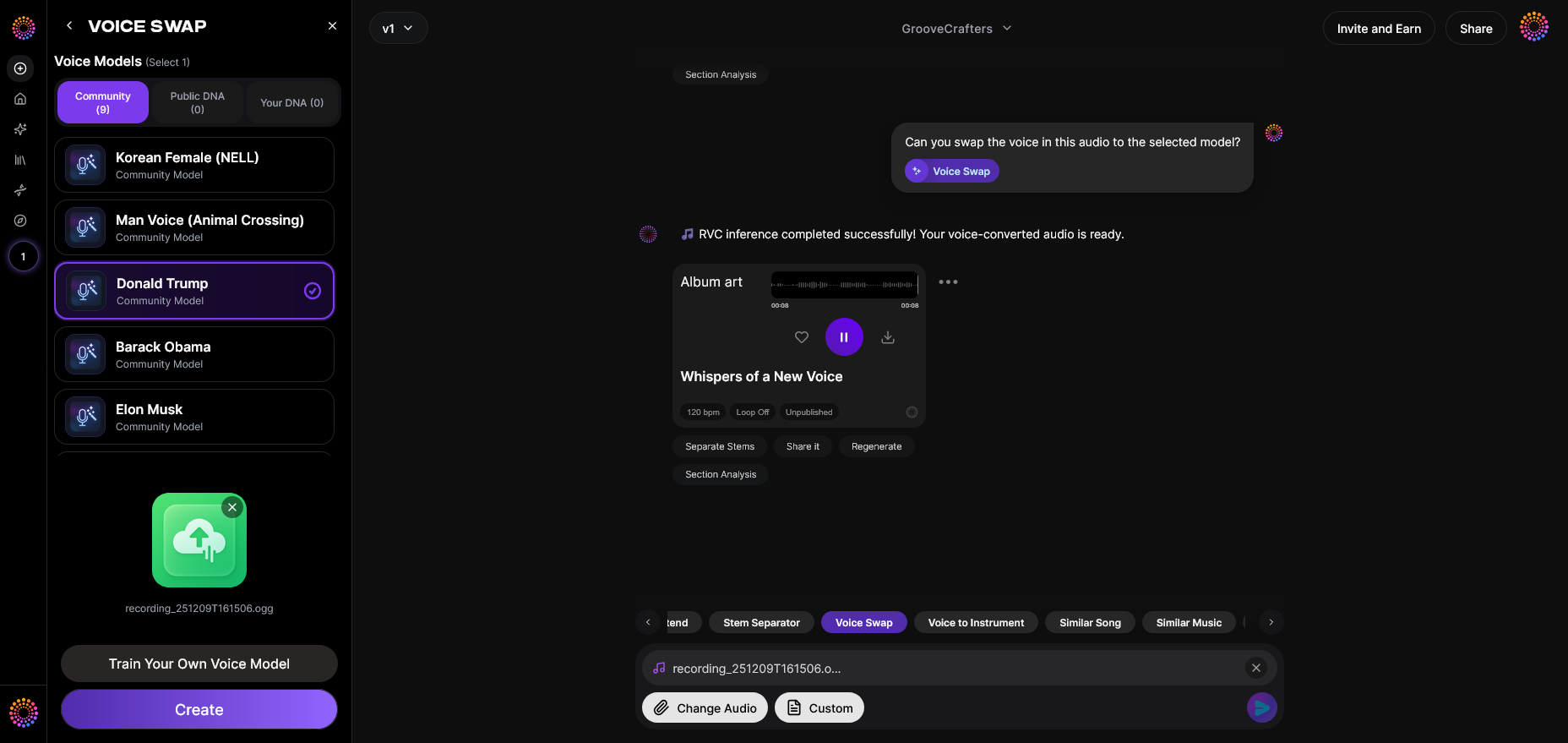
At the forefront of this innovation is Soundverse Voice Swap, a specialized tool designed for high-fidelity voice replacement in any audio track. It captures the original performance nuances — dynamics, phrasing, and emotion — while assigning them to a new voice model. This ensures the transformation feels authentic regardless of the target language or style.
What Does Voice Swap Do?
Soundverse Voice Swap replaces the vocal identity in a song or spoken recording with a selected Community Voice (celebrity, character, or custom) or DNA-based model (user-trained voice). Using its Voice-to-Voice conversion engine, the system processes the uploaded audio asynchronously — meaning users upload, wait for rendering, and retrieve the final result. The model keeps timing and feeling intact, making the result production-ready.
Core Capabilities for Multilingual and Global Workflows:
- Community Voices: Choose from pre-trained celebrity or character voices for multilingual covers and entertainment.
- Public and Personal DNA Models: Build a unique brand or artist voice to standardize tone across markets.
- Voice-to-Voice Conversion: Transform recorded vocals into another language or style while preserving expressiveness.
This tool fits naturally alongside the AI Song Generator, Similar Singing Generator, and AI Singing Generator, expanding Soundverse's complete suite for AI music creation. Together, they provide an ecosystem for developers and producers seeking large-scale multilingual music pipelines.
For insights into related workflows, explore Generate AI Music with Soundverse Text-to-Music or Soundverse AI Magic Tools Create Content Quickly With AI.
You can also watch the Explore Tab showcase to learn more about Soundverse tools.
Why Developers and Creators Prefer Voice Swap for Global Localization
1. Efficiency: Instead of hiring multiple vocalists, you can generate several language versions from a single master recording.
2. Consistency: Character voices remain identical across localizations, maintaining branding and audience connection.
3. Flexibility: Experiment with celebrity voices or fictional characters for creative reinterpretations.
4. Authentic Feel: Unlike basic pitch or timbre modulation tools, Voice Swap preserves expressive delivery. Notes bend the same way; emotions linger on syllables just as in the original performance.
The asynchronous processing architecture also ensures high fidelity without compromising on quality. Users can upload complex vocals, apply transformations, and download finished, polished tracks ready for production release.
The Broader Impact of Voice Cloning Technology on Cultural Exchange
Voice cloning is more than a technical marvel; it's a cultural connector. By enabling songs, spoken messages, and performances to transcend linguistic boundaries, it fosters greater creative exchange.
- Artists bridge fanbases: Musicians from one country can sing authentically in another’s native tongue without reshooting or retraining.
- Cultural preservation: Regional languages benefit from AI models capturing and replicating their tonal details, ensuring these expressions stay relevant in digital media.
- Educational opportunities: Students of music production can test compositions and translations efficiently, merging linguistic study with musical innovation.
As seen in Soundverse’s expanding AI ecosystem and resources such as How to Create Jazz Music with Soundverse AI, the tools encourage an era of experimental global creativity.
For broader market analysis, visit State of the Music Industry 2026 or review Music Industry Predictions for 2026.
Start Creating Multilingual Music with AI Voice Cloning
Unlock limitless creativity with Soundverse’s advanced voice cloning technology—produce songs, voices, and content in multiple languages instantly. Transform your global audience reach with just a few clicks.
Try Soundverse Free
Related Articles
- Soundverse SAAR: AI Voice Assistant — Discover how Soundverse SAAR helps creators automate voice generation and production tasks using cutting-edge AI.
- AI Music Generator and Human Composers: A Future Together — Explore how AI and human artistry are merging to create next-generation music experiences.
- How AI-Generated Music is Transforming the Music Industry — Learn how AI-driven sound and voice tools are reshaping how songs are produced and distributed globally.
- The Role of AI Music in Film and Television — Find out how voice cloning and AI sound design are revolutionizing storytelling in visual media.
Here's how to make AI Music with Soundverse
Video Guide
Here’s another long walkthrough of how to use Soundverse AI.
Text Guide
- To know more about AI Magic Tools, check here.
- To know more about Soundverse Assistant, check here.
- To know more about Arrangement Studio, check here.
Soundverse is an AI Assistant that allows content creators and music makers to create original content in a flash using Generative AI. With the help of Soundverse Assistant and AI Magic Tools, our users get an unfair advantage over other creators to create audio and music content quickly, easily and cheaply. Soundverse Assistant is your ultimate music companion. You simply speak to the assistant to get your stuff done. The more you speak to it, the more it starts understanding you and your goals. AI Magic Tools help convert your creative dreams into tangible music and audio. Use AI Magic Tools such as text to music, stem separation, or lyrics generation to realise your content dreams faster. Soundverse is here to take music production to the next level. We're not just a digital audio workstation (DAW) competing with Ableton or Logic, we're building a completely new paradigm of easy and conversational content creation.
TikTok: https://www.tiktok.com/@soundverse.ai
Twitter: https://twitter.com/soundverse_ai
Instagram: https://www.instagram.com/soundverse.ai
LinkedIn: https://www.linkedin.com/company/soundverseai
Youtube: https://www.youtube.com/@SoundverseAI
Facebook: https://www.facebook.com/profile.php?id=100095674445607
Join Soundverse for Free and make Viral AI Music

We are constantly building more product experiences. Keep checking our Blog to stay updated about them!