Voice Cloning and Copyright: What Creators Should Know in 2026
Learn voice cloning copyright laws, AI voice rights, and ethical voice use in 2026.
Voice Cloning and Copyright: What Creators Should Know
Voice cloning technology has exploded between 2024 and 2026, reshaping how creators, musicians, and voice actors interact with artificial intelligence. As AI tools become more accurate at mimicking human expression and intonation, questions around voice cloning copyright and ownership have become central to creative industries. For modern creators, understanding the intersection between AI innovation and intellectual property laws is no longer optional—it’s essential.
What is voice cloning and why does it matter in 2026?
Voice cloning refers to the process of using artificial intelligence to replicate the unique characteristics of a person’s voice. The cloned voice can then be used to generate speech, narration, or even singing in that recognizable tone. What once required advanced signal processing is now accessible to creators via intuitive AI platforms such as Soundverse and others.
In 2026, voice cloning has become integral to content production—from film dubbing and game voiceovers to synthetic music performances. However, the ethics and copyright implications have grown more complicated. Creators often ask: if an AI clones my voice, do I still own it? Or if I use a cloned celebrity voice for a parody, am I violating any rights?
How does copyright apply to voice cloning?
Traditionally, copyright protects recorded performances and original works of authorship, not the human voice itself. However, voice cloning introduces unique challenges. The cloned voice model is derived from data — samples of recorded speech — which may contain copyrighted attributes. Using such data without consent can trigger infringement claims or violations of privacy rights. As explained in AI Voice Cloning & Identity: The Limits of Intellectual Property, voices themselves are not inherently copyrightable, but recordings and trademarks can apply under specific contexts.
In most jurisdictions in 2026, voice copyright applies indirectly through performance rights and image or likeness laws. This means that while your voice is not copyrighted, recordings of your voice are. When AI clones your voice and reproduces speech, the ethical and legal ownership lies in how the data was obtained and how the output is used.
What are the current voice cloning copyright laws and policies in 2026?
Deepfake and voice mimicry regulations have expanded since 2025. Countries like the United States, Japan, and the EU now distinguish between legitimate artistic use and deceptive impersonation. The U.S. adopted the AI Transparency and Voice Rights Act in early 2026, requiring disclosure when AI-generated voices are used in commercial contexts. This prevents misuse in advertising, political campaigns, and entertainment. For details, see Is Voice Cloning Legal? State-by-State Guide (2026 Update).
Similarly, voice actors and musicians have pushed for clearer intellectual property and AI frameworks that define ownership over voice DNA—the combination of tone, rhythm, and timbre unique to an individual. This has led to the rise of new licensing standards in tools like Soundverse DNA, which trains AI models using fully licensed catalogs to maintain ethical alignment.
What are AI voice rights and who owns a synthetic voice?
AI voice rights encompass the legal and moral claims over synthetic voice models. The complexity arises when determining ownership: is it the creator of the dataset, the developer of the AI model, or the person whose voice was cloned? As of 2026, most professional voice actors sign voice data agreements that grant specific training rights to AI systems while retaining usage restrictions.
Synthetic voice ownership typically falls under three conditions:
- Licensed Training Data – If the AI was trained on authorized audio from a voice owner, usage must respect contractual licensing terms.
- Derived Authorship – If you create a new synthetic voice through manipulation or training, you may claim partial authorship but not ownership of the base likeness.
- Public Disclosure Obligation – Certain territories require that users disclose when a synthetic voice is used commercially.
Creators now include clauses in contracts that specify whether their likeness can be cloned, ensuring transparency with production studios and AI developers.
What ethical issues surround voice mimicry and deepfake voices?
Voice mimicry ethics revolve around consent, authenticity, and context of use. Deepfake voices can empower creators to resurrect lost performances or localize content globally. Yet they also carry risks of misrepresentation and exploitation. For example, creating a synthetic version of a deceased artist for new commercial releases raises cultural and emotional dilemmas. Explore these aspects further in Voice Cloning Ethics: Best Practices and Legal Considerations.
By 2026, ethical frameworks like the Ethical AI Music Framework from Soundverse have standardized best practices—requiring transparency in dataset sourcing and attribution trails. Artificial voice synthesis should empower creativity without erasing identity or appropriating someone’s work.
Creators must balance innovation with responsibility: a cloned voice used for parody may be ethically acceptable, but using it deceptively for endorsement is not. Voice mimicry ethics underscore the importance of consent and attribution in all AI voice workflows.
For a deeper dive into creative applications, watch our guide on creating Deep House music or explore the Soundverse Tutorial Series - 9. How to Make Music on the Soundverse YouTube channel.
How to make voice cloning copyright-safe with Soundverse Trace
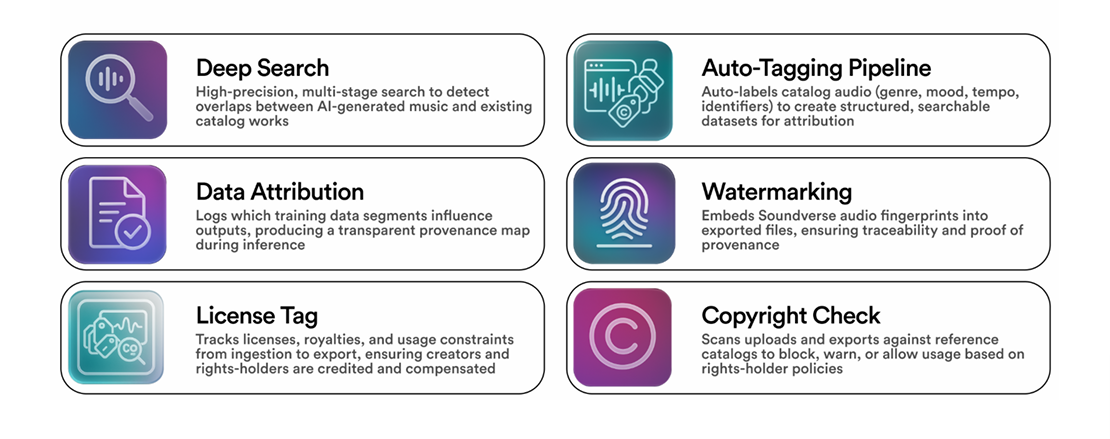
Soundverse Trace is the industry’s leading solution for rights protection and verification in AI audio production. Designed as a comprehensive trust layer, it embeds attribution, deep search, and licensing metadata directly into the AI music and voice lifecycle.
Core capabilities include:
- Deep Search: High-precision scanning (1:1 and 1:N) to detect overlaps between generated audio and existing content.
- Data Attribution: Logs which training data influenced particular voice or music outputs.
- Audio Watermarking: Embeds inaudible fingerprints that track authorship and prevent misuse.
- License Tagging: Preserves rights information from ingestion through to final export.
For creators navigating voice cloning copyright challenges, Soundverse Trace enables transparent provenance verification and efficient rights management. Whether you are producing an AI cover, building a character voice, or remixing vocal content, it ensures the outputs respect intellectual property laws.
This traceability also automates royalty payouts and takedowns for rights holders, creating a more ethical and sustainable digital landscape for AI voices.
How creators can protect themselves in the AI voice era
- Register your voice performances. Copyright your recorded works even if voice cloning tech is used later.
- Use licensed AI platforms. Always verify that the AI service, such as Soundverse or Mubert, trains only on licensed content.
- Monitor distribution. Employ watermark-based tracking systems such as Soundverse Trace to identify misused voice clones.
- Publish transparent disclaimers. When using synthetic voices, disclose usage to prevent confusion or misrepresentation.
Creators can also explore guides such as How to Create Country Music with Soundverse AI or Generate AI Music with Soundverse Text-to-Music to learn ethically aligned AI workflows.
How Soundverse encourages responsible innovation
Through interconnected tools like Voice Swap and Soundverse DNA, creators can responsibly generate synthetic voices and music while ensuring consent-based training and compensation. The Ethical AI Music Framework integrates Soundverse Trace to provide an auditable record of ownership and royalties.
Complementary tools such as Soundverse Assistant help automate production decisions in accordance with rights policies, as detailed in Soundverse AI Magic Tools Create Content Quickly with AI.
By embedding ethics into every generation stage, Soundverse stands at the forefront of balanced AI artistry—where innovation and creator protection coexist.
Explore AI-Powered Music Creation with Soundverse
Unlock the power of AI to compose, remix, and design music effortlessly while keeping your creative ownership intact. Soundverse helps you make original, royalty-free content in minutes.
Related Articles
- Copyright-Free vs. Royalty-Free Music: What Creators Should Know — Learn the key differences between copyright-free and royalty-free music and how to protect your work as a creator.
- Enhancing YouTube Content with Royalty-Free and Copyright-Free Music Using Soundverse AI — Discover how to elevate your YouTube videos legally and creatively with AI-generated royalty-free music.
- Navigating the World of Royalty-Free and Copyright-Free Music Using Soundverse AI — Get practical guidance on choosing the right music for your content while respecting copyright boundaries.
- The Role of AI Music in Film and Television — Explore how AI music tools are reshaping the soundscapes of movies and TV while addressing copyright concerns.
Here's how to make AI Music with Soundverse
Video Guide
Here’s another long walkthrough of how to use Soundverse AI.
Text Guide
- To know more about AI Magic Tools, check here.
- To know more about Soundverse Assistant, check here.
- To know more about Arrangement Studio, check here.
Soundverse is an AI Assistant that allows content creators and music makers to create original content in a flash using Generative AI. With the help of Soundverse Assistant and AI Magic Tools, our users get an unfair advantage over other creators to create audio and music content quickly, easily and cheaply.
Soundverse Assistant is your ultimate music companion. You simply speak to the assistant to get your stuff done. The more you speak to it, the more it starts understanding you and your goals. AI Magic Tools help convert your creative dreams into tangible music and audio. Use AI Magic Tools such as text to music, stem separation, or lyrics generation to realise your content dreams faster.
Soundverse is here to take music production to the next level. We're not just a digital audio workstation (DAW) competing with Ableton or Logic, we're building a completely new paradigm of easy and conversational content creation.
TikTok: https://www.tiktok.com/@soundverse.ai
Twitter: https://twitter.com/soundverse_ai
Instagram: https://www.instagram.com/soundverse.ai
LinkedIn: https://www.linkedin.com/company/soundverseai
Youtube: https://www.youtube.com/@SoundverseAI
Facebook: https://www.facebook.com/profile.php?id=100095674445607
Join Soundverse for Free and make Viral AI Music
We are constantly building more product experiences. Keep checking our Blog to stay updated about them!
Image Steps: []