How to Protect Your Voice from AI Cloning: A Complete 2026 Guide
Learn how to protect your voice from AI cloning using Soundverse Trace and advanced vocal security tactics in 2026.
How to Protect Your Voice From AI Cloning
AI voice cloning has become one of the most pressing digital rights issues of 2026. As artificial intelligence continues to advance, synthetic speech systems can now replicate voices with near-perfect accuracy. For creators, podcasters, and professionals who rely on their unique sound, this technological progress has a dark side: identity theft through voice replication. If you’re wondering how to protect your voice from AI cloning, this guide dives deep into the practical steps, tools, and ethical considerations shaping voice protection in 2026.
Why is AI voice cloning becoming a major concern in 2026?

Since 2024, voice cloning tools have become more accessible. With open-source models and commercial services offering quick voice replication for entertainment, customer support, and gaming, misuse has skyrocketed. In 2025, multiple high-profile incidents were reported where cloned voices were used for financial scams, unauthorized endorsements, and even misinformation campaigns. For example, Resemble AI details how malicious voice cloning has already been used in scams, while Adaptive Security calls it "a weapon for fraud" in corporate contexts.
By 2026, governments and creators are calling for stronger voice rights and vocal biometric security solutions to verify authenticity. For anyone whose career depends on their voice — from YouTubers and audiobook narrators to politicians — protecting your voice from AI cloning isn’t optional anymore. It’s essential.
What makes your voice vulnerable to cloning?

Voice cloning technologies require only a few seconds of high-quality audio to build a model capable of reproducing tone, pitch, emotion, and diction. This means any publicly shared podcast, voice note, or live stream can be scraped and used as training data without your consent.
Common vulnerabilities include:
- Public recordings: Podcasts, interviews, and digital courses often contain hours of voice data.
- Social media uploads: Audio snippets on platforms like TikTok and Instagram are easily downloadable by scraping tools.
- Insecure file sharing: Sending unencrypted voice files can allow unauthorized access.
- Label-free metadata: Without embedded ownership data, your voice recordings can be detached from your identity.
This problem has intensified in parallel with generative AI music tools discussed in this Soundverse article on AI music trends, showing how creative assets need new protection layers. External sources such as ThreatLocker and Consumer Reports have documented how voice cloning attacks have scaled, impacting both individuals and businesses globally.
How does voice cloning prevention work?
Voice cloning prevention combines technological, ethical, and security measures to ensure that voice samples are either protected or verifiable. The main approaches include:
- Audio watermarking: Embedding inaudible signals that identify rightful ownership.
- Dataset attribution tracking: Keeping a record of which voice data influenced any generated output.
- Consent-based AI training: Allowing creators to explicitly license their voices for use in AI models.
- Vocal biometric verification: Validating a voice against an authenticated registry or digital fingerprint.
Together, these methods create a multi-layer defense system against unauthorized cloning. But implementing them effectively requires specialized solutions — and this is where Soundverse Trace becomes invaluable.
For additional sound security education, check out our Soundverse Tutorial Series - Explore Tab on YouTube.
How to protect your voice from AI cloning with Soundverse Trace
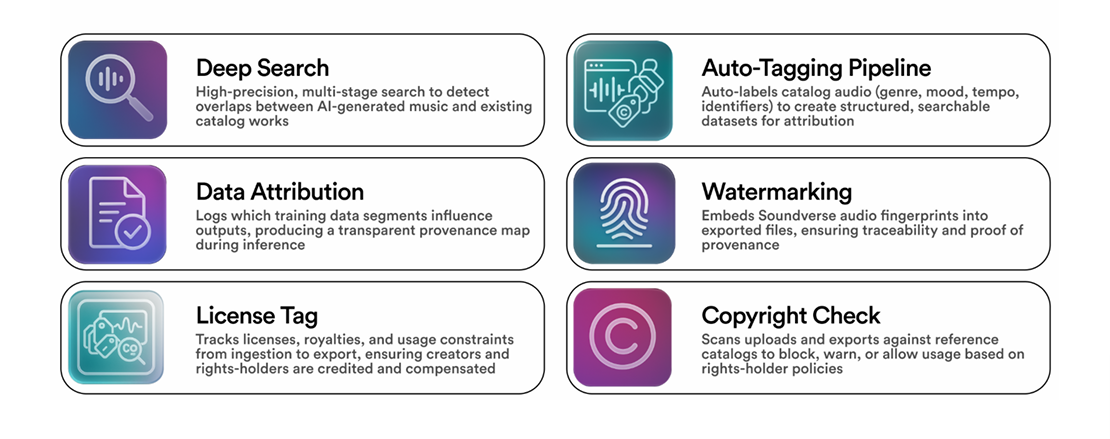
Soundverse Trace is a comprehensive trust layer for AI audio creation. Its capabilities go beyond ordinary watermarking and instead apply a multilayer strategy that covers the entire lifecycle of AI-generated audio—from dataset creation to final export.
Key features of Soundverse Trace:
- Deep Search: High-precision scanning (1:1 or 1:N) to detect overlaps between your voice and potential cloned outputs. This means creators can confirm whether their voice data appear in any unauthorized models.
- Data Attribution: Detailed logging of which training data influenced a generated voice output. This creates transparent accountability for AI developers and users.
- Audio Watermarking: Embeds robust, inaudible fingerprints into audio files, ensuring every clip can be verified later for authenticity.
- License Tagging: Preserves rights metadata from ingestion to export, making sure your vocal work retains its ownership information across versions and distributions.
By using Soundverse Trace, artists and speakers are not just protecting content — they are integrating a verifiable ownership framework into their voice assets, similar to how Soundverse DNA ensures ethical use of musical data.
Step-by-Step Guide: How to Protect Your Voice Using Soundverse Trace
Step 1: Upload or record your original voice sample
Begin by uploading your original audio file into Soundverse’s platform. This creates a baseline voice profile that can be watermarked and tracked. Remember, this process is asynchronous: Soundverse processes uploaded audio, not live microphone input.
Step 2: Apply audio watermarking
Use Soundverse Trace’s watermarking tool to embed inaudible fingerprints into your recordings. These marks ensure that anyone who reproduces or clones your voice can be detected through forensic audio analysis.
Step 3: Tag your license and rights metadata
Before exporting, attach a license tag to your audio that defines usage rights, commercial permissions, and origin. This metadata stays intact even when your clip is re-edited, shared, or compiled in an AI dataset.
Step 4: Run Deep Search for cloned voice detection
When suspicious voice clones circulate, initiate a Deep Search scan across public datasets and AI libraries. Soundverse Trace will identify overlaps or near-identical patterns between your voice fingerprint and possible clones.
Step 5: Log and verify data attribution
Every time Soundverse detects resemblance or training usage, it logs attribution data. This documentation helps creators verify provenance and take action for takedown or royalty claims based on verified overlap.
For creators who already use Soundverse’s generation tools like AI Magic Tools, integrating Trace adds a rights verification layer that protects not just your sound, but your entire digital identity.
For a deeper dive, watch our guide on creating Deep House music to understand content creation workflows securely.
Pro Tips to Strengthen Your Voice Protection Strategy
- Limit public exposure: Share clips strategically; avoid uploading long, clean recordings that can feed AI models.
- Use watermarking everywhere: Even lightweight watermarking increases forensic traceability.
- Regularly monitor datasets: Run periodic scans using Deep Search to check for unauthorized use.
- Leverage license tagging: This metadata acts like a digital name tag across all platforms.
- Educate collaborators: Ensure teams, co-hosts, and producers understand how to secure and store voice data.
These measures parallel broader ethical AI principles outlined in the Ethical AI Music Framework, which promotes consent and transparency at every stage of data use. The FTC has also begun advocating for voice cloning safety standards to reduce misuse globally.
Why voice rights matter for creators and professionals
Voice rights define who owns, controls, and profits from a vocal performance in the AI era. In 2026, vocal biometric security is viewed as part of digital identity management, much like facial recognition or signature verification.
For creators, asserting voice rights ensures control over their brand personality. For organizations, it prevents impersonation attacks that could damage credibility. As companies increase their use of synthetic agents, the ability to verify authentic voices will determine the trustworthiness of digital communication itself.
How Soundverse Trace fits into the future of vocal protection
Soundverse Trace exemplifies how technology can safeguard human creativity. Paired with ethical frameworks and secure AI pipelines like Soundverse DNA, it forms a foundation where innovation thrives responsibly.
In recent AI music generation advancements, Soundverse demonstrated that creative AI can coexist with creator rights. With Trace’s trust layer, the same principle now applies to voices, marking a pivotal advancement for podcasters, educators, and entertainers.
Take Control of Your Digital Voice Today
Join Soundverse to safeguard and manage your vocal identity while unlocking creative AI-powered tools to produce unique sound experiences securely.
Protect Your Voice with Soundverse
Related Articles
- Soundverse SAAR: AI Voice Assistant — Discover how Soundverse’s SAAR voice assistant empowers creators with safe, innovative vocal features.
- Soundverse AI Magic Tools: Create Content Quickly with AI — Explore advanced AI tools that accelerate content creation without compromising authenticity or control.
- AI Music Generator and Human Composers: A Future Together — Learn how humans and AI can coexist creatively in a future where authenticity and technology merge.
- Soundverse Assistant: Your AI Music Co-Producer — Meet the Soundverse Assistant and see how AI can safely collaborate on your musical creations.
Here's how to make AI Music with Soundverse
Video Guide
Here’s another long walkthrough of how to use Soundverse AI.
Text Guide
- To know more about AI Magic Tools, check here.
- To know more about Soundverse Assistant, check here.
- To know more about Arrangement Studio, check here.
Soundverse is an AI Assistant that allows content creators and music makers to create original content in a flash using Generative AI. With the help of Soundverse Assistant and AI Magic Tools, our users get an unfair advantage over other creators to create audio and music content quickly, easily and cheaply. Soundverse Assistant is your ultimate music companion. You simply speak to the assistant to get your stuff done. The more you speak to it, the more it starts understanding you and your goals. AI Magic Tools help convert your creative dreams into tangible music and audio. Use AI Magic Tools such as text to music, stem separation, or lyrics generation to realise your content dreams faster. Soundverse is here to take music production to the next level. We're not just a digital audio workstation (DAW) competing with Ableton or Logic, we're building a completely new paradigm of easy and conversational content creation.
TikTok: https://www.tiktok.com/@soundverse.ai
Twitter: https://twitter.com/soundverse_ai
Instagram: https://www.instagram.com/soundverse.ai
LinkedIn: https://www.linkedin.com/company/soundverseai
Youtube: https://www.youtube.com/@SoundverseAI
Facebook: https://www.facebook.com/profile.php?id=100095674445607
Join Soundverse for Free and make Viral AI Music

We are constantly building more product experiences. Keep checking our Blog to stay updated about them!
Image Steps: []