How AI Music Platforms Prevent Duplicate Songs in 2026
Discover how AI music platforms ensure originality and stop duplicate songs with Soundverse Trace in 2026.
How AI Music Platforms Prevent Duplicate Songs
In 2026, the world of generative audio has become an integral part of the modern music industry. AI music platforms are producing millions of tracks every month—songs used in social media, film scoring, podcasts, and gaming environments. With that explosion of creativity also comes a challenge: duplicate AI music. Preventing duplication and safeguarding originality have become top priorities for developers and digital rights managers. This article explores how AI music platforms detect, manage, and stop the spread of duplicate AI songs while ensuring content authenticity using advanced systems like Soundverse Trace.
Why Are Duplicate Songs a Problem in AI Music Generation?
Duplicate songs can occur in multiple ways in AI-generated music. Models trained on large datasets sometimes reproduce patterns, melodies, or even audio fragments too similar to existing compositions. This raises questions about originality, copyright infringement, and reuse ethics. For music tech professionals and platform operators, duplicate AI music affects catalog integrity, licensing accuracy, and user experience.
By 2026, AI music generation platforms have introduced intricate systems to identify these overlaps at scale. Without these safeguards, it’s easy for generated tracks to sound-alike or duplicate without proper attribution. Therefore, originality detection and algorithmic audio fingerprinting have become the foundation of responsible AI content protection.
How Do AI Music Platforms Detect Duplicate AI Music?
AI music platforms rely on a multilayered approach combining mathematics, machine learning, and metadata analysis to detect similarity among audio files. Some of the most common techniques include:
1. Algorithmic Audio Fingerprinting
Audio fingerprinting converts sound into a unique identifier. It analyzes frequency spectrums, time signatures, and rhythmic patterns to map an invisible fingerprint for every generated song. Once embedded, any new music created on the platform can be compared against this massive index of fingerprints to locate 1:1 or near-duplicate matches.
High-precision scanning ensures that even microscopic similarities—such as a repeated chord progression or instrument timbre—are flagged. These algorithmic fingerprints support large-scale music originality detection and enable AI content protection at industrial levels.
2. Embedding Metadata and Watermarks
AI music platforms also use inaudible watermarking to mark each song as unique digital property. This process happens asynchronously after audio generation. The watermark embeds data like creation date, model used, and dataset attribution, forming an enduring proof of origin.
3. Deep Cross-Database Comparison
Using high-performance search methods, platforms conduct both 1:1 and 1:N comparisons between generated outputs and existing libraries. When a new track is created, its fingerprint is matched against millions of entries to detect overlaps automatically.
This system allows verification of music originality before export or publication. Several articles from Soundverse’s knowledge base—like AI Music Generator and Human Composers: A Future Together and How AI-Generated Music is Transforming the Music Industry—illustrate how such methods align with industry evolution.
What Technologies Enable Music Originality Detection in 2026?
Advances from 2024 and 2025 laid the groundwork for higher-precision originality systems. In 2026, most large AI music platforms have integrated:
- Spectral similarity mapping: compares harmonic structures to detect repeated melodies.
- Symbolic pattern recognition: analyzes note sequences and rhythm metrics for near-copy detection.
- Machine learning attribution nodes: create audit trails between dataset elements and generated audio segments.
- Integrity enforcement APIs: allow developers and rights managers to query originality in bulk catalogs.
These innovations, combined with scalable data provenance models, help ensure that AI-created compositions can be traced back to transparent sources. They prevent unethical replication while maintaining creative freedom for artists and producers.
How AI Music Platforms Implement AI Content Protection Mechanisms
AI content protection in 2026 goes beyond just blocking plagiarism—it’s about reinforcing trust across the digital creative chain. A modern AI music platform usually includes these layers:
- Attribution Logging: Every track generated is registered with details about its dataset influence, ensuring transparency.
- Fingerprint Vaults: Unique fingerprints are stored in encrypted databases accessible only to verification systems.
- License Tagging: Rights metadata travels with each audio file from ingestion to export, ensuring fair royalty distribution.
- Origin Validation Tools: When new users upload reference songs—like using a Similar Song Generator—the platform cross-checks that their results will not infringe copyright.
The Ethical AI Music Framework complements these systems by empowering consent-based data usage and ongoing artist compensation. Together, they build a holistic defense against duplication and misattribution. For a deeper dive into platform integrity, see our video on creating music with AI or explore the “Explore” tab walkthrough.
How to Prevent Duplicate Songs with Soundverse Trace
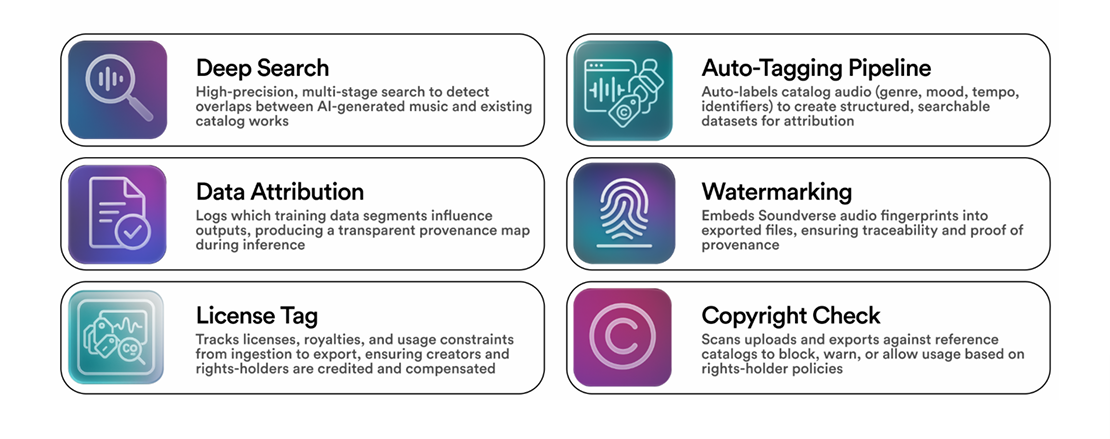
Soundverse Trace stands as the industry’s most sophisticated layer for trust and rights protection in AI-generated music.
What Soundverse Trace Does
Soundverse Trace embeds attribution, deep search, and rights protection across every stage—from dataset creation to final export. It ensures both creators and rights-holders can verify, track, and defend their music catalog’s integrity.
Core Capabilities
- Deep Search: Performs high-precision scanning and detects overlaps across single tracks (1:1) or full catalogs (1:N).
- Data Attribution: Logs which training data influenced each output, building transparency across the creative process.
- Audio Watermarking: Embeds inaudible fingerprints that prove provenance and help automate takedowns or payouts.
- License Tagging: Preserves rights metadata continuously through every lifecycle stage.
Together, these capabilities form an end-to-end AI content protection routine that locks originality and promotes ethical creation.
Why Music Professionals Choose Soundverse Trace for AI Music Integrity
For music tech professionals in 2026, relying on manual copyright checks or simple plagiarism detection no longer scales. Platforms like Soundverse Trace automate the full verification workflow:
- Rights Validation: Automated checks detect whether generated music unintentionally overlaps protected material.
- Royalty Tracking: Attribution logs link dataset influence to royalties owed, supporting sustainable creator income.
- Provenance Verification: Every exported song includes a permanent audit trail, confirming originality for licensing and distribution.
Soundverse Trace integrates seamlessly with larger Soundverse tools such as Soundverse Assistant and Ethical AI Music Framework, making it an indispensable component of transparent AI artistry. For an example of composition flow, view our tutorial on making Deep House music.
How Soundverse Trace Compares to Other AI Music Platforms
Competing platforms like Mubert, Udio, and Soundraw each offer creative generation suites, but many stop short of comprehensive rights verification. Soundverse Trace’s integrated trust layer stands out for combining watermarking, licensing, deep search, and attribution under one system.
For creators moving from older platforms, articles like Mubert Alternatives: Soundverse and Soundraw Alternative explore how Soundverse brings next-generation traceability and originality assurance.
Why Duplicate Detection Will Remain Critical in the Future of AI Music
As generative audio scales through 2026 and beyond, originality protection will dictate how artists, producers, and digital rights managers collaborate. Music originality detection systems will evolve toward hybrid models combining fingerprinting, dataset attribution auditing, and universal license registries. By continuously strengthening AI content protection, platforms will support ethical expansion of AI artistry while preventing creative redundancy.
Duplicate AI music will exist only where oversight fails. With AI systems like Soundverse Trace, the balance between innovation and responsibility becomes achievable.
Start Creating Unique Tracks with Soundverse AI
Eliminate duplicates, explore limitless genres, and compose original music effortlessly with advanced AI music tools. Experience how Soundverse ensures every melody you create is truly one of a kind.
Create Music Now
Related Articles
- How AI-Generated Music is Transforming the Music Industry: Explore how AI music platforms are shaping the future of creativity and redefining how artists produce and distribute music.
- The Benefits of Composing with AI Music Generator: Discover how AI music generators streamline the composition process while maintaining originality and innovation.
- AI Music Generator and Human Composers: A Future Together: Learn how human creativity and AI technology complement each other to produce groundbreaking musical experiences.
- Soundverse AI Magic Tools: Create Content Quickly with AI: See how Soundverse’s innovative AI Magic Tools empower creators to generate, fine-tune, and customize music faster than ever.
Here's how to make AI Music with Soundverse
Video Guide

Here’s another long walkthrough of how to use Soundverse AI.
Text Guide
- To know more about AI Magic Tools, check here.
- To know more about Soundverse Assistant, check here.
- To know more about Arrangement Studio, check here.
Soundverse is an AI Assistant that allows content creators and music makers to create original content in a flash using Generative AI.
With the help of Soundverse Assistant and AI Magic Tools, our users get an unfair advantage over other creators to create audio and music content quickly, easily and cheaply.
Soundverse Assistant is your ultimate music companion. You simply speak to the assistant to get your stuff done. The more you speak to it, the more it starts understanding you and your goals.
AI Magic Tools help convert your creative dreams into tangible music and audio. Use AI Magic Tools such as text to music, stem separation, or lyrics generation to realise your content dreams faster.
Soundverse is here to take music production to the next level. We're not just a digital audio workstation (DAW) competing with Ableton or Logic, we're building a completely new paradigm of easy and conversational content creation.
TikTok: https://www.tiktok.com/@soundverse.ai
Twitter: https://twitter.com/soundverse_ai
Instagram: https://www.instagram.com/soundverse.ai
LinkedIn: https://www.linkedin.com/company/soundverseai
Youtube: https://www.youtube.com/@SoundverseAI
Facebook: https://www.facebook.com/profile.php?id=100095674445607
Join Soundverse for Free and make Viral AI Music

We are constantly building more product experiences. Keep checking our Blog to stay updated about them!