AI Music and Platform Risk Assessment: Ensuring Ethical Innovation in 2026
Explore key AI music risk assessment trends & learn how Soundverse Trace ensures ethical, compliant innovation in music AI platforms.
AI Music and Platform Risk Assessment
In 2026, the convergence of artificial intelligence and music creation is both exciting and complex. As AI models compose, remix, and distribute music at breakneck speed, executives and researchers face a new frontier of platform risk, ethical boundaries, and data governance. AI music risk assessment has emerged as the new cornerstone of trust and accountability in this space. Without a structured approach to music AI safety and AI platform compliance, the creative economy could face escalating intellectual property disputes, algorithmic bias, and systemic misuse.
The following analysis explores how risk management now shapes AI-powered music platforms in 2026, the evolving standards guiding ethical AI deployment in streaming, and how innovations such as Soundverse Trace reinforce transparent, rights-respecting music ecosystems.
Why is AI music risk assessment critical in 2026?
After years of explosive experimentation in 2024 and 2025, music AI has matured into mainstream production workflows. However, this rapid adoption has exposed critical vulnerabilities. Unauthorized data ingestion, model hallucination, and opaque attribution chains can trigger legal or reputational damage. In fact, by 2026 regulators across the EU, UK, and US have emphasized AI accountability acts that require platforms to prove the lineage and provenance of every generated asset (AI Platform Risk Assessments: Why 2026 Is the Year for Action).
An AI music risk assessment is therefore no longer optional — it’s a regulatory and ethical imperative. It evaluates the dataset integrity, licensing transparency, output attribution, and end-user misuse potential within AI models trained on sound data.

What major risks do AI-powered music platforms face?
- Copyright Contamination: AI models trained on copyrighted works without adequate licensing create derivative content that infringes original compositions (Protecting your music in the age of AI | The ISM).
- Attribution Gaps: When an AI generator cannot show which datasets contributed to a given music output, rights-holders lose visibility over compensation.
- Regulatory Non-Compliance: With new legal frameworks around consent-based training data, non-compliant AI systems risk being delisted or fined (Music and AI: 2025's developments that will shape 2026's disputes).
- Ethical Bias and Cultural Dilution: Algorithms that favor Western tonal structures or commercial trends overshadow underrepresented cultures and threaten musical diversity.
- Data Privacy Concerns: Some training datasets inadvertently capture personally identifiable audio elements (e.g., voice samples) without proper consent.
Each of these risk vectors demands a unifying framework of trust — something that goes beyond manual auditing and integrates directly into the AI development pipeline.

How is ethical AI in streaming evolving?
Streaming platforms have transformed into algorithmic ecosystems where personalization defines engagement. However, in 2026, ethical AI in streaming has taken center stage as firms confront the downstream impacts of generative content. Ethical frameworks now focus on three pillars:
- Consent and Transparency: Ensuring all training and inference data respect creator permissions and contributor identities.
- Algorithmic Fairness: Avoiding bias loops that overpromote specific artists or cultural motifs.
- Sustainability and Traceability: Creating persistent metadata trails that allow full tracing of how AI-influenced music was created, shared, and monetized.
Several streaming giants have implemented ‘model cards’ and ‘data provenance dashboards’ to comply with emerging music AI standards. These initiatives support the idea that every AI-generated track must be traceable — from the dataset it came from to the listener’s ear. According to AI-Generated Music: Bandcamp Draws a Hard Line - CMS, many platforms are now adopting mandatory disclosure policies to ensure ethical transparency.
How do music companies approach risk management in music tech?
Risk management in the music technology sector now mirrors cybersecurity and financial governance strategies. Music companies perform layered risk evaluations across the product lifecycle: from dataset ingestion to audio generation and distribution.
Key elements of risk management in music tech include:
- Due Diligence on AI Training Sets: Confirm that all data sources are ethically sourced and fully licensed.
- Automated Rights Auditing: Regular scanning of AI outputs to detect IP overlaps.
- Crisis Management Playbooks: Proactive protocols for potential infringement or misinformation cases.
- Transparency Reports: Shared records of dataset contributors, licensed catalogs, and compensation flows.
Firms utilize hybrid teams consisting of legal, AI ethics, and product design experts to continuously assess risk posture. Moreover, integration frameworks like Soundverse Trace allow this diligence to shift from manual oversight to built-in automation.
For instance, Soundverse has already explored ethical content frameworks under initiatives like the Ethical AI Music Framework, which ensures every AI-generated file is both traceable and rights-compliant. This approach underpins the balance between innovation and accountability.
For a deeper dive, watch our guide on creating Deep House music or explore the Soundverse tutorial on how to make music to see ethical creation in action.
How to ensure music AI safety without stifling creativity?
Ensuring music AI safety requires a balance between artistic freedom and structured governance. In 2026, leading AI music studios employ multi-layered safety architectures:
- Dataset Vetting: Curate only verified, opt-in music libraries for model training. Programs like the Soundverse Content Partner Program allow rights-holders to contribute, earning recurring royalties in return.
- Attribution and Licensing Metadata: Attach standardized metadata through every inference stage so creators remain linked to their contributions.
- Automated Compliance Verification: Integrate APIs that flag unlicensed data before it propagates through pipelines.
- Ethics Committees: Cross-functional review boards evaluate new model updates for fairness, cultural representation, and potential misuse scenarios.
These safeguards promote transparent co-creation — a world where machines assist human composers without erasing human credit.
What does regulatory compliance look like for AI music platforms in 2026?
With AI-specific creative legislation gaining global momentum, AI platform compliance now incorporates model registration, content traceability, and compensation verification. Platforms must submit compliance reports demonstrating:
- Consent-based training and licensing.
- Proven content lineage using watermarking or signature-fingerprinting.
- Monetization pathways for rightful rights-holders.
Non-compliant systems risk removal from app stores and API marketplaces. Therefore, the competitive edge in 2026 lies in provable trust as much as creative output (How AI Music Impacts Music Licensing in 2026 - Soundverse AI).
For more background on market movements shaping these directions, see the Music Industry Trends report or the AI in the USA analysis for regional compliance evolution.
How to make AI music risk assessment seamless with Soundverse Trace
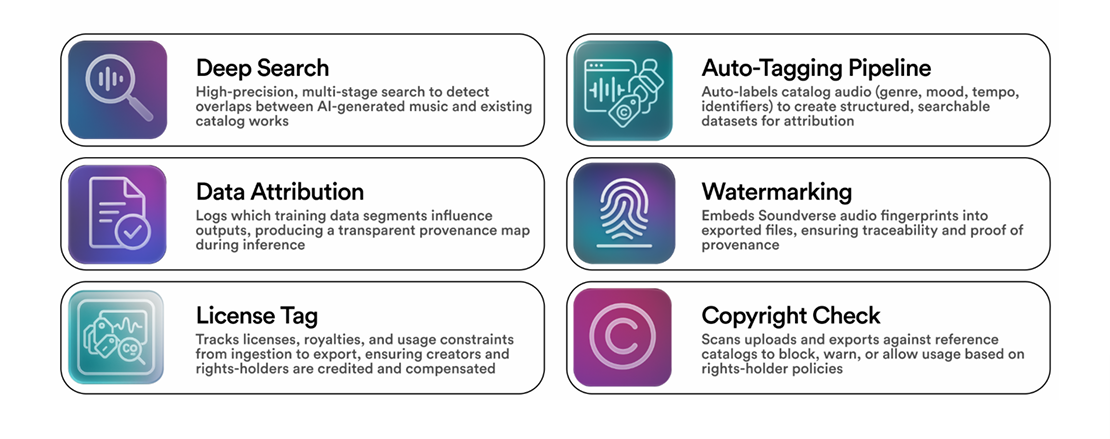
Soundverse Trace introduces an integrated trust layer for AI music that directly addresses the issues outlined above. It embeds attribution, deep search, and rights protection into every stage of the music AI lifecycle — from dataset creation to final export.
Core Capabilities of Soundverse Trace
- Deep Search: Utilizes both one-to-one and one-to-many high-precision scans to detect overlaps or potential infringements across massive audio catalogs.
- Data Attribution: Logs dataset contributions so that each generated output can trace back to the specific audio materials that influenced it.
- Audio Watermarking: Embeds inaudible digital fingerprints inside AI-generated tracks to establish immutable provenance.
- License Tagging: Automatically preserves and carries license metadata from ingestion to export, enabling seamless compliance verification.
Primary Advantages
- Reduce Liability: Automates copyright compliance workflows.
- Enhance Creator Trust: Guarantees each output maintains transparent lineage.
- Streamline Royalties: Facilitates accurate royalty routing through attribution logs.
- Support Ethical AI Initiatives: Reinforces programs like the Ethical AI Music Framework through practical implementation.
By integrating Soundverse Trace, a label, AI vendor, or streaming service can operationalize risk management instead of treating it as an afterthought. It turns compliance into an infrastructural advantage.
To explore creative-side innovations complementing Trace, check out tools such as Soundverse Arrangement Studio or the Soundverse AI Magic Toolset, both of which extend trustworthy creation with AI.
The future of AI music governance and creative accountability
By 2026, ethical and legal infrastructures for AI creativity are maturing fast. Stakeholders now recognize that embedding attribution systems like Soundverse Trace isn’t simply a compliance measure — it’s the foundation of a sustainable music AI industry.
The alignment between AI music risk assessment, ethical AI in streaming, and risk management in music tech ensures that innovation can flourish responsibly. Artists, AI developers, and regulators can collaborate through shared frameworks based on consent and transparency.
In a world where models compose millions of tracks daily, it’s not just about who can generate the next viral beat. It’s about who can guarantee that every beat belongs — ethically, legally, and creatively.
For continued discussions on responsible artistry in AI, explore Soundverse’s coverage on how AI-generated music is transforming the music industry or innovative creators merging technology and art through Soundverse Assistant.
In conclusion, Soundverse Trace represents a paradigm shift — embedding compliance, trust, and transparency directly into the creative DNA of AI music. As we move deeper into an AI-first era of composition, systems that assess and mitigate risks will not slow progress; they will enable its sustainable, equitable growth.
Start Your AI Music Journey with Confidence
Discover how Soundverse empowers creators with secure, ethical, and high-quality AI-generated music. Minimize risk while maximizing creativity across genres and formats.
- How AI-Generated Music Is Transforming the Music Industry: Explore how artificial intelligence is reshaping music creation and distribution across the global industry.
- Navigating the World of Royalty-Free and Copyright-Free Music Using Soundverse AI: Learn how to use Soundverse AI to source legal, royalty-free, and risk-free music for your creative projects.
- Copyright-Free vs. Royalty-Free Music: What Creators Should Know: Understand the key differences between copyright-free and royalty-free music to avoid potential platform risks.
- AI Music Generator and Human Composers: A Future Together: Discover how AI tools can complement the creativity of human composers for a harmonious future of music-making.
Here's how to make AI Music with Soundverse
Video Guide

Here’s another long walkthrough of how to use Soundverse AI.
Text Guide
- To know more about AI Magic Tools, check here.
- To know more about Soundverse Assistant, check here.
- To know more about Arrangement Studio, check here.
Soundverse is an AI Assistant that allows content creators and music makers to create original content in a flash using Generative AI.
With the help of Soundverse Assistant and AI Magic Tools, our users get an unfair advantage over other creators to create audio and music content quickly, easily and cheaply.
Soundverse Assistant is your ultimate music companion. You simply speak to the assistant to get your stuff done. The more you speak to it, the more it starts understanding you and your goals.
AI Magic Tools help convert your creative dreams into tangible music and audio. Use AI Magic Tools such as text to music, stem separation, or lyrics generation to realise your content dreams faster.
Soundverse is here to take music production to the next level. We're not just a digital audio workstation (DAW) competing with Ableton or Logic, we're building a completely new paradigm of easy and conversational content creation.
TikTok: https://www.tiktok.com/@soundverse.ai
Twitter: https://twitter.com/soundverse_ai
Instagram: https://www.instagram.com/soundverse.ai
LinkedIn: https://www.linkedin.com/company/soundverseai
Youtube: https://www.youtube.com/@SoundverseAI
Facebook: https://www.facebook.com/profile.php?id=100095674445607
Join Soundverse for Free and make Viral AI Music

We are constantly building more product experiences. Keep checking our Blog to stay updated about them!
Image Steps: []