How AI Music Is Reviewed by YouTube, Meta, and TikTok Algorithms in 2026
Discover how YouTube, Meta, and TikTok review AI music in 2026. Explore AI music algorithms, moderation policies, and Soundverse Trace tech.
How AI Music Is Reviewed by YouTube, Meta, and TikTok Algorithms
Artificial intelligence has reshaped how music is created, distributed, and consumed. But in 2026, the real frontier isn’t only creation—it’s moderation. As AI-generated tracks dominate feeds on YouTube, Meta, and TikTok, each platform has developed sophisticated AI music algorithms to determine authenticity, originality, and rights compliance.
This article explores how these platforms evaluate AI-generated music, what creators need to know about social media AI audio moderation, and how trust-layer technologies like Soundverse Trace are helping music producers and marketers navigate these evolving systems.
What are AI music algorithms and why do they matter in 2026?
AI music algorithms refer to the systems that analyze and process music generated with artificial intelligence. They detect originality, rights ownership, and potential violations before content reaches larger audiences. In 2026, these algorithms form the backbone of digital content trust systems.
Social platforms rely heavily on these algorithms because the amount of AI-generated music uploaded daily is staggering. YouTube alone processes tens of thousands of new AI music uploads every day, while Meta’s Reels and TikTok’s short-form ecosystem are flooded with synthetic soundtracks. Without automated checks, distinguishing legitimate AI compositions from plagiarized material would be impossible.
For creators and marketers, understanding how AI music algorithms operate helps improve music discoverability, avoid copyright claims, and align content with platform policies.

How does YouTube review AI-generated music content?
YouTube has long led the industry with its Content ID system—a resource that uses audio fingerprinting to identify copyrighted music. However, by 2026, YouTube introduced expanded layers of what it now calls AI Content Review, an extension of its verification engine that specifically detects synthetic and hybrid audio.
Core pillars of YouTube AI content review in 2026
- Source Attribution – YouTube algorithms evaluate whether a piece of music contains licensed material. Tracks generated via registered platforms such as Soundverse or Mubert often include embedded metadata tagging the origin of stems or datasets.
- AI Disclosure Requirement – As of 2025’s policy update, YouTube requires creators to label AI-generated or AI-modified music. The AI system cross-checks declared disclosures with detected watermark or metadata patterns.
- Behavioral Listening – Beyond waveform analysis, YouTube’s newer models analyze timbral evolution, production patterns, and even lyrical structures (for AI-sung tracks) to ensure creative authenticity.
For musicians publishing AI-generated material, this means uploading clean files with metadata clearly identifying creation tools. Using verified systems—like Soundverse’s text to music creation—increases transparency and ensures longevity of uploads. For a deeper dive, watch our guide on creating Deep House music and Soundverse tutorial on music creation.

How is Meta handling music moderation across platforms like Instagram and Facebook?
Meta’s approach, often called Meta Music Moderation, combines algorithmic listening with creator accountability. Since 2025, Meta platforms have added AI-audio classifiers that evaluate whether tracks uploaded to Reels, Stories, or Feed videos originate from legitimate AI training datasets.
Features of Meta’s AI music moderation
- Provenance Analysis – Meta prioritizes transparency through provenance tracking, scanning file headers and fingerprinting marks to identify AI audio origins.
- Usage-Based Compensation – Integrated with Meta’s licensing partners, recognized music frameworks automatically trigger revenue splits or rights payouts when derivative AI sound is detected.
- Hybrid Human Review – While AI handles scale, human specialists remain vital for edge cases—especially when AI-generated vocals mimic known artists.
Creators using Meta for brand promotions or reels now prefer tools like Soundverse Trace to embed robust attribution markers before publishing. This protects them from takedowns and enhances monetization consistency.
How does TikTok’s algorithmic music review work in 2026?
TikTok’s rise as a discovery platform for both human and AI artists has forced a redefinition of fairness in audio recommendation. Its algorithmic music review in 2026 integrates deep learning layers that balance virality with verification.
TikTok’s AI audio review focuses on:
- Authenticity scoring – The recommendation model evaluates whether the uploaded sound has been seen before in other TikToks, ensuring AI-generated sounds aren’t duplicates of copyrighted ones.
- Origin Transparency – TikTok now encourages use of certified AI production labels that identify whether content was created through platforms supporting traceability frameworks.
- User Trust Signals – Account-level reputation influences how AI-generated tracks perform. Verified, traceable, or licensed creators often get priority placement in algorithmic feeds.
For musicians and marketers launching viral campaigns, pairing AI-generated audio with verifiable data attribution can dramatically improve algorithmic ranking potential. For more on platform transparency, check out how Soundverse Trace enables human music certification through deep verification.
Why transparency has become essential for social media AI audio
By 2026, social platforms no longer debate if AI music belongs; they debate whose rights and what ethics define its legitimacy. Timeline floods of unlabeled or cloned compositions in 2024–2025 pushed regulators and rights-holders to demand transparency layers.
Transparency fosters trust—for artists, users, and advertisers. Labeling AI content helps platforms ensure royalty fairness and territorial rights compliance while helping audiences build confidence that they’re engaging with ethically generated music.
But maintaining that level of traceability across millions of uploads is complex. That’s where technologies like Soundverse Trace are transforming compliance and review workflows.
How to make AI music algorithm-friendly with Soundverse Trace
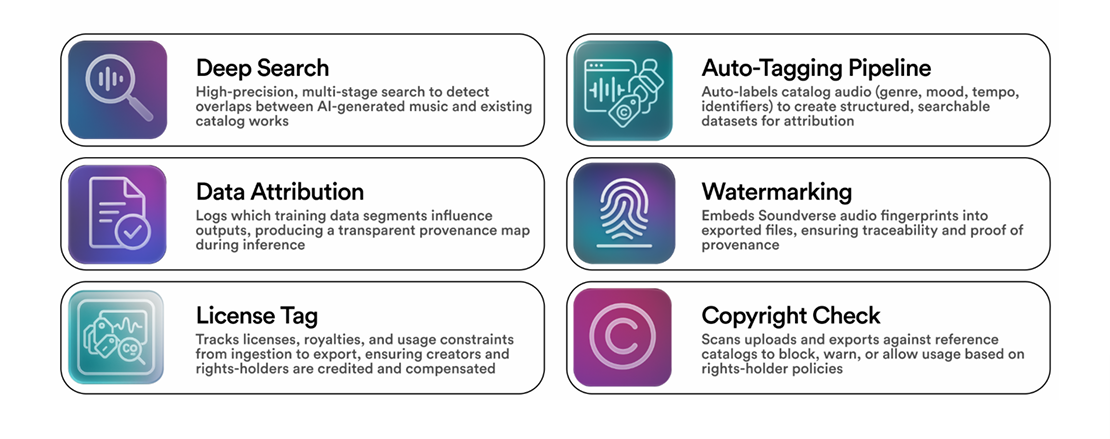
Soundverse Trace acts as a comprehensive trust layer for AI music, addressing the exact challenges YouTube, Meta, and TikTok face when reviewing synthetic audio.
What is Soundverse Trace?
Soundverse Trace embeds attribution, deep search, and rights protection directly into each AI-generated track’s DNA—from dataset creation to final export. It brings structure and traceability into what was once a gray area of AI-generated art.
Core capabilities of Soundverse Trace
- Deep Search: Performs high-precision scanning (1:1, 1:N) to detect possible overlaps or reused material within gigantic datasets.
- Data Attribution: Logs exactly which training inputs influenced an audio output, ensuring accurate dataset transparency.
- Audio Watermarking: Integrates inaudible fingerprints into each file, allowing social platforms’ AI systems to confirm the track’s origin quickly.
- License Tagging: Maintains rights metadata from ingestion to export, enabling automatic licensing compliance and payouts.
Use cases for creators
- Prevent copyright infringement – Establish proof of source instantly.
- Track catalog usage for royalties – Link each distribution event to specific AI data contributors.
- Verify provenance – Confirm authenticity across uploading or sharing.
- Automate payouts or takedowns – Support fast response in legal or licensing disputes.
When creators prepare to upload AI music to YouTube, Meta, or TikTok, Soundverse Trace equips their files with metadata compatible with these platforms’ verification systems. This eliminates confusion over authorship and ensures maximum content longevity.
Soundverse Trace is also part of the broader Ethical AI Music Framework, which ensures artists who contribute data are attributed and compensated. For professionals seeking broader transparency discussions, explore AI-generated music industry trends and the role of AI music in film and television to understand how attribution layers are creating ethical standards industry-wide. You can further learn how music authenticity works in Web3 using blockchain and Soundverse Trace.
How does Soundverse connect to monetization and rights management?
Beyond compliance, Soundverse’s infrastructure opens new monetization doors. Through its Content Partner Program, rights-holders can opt in to contribute audio samples for AI training. Each use results in usage-based royalties—aligning innovation with artist integrity.
For content creators, joining a transparent AI ecosystem means fewer algorithmic penalties, smoother distribution, and ethical future readiness. Pairing Soundverse Trace with your regular creative pipeline (lyrics, composition, marketing) ensures safe publishing on every major platform.
Check Soundverse Assistant—your AI music co-producer to explore how generation and traceability unite for modern creators. For additional guidance, see how Soundverse Trace makes verifying audio authenticity seamless and how to create brand-safe AI music in 2026.
Experience the Power of AI Music Creation Today
Generate professional-grade tracks in minutes with Soundverse’s intelligent music generation tools. Unleash your creativity and let AI handle the complexity—so you can focus on what matters most: making music.
Related Articles
- How AI-Generated Music Is Transforming the Music Industry — Discover how artificial intelligence is disrupting and redefining the global music landscape.
- The Role of AI Music in Film and Television — Learn how AI-composed music is reshaping scoring, soundtrack creation, and storytelling in media.
- AI Music Generator and Human Composers: A Future Together — Explore how human creativity and AI technology are collaborating to craft new musical possibilities.
- AI Ranks Soundverse’s AI Singer #1 — The Ultimate AI Singing Platform Dominating 2025 — See why Soundverse’s AI Singer is setting new standards for quality, realism, and performance in AI music.
Here's how to make AI Music with Soundverse
Video Guide

Here’s another long walkthrough of how to use Soundverse AI.
Text Guide
- To know more about AI Magic Tools, check here.
- To know more about Soundverse Assistant, check here.
- To know more about Arrangement Studio, check here.
Soundverse is an AI Assistant that allows content creators and music makers to create original content in a flash using Generative AI.
With the help of Soundverse Assistant and AI Magic Tools, our users get an unfair advantage over other creators to create audio and music content quickly, easily and cheaply.
Soundverse Assistant is your ultimate music companion. You simply speak to the assistant to get your stuff done. The more you speak to it, the more it starts understanding you and your goals.
AI Magic Tools help convert your creative dreams into tangible music and audio. Use AI Magic Tools such as text to music, stem separation, or lyrics generation to realise your content dreams faster.
Soundverse is here to take music production to the next level. We're not just a digital audio workstation (DAW) competing with Ableton or Logic, we're building a completely new paradigm of easy and conversational content creation.
TikTok: https://www.tiktok.com/@soundverse.ai
Twitter: https://twitter.com/soundverse_ai
Instagram: https://www.instagram.com/soundverse.ai
LinkedIn: https://www.linkedin.com/company/soundverseai
Youtube: https://www.youtube.com/@SoundverseAI
Facebook: https://www.facebook.com/profile.php?id=100095674445607
Join Soundverse for Free and make Viral AI Music

We are constantly building more product experiences. Keep checking our Blog to stay updated about them!
Image Steps: []