The Long-Term Risks of Ignoring Ethics in AI Music
Explore why ignoring ethics in AI music poses major risks for creators, tech, and the music industry in 2026.
The Long-Term Risks of Ignoring Ethics in AI Music
In 2026, artificial intelligence has become deeply integrated into music creation, distribution, and monetization. Yet as the technology matures, a pressing discussion dominates industry forums: the long-term risks of ignoring ethics in AI music. Without a shared ethical foundation, automation can erode creative rights, magnify bias, and destabilize the economic fabric that sustains artists. This article explores what happens when AI innovation advances faster than responsibility, and how frameworks like Soundverse’s Ethical AI Music Framework are shaping a transparent, equitable future.
Why does AI ethics in music matter more than ever in 2026?
AI ethics in music refers to principles that ensure fairness, consent, and accountability in how AI systems create and monetize music content. In the early years of AI music tools (2024–2025), rapid growth led to unregulated data scraping, copyright confusion, and lawsuits surrounding unauthorized voice or style replication. By 2026, regulators and enterprise users recognize that sustainable adoption depends on ethical AI in music creation. Ignoring this reality risks damaging trust between creators, developers, and audiences.
What are the immediate and long-term dangers of unethical AI music creation?
Unethical practices may not only hurt individual artists—they threaten the entire creative economy. Here are key long-term risks:
1. Erosion of Artist Rights
If AI models train on unlicensed or scraped audio, original musicians lose control over their intellectual property. Over time, consentless replication undermines incentives for innovation. Without ethical data sourcing, the creative ecosystem could devolve into a landscape of imitation, forcing professionals to rely on legal defense rather than artistic growth.
2. Legal and Copyright Instability
AI copyright issues intensify as machine learning models blur the boundaries between original and derivative works. Legislators are struggling to decide who owns AI-generated content: the developer, the end user, or the dataset contributor? Ignoring ethics here invites uncertainty that slows investment and creates disputes similar to the ones seen when streaming platforms first emerged.
3. Loss of Cultural Diversity
AI trained carelessly can homogenize global sounds. If machine-generated music favors dominant genres due to biased training datasets, regional and minority music cultures may be sidelined. Ethical frameworks protect diversity by ensuring representation and consent-driven inclusion.
4. Economic Displacement and Inequality
In 2026, algorithmic generation can produce thousands of tracks within minutes. Without responsible AI development that includes compensation mechanisms, small artists and independent producers risk losing their livelihood. Ethical attribution and royalty-sharing are vital for economic sustainability.
5. Public Distrust and Creative Devaluation
Audiences increasingly demand transparency. When they discover that their favorite AI track was trained without artist consent, backlash harms the reputation of both AI developers and music platforms. Ethical compliance boosts trust and differentiates credible companies from those exploiting loopholes.
For a deeper dive, watch our guide on how to make music and understand how ethics can be embedded in creation workflows.

How are regulators addressing AI music ethics in 2026?
Governments and trade organizations are actively defining AI music regulation frameworks. Europe now enforces transparency laws requiring labeling of algorithmically generated works. North America has introduced proposals focusing on rights attribution and fair licensing. Asia, meanwhile, is investing in cross-industry certification standards for AI dataset validation.
These efforts highlight a global consensus: the line between human and machine creativity must be transparent. Yet legislative processes are slow. Therefore, private initiatives from tech innovators and music companies are crucial to accelerate ethical adoption before regulation becomes mandatory.
How can ethical AI in music creation preserve creative integrity?
Ethical AI in music creation integrates legal compliance, transparency, and monetization fairness. It relies on consented data use, explainable model inference, and continuous attribution.
Adhering to these principles ensures:
- Respect for intellectual property through licensed dataset sourcing.
- Cultural richness by encouraging diverse artist participation.
- Economic sustenance via recurring compensation and fair royalties.
- Trust through verifiable watermarking and attribution transparency.
When AI ethics becomes a design foundation rather than a patchwork regulation, innovation remains both profitable and principled. The AI Music Ethics and Disclosure: Complete Guide for 2026 further outlines transparency’s role in public trust.
How Soundverse’s Ethical AI Music Framework eliminates long-term risks
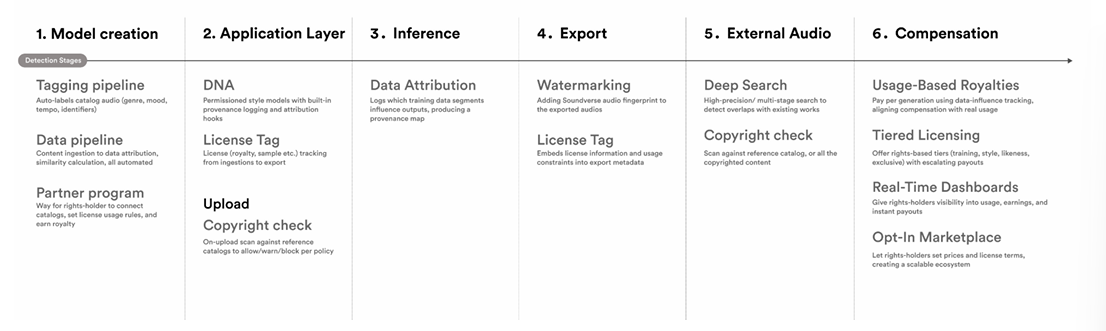
The Soundverse Ethical AI Music Framework directly addresses the challenges that arise when ethics are overlooked. It is a comprehensive, end-to-end infrastructure that bridges innovation and artist integrity. Rather than relying on opaque black-box systems, it introduces a transparent six-stage pipeline:
- Licensed Data Sourcing (No scraping): Training occurs only on authorized datasets. Every piece of music used for model learning is fully licensed, eliminating legal and ethical blind spots.
- Permissioned Models (DNA): Soundverse DNA allows creators to contribute their sonic identity through an opt-in model. This forms the foundation for ethical AI in music creation, enabling artists to monetize their styles safely.
- Explainable Inference (Attribution): Each generated composition carries transparent metadata showing which licensed influences shaped the result.
- Traceable Export (Watermarking): Exports include digital watermarks for attribution, ensuring traceability across platforms.
- Deep Search (External Scanning): The system cross-checks AI outputs against global datasets for copyright overlap, maintaining lawful originality.
- Recurring Compensation (Partner Program): Rights holders earn royalties whenever their licensed material contributes to model outputs.
The framework powers enterprise-grade compliance, sustainable monetization, and artist protection—making it an ethical benchmark in the AI music landscape. As AI Music and Ethical Defaults: Building Trust in 2026's Creative AI highlights, enforceable safeguards are critical to protecting creative identities.
What additional Soundverse tools reinforce ethical and responsible AI development?
Soundverse complements the Ethical AI Music Framework with advanced solutions:
- Soundverse Trace: A trust layer for AI music lifecycle management, embedding attribution and rights tracking from dataset creation to final export.
- Content Partner Program: An opt-in licensing infrastructure that rewards valid contributors with recurring, transparent royalties.
- Soundverse DNA: An artist-trained music generation system that translates authentic sonic identities into copyright-safe compositions.
Each tool collectively creates a transparent ecosystem where ethics are not optional—they are embedded into the product DNA. See our tutorial for Deep House creation to explore how this framework integrates creative transparency.
What happens if the music industry ignores ethical AI adoption in the next decade?
The consequences extend far beyond individual companies. Ignoring ethics could trigger global controversies similar to the piracy crisis of the 2000s. Copyright disputes, cultural dilution, and artist exploitation would escalate, potentially stalling the progress of generative music AI altogether.
By examining current music industry trends, it is clear creators now value verified attribution and ethical partnerships. Platforms that fail to adapt risk losing users to alternatives offering transparent models, such as those available through Soundverse’s AI Magic tools and Soundverse AI Music Generator.
What can developers and producers do now to advocate ethical AI music use?
- Choose ethical tools: Adopt platforms committed to licensed data sourcing and transparent attribution.
- Demand explainability: Ensure every generated composition comes with traceable metadata.
- Educate peers: Spread awareness about AI ethics in music at conferences and community events.
- Join partner programs: Engage directly with ethical licensing networks, such as Soundverse’s Content Partner Program.
The transition toward ethical AI depends not only on technology, but also on the values and practices of those who use it.
Create Music Responsibly with Soundverse AI
Join a platform built for ethical innovation in AI music. Generate original tracks, explore safe creative practices, and lead the movement toward fair, transparent music technology.
Start Creating Ethically
Related Articles
- How AI-Generated Music Is Transforming the Music Industry: Discover how AI is reshaping the creative and business sides of the global music ecosystem.
- AI Music Generator and Human Composers: A Future Together: Explore how AI and human creativity can harmonize rather than compete in modern music production.
- Copyright-Free vs Royalty-Free Music: What Creators Should Know: Learn the key legal differences between copyright-free and royalty-free music in the age of AI creation.
- The Role of AI Music in Film and Television: See how AI-driven composition tools are transforming soundtracks for screen media while raising new ethical questions.
Here's how to make AI Music with Soundverse
Video Guide

Here’s another long walkthrough of how to use Soundverse AI.
Text Guide
- To know more about AI Magic Tools, check here.
- To know more about Soundverse Assistant, check here.
- To know more about Arrangement Studio, check here.
Soundverse is an AI Assistant that allows content creators and music makers to create original content in a flash using Generative AI.
With the help of Soundverse Assistant and AI Magic Tools, our users get an unfair advantage over other creators to create audio and music content quickly, easily and cheaply.
Soundverse Assistant is your ultimate music companion. You simply speak to the assistant to get your stuff done. The more you speak to it, the more it starts understanding you and your goals.
AI Magic Tools help convert your creative dreams into tangible music and audio. Use AI Magic Tools such as text to music, stem separation, or lyrics generation to realise your content dreams faster.
Soundverse is here to take music production to the next level. We're not just a digital audio workstation (DAW) competing with Ableton or Logic, we're building a completely new paradigm of easy and conversational content creation.
TikTok: https://www.tiktok.com/@soundverse.ai
Twitter: https://twitter.com/soundverse_ai
Instagram: https://www.instagram.com/soundverse.ai
LinkedIn: https://www.linkedin.com/company/soundverseai
Youtube: https://www.youtube.com/@SoundverseAI
Facebook: https://www.facebook.com/profile.php?id=100095674445607
Join Soundverse for Free and make Viral AI Music

We are constantly building more product experiences. Keep checking our Blog to stay updated about them!