How Do AI Music Generators Work in 2026?
Discover how AI music generators create music using machine learning and text-to-music technology.
How Do AI Music Generators Work
Artificial intelligence has profoundly shaped the creative industries, and by 2026, AI music generators stand out as one of the most transformative innovations in modern sound production. From musicians to game developers, creators now rely on these intelligent systems to craft instrumental tracks, ambient soundscapes, and even full musical arrangements without manual composition. But what exactly happens under the hood when you use an AI music generator, and how has this technology matured to become an essential part of today’s music ecosystem?
What Are AI Music Generators?
AI music generators are software systems that use algorithms and machine learning to create music automatically. These tools work by analyzing musical data—such as rhythm patterns, harmonic structures, and instrumentation—to produce new compositions. They don’t just replicate existing songs; rather, they synthesize original material aligned with a user’s prompt or stylistic preferences.
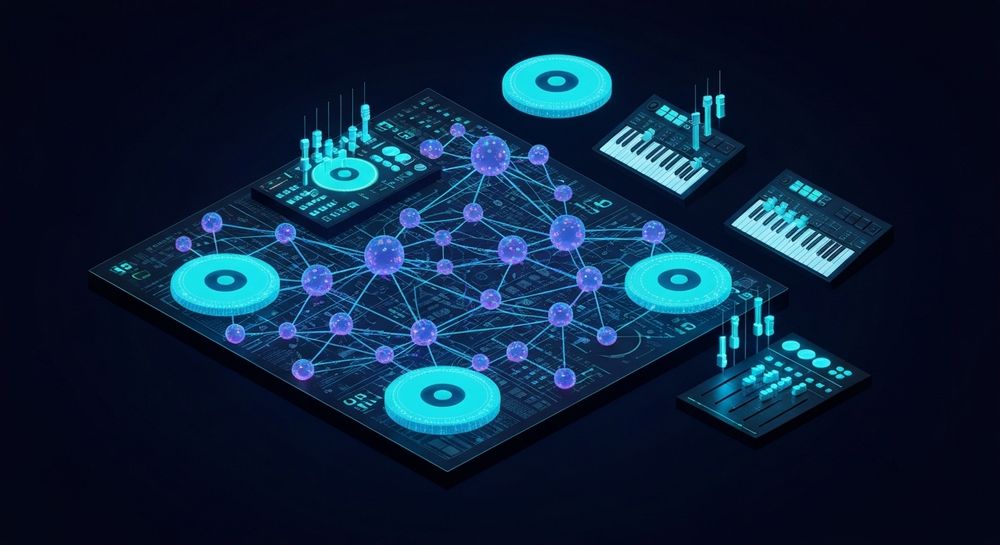
As of 2026, platforms like Soundverse have advanced far beyond early audio AI models from 2024. Modern AI music composition tools now integrate descriptive text inputs, genre conditioning, and emotional tone mapping. Users might type something like “create an ambient chillout background with guitar and synth pads,” and within seconds, the generator delivers a coherent, royalty-free track optimized for commercial or creative use. To understand the foundational science behind this evolution, see What AI Music Generators Can Do (And How They Do It) by AssemblyAI.
How Does AI Create Music?
The process that allows AI to create music involves several layers of computation. It typically begins with data input (like text descriptions), then transitions through model interpretation, composition generation, and sound synthesis.
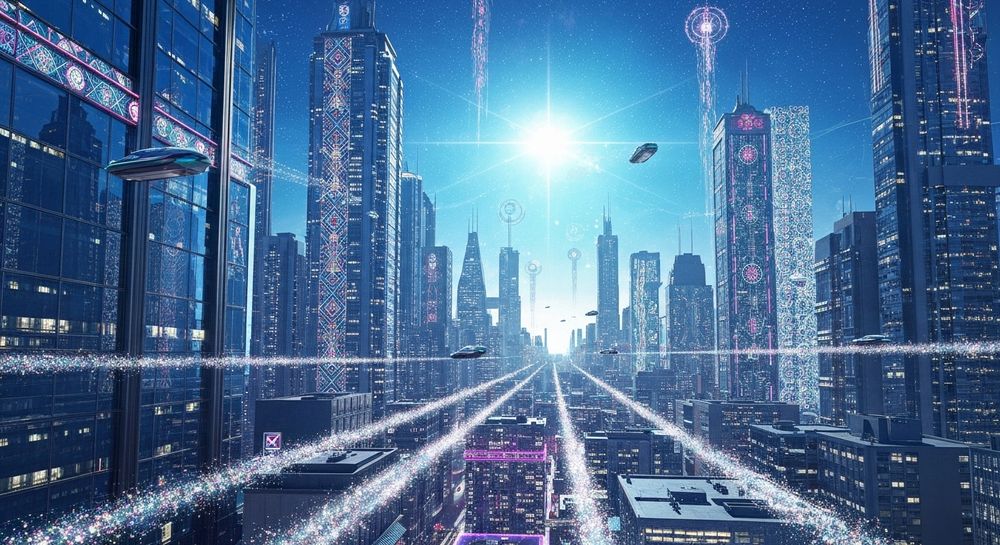
- Text Understanding: AI interprets natural language prompts, understanding words related to emotion, genre, tempo, and instrumentation.
- Musical Mapping: It converts that understanding into structured musical attributes like key, rhythm, and arrangement.
- Audio Rendering: Finally, the generator builds a full instrumental composition using trained neural networks capable of understanding melodies, harmony progressions, and sonic texture.
Machine learning in music forms the backbone of these systems. It relies on datasets of real songs, instrumental tracks, and synthesized audio to teach the model important relationships between notes, beats, and sound timbres. The most ethical providers, like Soundverse, ensure these datasets are fully licensed so artists receive compensation and attribution. Check the related A super-brief introduction to Music AI from BMAT Music Innovators for additional context.
What Drives Music Generation Technology in 2026?
Music generation technology now combines deep learning with contextual awareness. Modern neural models such as transformers and diffusion-based generative engines give these tools the capability to understand complex musical ideas and reproduce them in beautiful, stylistically accurate compositions.
Key innovations shaping artificial intelligence in music production include:
- Transformer Networks: Handle long-term dependencies in musical sequences, ensuring that melodies are coherent across extended pieces.
- Diffusion Audio Models: Used to refine the output audio into realistic, high-fidelity sound.
- Genre and Instrument Filters: Enable users to specify genres from jazz to EDM, controlling the overall sonic palette.
The results are remarkably flexible, whether you need a cinematic score or a looping ambient backdrop for meditation apps. Many creators now explore such tools alongside traditional workflows, generating instrumental layers with AI before manually mixing and master-processing their final works. For a hands-on demonstration, watch Soundverse Tutorial Series - 9. How to Make Music.
Why Are AI Music Composition Tools Becoming Popular?
Between 2024 and 2025, AI composition gained momentum primarily among content creators and short-form video producers. By 2026, the adoption expanded to mainstream musicians and production studios. The reason is clear: AI music generators provide speed, inspiration, and cost efficiency.
For musicians, AI acts like a co-producer that suggests new musical directions. For producers, it fills budget gaps when hiring composers isn’t feasible. Content creators benefit from quick royalty-free tracks tailored to mood and theme. Applications now span advertising, gaming, podcast intros, and therapeutic sound design.
If you want a deeper dive into how these trends evolved, our coverage on music industry trends offers an in-depth look at how generative audio reshaped professional production workflows.
How Machine Learning and Neural Networks Compose Music
Machine learning in music composition relies on pattern learning. The AI digests large datasets containing thousands of rhythmic styles and chord progressions. Then, it predicts what note or sound texture should follow a given musical pattern. In Soundverse’s models, this sequence building is guided by high-dimensional embeddings that represent genre, timbre, and mood.
Training a model to generate music isn’t simple. Engineers must balance creativity and coherence. Overfitting to training data can lead to repetitive melodies; underfitting can result in chaotic compositions. Hence, developers increasingly use hybrid supervised and reinforcement learning schemes, ensuring outputs remain unique yet musically valid.
A critical development in 2026 is ethical data sourcing. Tools such as Soundverse DNA integrate consent-based datasets. This approach guarantees compositions are generated using licensed catalogs so that artists can monetize their sound identities while users enjoy consistent, copyright-safe music.
To understand how ethical frameworks drive music AI evolution, check out The Ethical AI Music Framework for detailed insights into consent, attribution, and transparency in AI-driven production.
How to Make Music with Soundverse AI Music Generator
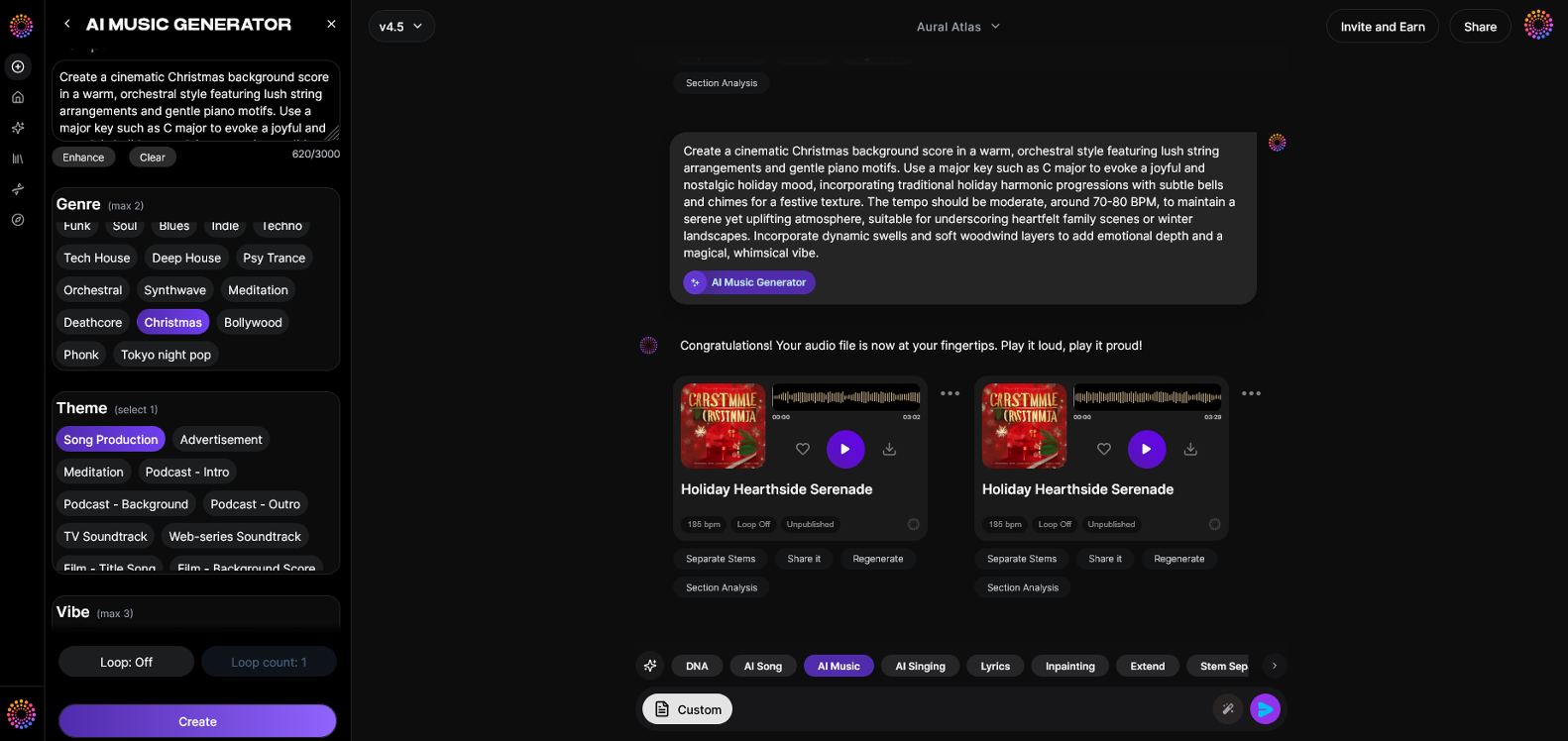
Soundverse’s AI Music Generator simplifies instrumental creation through a streamlined text-to-music interface.
Feature Overview: This tool produces fully arranged instrumentals from descriptive text prompts. It focuses on non-vocal tracks like beats, ambient loops, and cinematic soundscapes, with built-in options for looping and genre control. Supported models (V4 and V5) provide advanced synthesis quality suited for professional use.
Primary use cases include creating background tracks for videos, game soundtracks, meditation sessions, and advertising campaigns. For a visual walkthrough, take a look at our Deep House tutorial on YouTube.
Step 1: Feature Overview
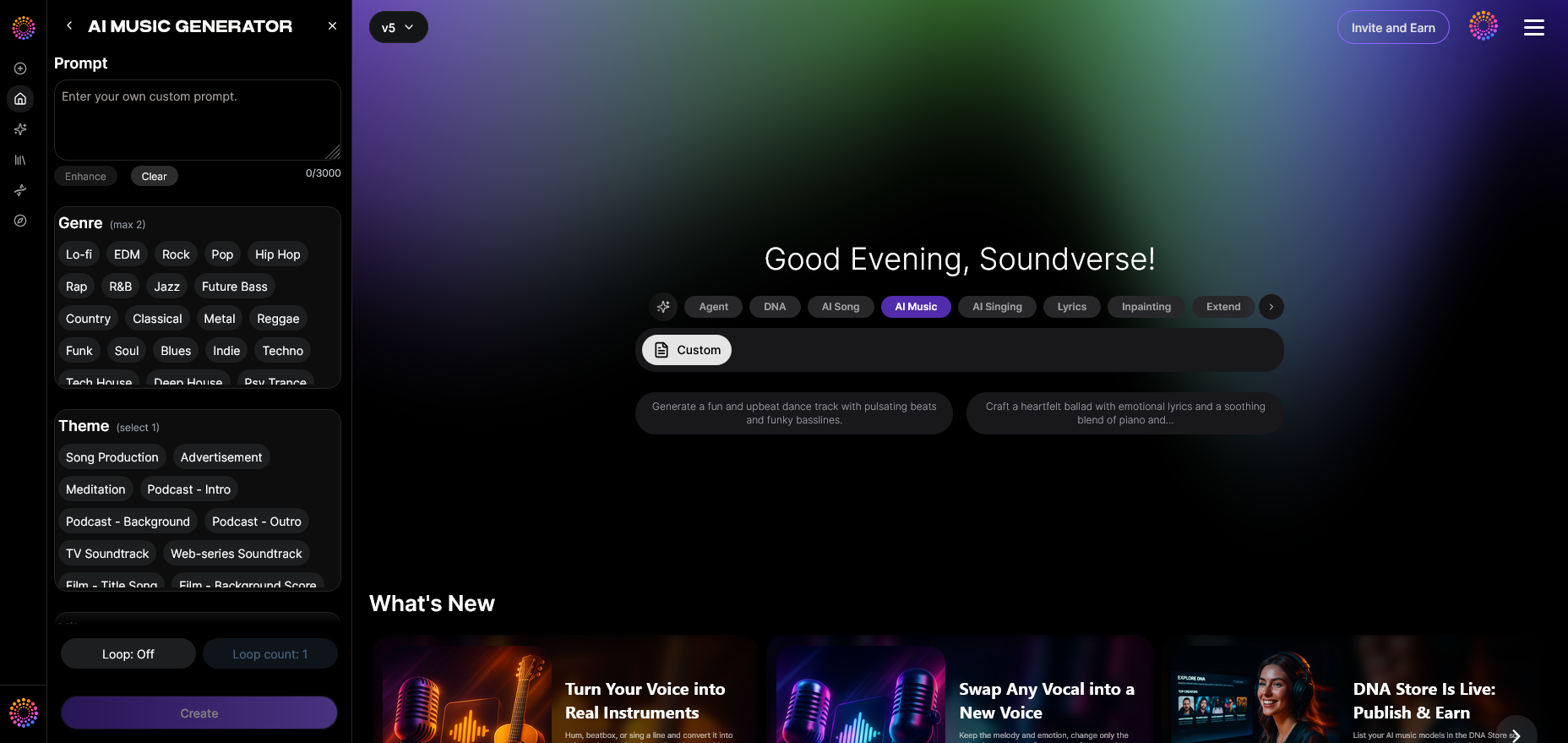
Access the AI Music Generator from Soundverse’s main menu. This is your gateway to text-to-music creation. You can explore related modules like AI Song Generator for full vocal pieces or DNA to maintain consistent artist styles.
Step 2: Description Input
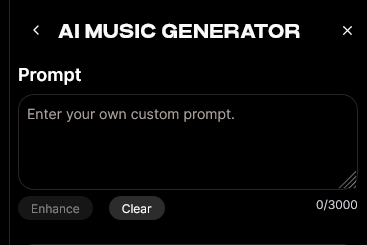
Type your desired mood or concept. For example, you could enter “calming piano and strings suitable for relaxation” or “energetic drum and bass for game battles.” The AI interprets descriptive cues and prepares composition parameters accordingly.
Step 3: Style & Duration
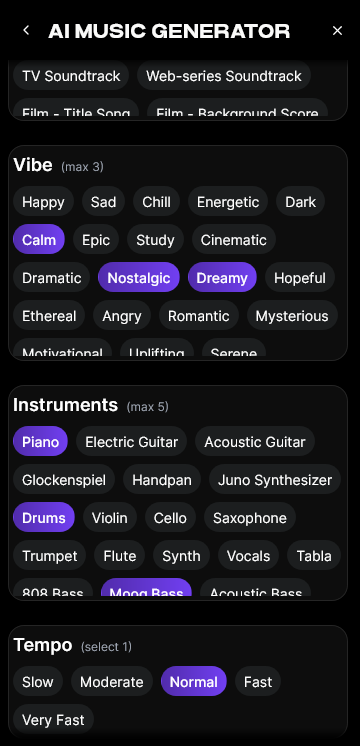
Select your genre, tone, and track length. You can adjust these to match your project—short background loops for games or extended durations for film ambience.
Step 4: Generation
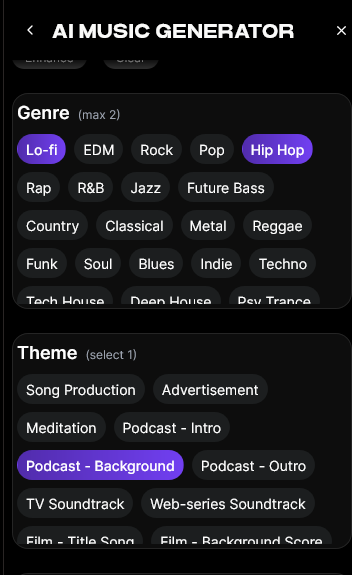
Click “Generate Music” to let the AI create a unique instrumental piece. Behind the scenes, Soundverse’s model transforms text into layered arrangements, patterns, and virtual instruments, producing an original composition aligned with your prompt.
Step 5: Export Options

Once the generation completes, download the instrumental track in your preferred format. If you plan to embed it in digital content like YouTube videos, you can also apply Loop Mode for seamless repetition.
For further inspiration, browse prompts such as those featured in 100 text-to-music prompts that will help you create viral music or explore creative styles through How to Create EDM with Soundverse AI.
Advantages of Using AI Music Generators for Modern Creators
- Speed: Generate production-ready soundtracks in minutes.
- Customization: Adjust genre, mood, and instrumentation.
- Cost Efficiency: No need for session musicians when producing background music.
- Consistency: Perfect for recurring brand content or game loops.
- Ethical Licensing: With Soundverse DNA, creators can trust full rights transparency.
For additional creative capabilities, the Soundverse AI Magic Tools can help streamline your workflow and automatically select the right feature for your needs.
Start Creating Your Own AI-Generated Music Today
Experience the power of Soundverse’s AI music generators and transform your ideas into professional-quality tracks in seconds. No musical background needed—just your imagination.
Related Articles
- How an AI Music Generator Inspires Creative Fusion: Learn how AI-driven tools blend technology and artistry to ignite new forms of music creativity.
- The Benefits of Composing with AI Music Generator: Discover how musicians and creators use AI music generators to streamline composition and spark inspiration.
- AI Music Generator and Human Composers: A Future Together: Explore how human creativity and AI-generated music can coexist to redefine the future of sound.
- Best AI Music Generator: Top Picks and Review: Compare leading AI music generators to find the perfect platform for your creative workflow.
Here's How to Make AI Music with Soundverse
Video Guide
Here’s another long walkthrough of how to use Soundverse AI.
Text Guide
- To know more about AI Magic Tools, check here.
- To know more about Soundverse Assistant, check here.
- To know more about Arrangement Studio, check here.
Soundverse is an AI Assistant that allows content creators and music makers to create original content in a flash using Generative AI.
With the help of Soundverse Assistant and AI Magic Tools, our users get an unfair advantage over other creators to create audio and music content quickly, easily and cheaply.
Soundverse Assistant is your ultimate music companion. You simply speak to the assistant to get your stuff done. The more you speak to it, the more it starts understanding you and your goals.
AI Magic Tools help convert your creative dreams into tangible music and audio. Use AI Magic Tools such as text to music, stem separation, or lyrics generation to realise your content dreams faster.
Soundverse is here to take music production to the next level. We're not just a digital audio workstation (DAW) competing with Ableton or Logic, we're building a completely new paradigm of easy and conversational content creation.
TikTok: https://www.tiktok.com/@soundverse.ai
Twitter: https://twitter.com/soundverse_ai
Instagram: https://www.instagram.com/soundverse.ai
LinkedIn: https://www.linkedin.com/company/soundverseai
Youtube: https://www.youtube.com/@SoundverseAI
Facebook: https://www.facebook.com/profile.php?id=100095674445607
Join Soundverse for Free and Make Viral AI Music

We are constantly building more product experiences. Keep checking our Blog to stay updated about them!