How AI Handles Complex Time Signatures in Music Composition
Explore how AI handles odd meters, rhythmic complexity, and time signature modeling in 2026.
How AI Handles Complex Time Signatures
In 2026, AI music composition has advanced far beyond simple beat generation or looping. It now dives deep into one of the most intellectually demanding aspects of music theory — time signatures. Whether it's a grooving 7/8 jazz fusion track or an intricate progressive rock composition in 13/16, AI systems are becoming remarkably adept at handling rhythm complexity and creating convincing odd-meter works. For producers and composers exploring algorithmic rhythm generation, this represents a thrilling new frontier.
What makes time signatures important in music?
Time signatures define how musical time is organized. They tell performers and composers how beats are grouped, and therefore how rhythms feel. Common signatures like 4/4 or 3/4 create predictable patterns, which most listeners easily connect with. More complex or 'odd' meters, such as 5/4, 7/8, or hybrid meters like 9/8 alternating with 6/8, add tension, unpredictability, and distinct motion. These rhythmic complexities often define genres like progressive rock, Balkan folk, and experimental jazz.
In the past, computational composition struggled to emulate this nuance. Early algorithmic systems could generate melodies and harmonies but often defaulted to simple meters, losing the expressive potential of rhythmic diversity. The recent wave of machine learning and deep generative models changed that trajectory.
How does AI interpret and create complex time signatures?
Modern time signature AI models trained between 2024 and 2026 use mathematical representations of rhythmic patterns instead of rigid rules. Instead of merely counting beats, these systems learn the relationships among rhythmic subdivisions, syncopations, and thematic cycles.
When training an AI to recognize rhythms, data points from percussion layers, note lengths, dynamic accents, and tempo modulation are analyzed simultaneously. Transformers — the same architectures that revolutionized text generation — now analyze entire measures and rhythmic grids, predicting plausible sequences for unconventional meters. This learning approach makes odd meter AI composition more natural and dynamic, allowing producers to receive music that breathes rhythmically and feels organic.
Why has AI rhythm complexity become a trend in 2026?
The evolution of AI music composition during 2024 and 2025 positioned rhythm as the next unexplored dimension. After breakthroughs in melody and harmony modeling, developers realized that rhythm defines a track’s personality as much as pitch does. Musicians increasingly request pieces that avoid the mechanical feel of early AI outputs. As a result, 2026 sees software optimized for cross-meter blending, micro-timing, and groove preservation.
Social media and gaming industries accelerate this demand. Platforms like TikTok and YouTube Shorts reward rapid rhythmic hooks and unexpected rhythmic twists that capture attention within seconds. Game developers, meanwhile, use odd-meter loops to evoke tension or depict motion in dynamic scenes. The ability of an AI to generate asymmetric patterns thus allows for richer emotional storytelling.
If you follow current music industry trends, you’ll notice the growing emphasis on algorithmic rhythm generation—an area that Soundverse has embraced profoundly.
What challenges do AI systems face with rhythm modeling?
Modeling rhythm is different from modeling melody. The variance between expected beat positions and expressive timing (known as 'feel') is critical. Human drummers naturally push or pull timing to create groove. AI systems must infer this from data rather than direct human emotion.
Additionally, odd meters complicate loop synchronization. A loop in 7/8 rarely fits neatly into standard playback grids. AI systems require context-aware quantization and adaptive grouping logic to prevent rhythmic misalignment. Time signature AI must identify cyclical markers in raw data before looping can occur smoothly.
How does machine learning approach odd meter generation?
To teach AI to compose in odd meters, training datasets include audio and MIDI samples spanning multiple genres. The AI identifies periodicities — repeating rhythmic structures — then constructs probability models predicting what should follow a given beat pattern. Think of it like how language models predict next words; rhythm models predict next beats.
Advancements in rhythm complexity modeling have led to hybrid networks combining rule-based logic (to maintain metric integrity) and neural embeddings (to interpret groove and human-like flow). These hybrid approaches yield music that feels alive even under mathematically complex signatures.
Developers often reference ethnomusicological datasets, including Indian tala cycles and African polyrhythms, to expand rhythmic diversity. By analyzing these structures, AI understands non-Western meters and can simulate culturally rich rhythmic systems.
How to make complex time signature music with Soundverse AI Music Generator
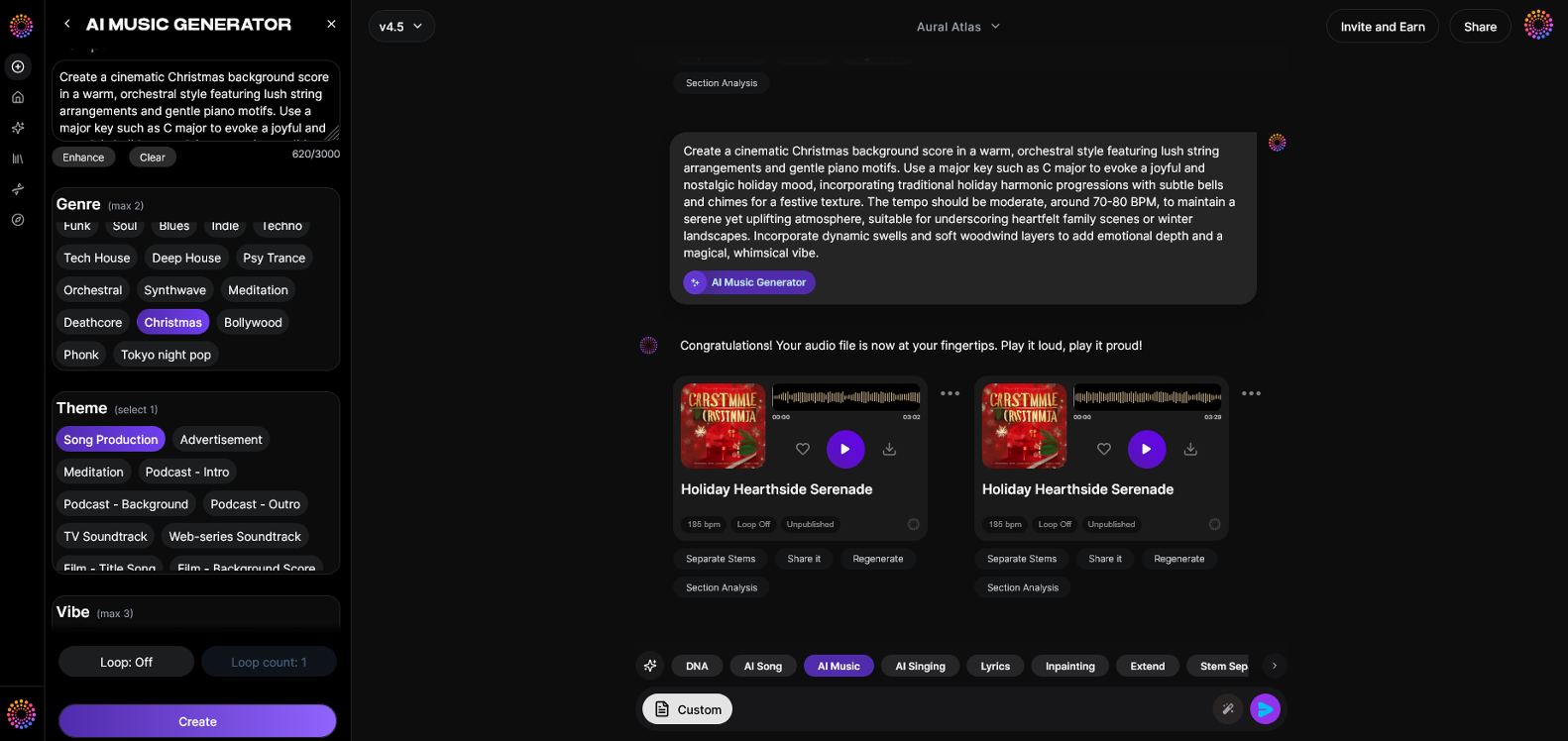
For creators who want to experiment with odd-meter-inspired background tracks, the Soundverse AI Music Generator offers an efficient workflow. This tool can turn textual prompts into fully produced instrumental compositions, allowing users to describe not only genre and mood but rhythmic intent.
With its powerful text-to-music engine and the ability to fine-tune parameters like instrument choice and tempo, the AI Music Generator thrives in rhythmically intricate applications. The Loop Mode ensures seamless repetition even with asymmetrical bars. Soundverse’s V4 and V5 models focus on producing immersive textures — ideal for creating game soundtrack loops, meditation scores, and advertising music where rhythmic variation boosts engagement.
If precision matters, producers can use Soundverse alongside other AI tools in its ecosystem. The Similar Music Generator enables composers to match the rhythm and meter of a provided reference track, perfect for film scoring where directors approve specific 'temp' beats. Meanwhile, the Melody to Song Generator can develop complete arrangements around your uploaded melody, adjusting rhythmic phrasing to suit its natural flow.
Soundverse intentionally eliminates live or real-time previewing to ensure accurate post-processing. Instead, users submit a text prompt, and the AI asynchronously processes the request, producing downloadable instrumental output. This structured generation ensures predictable, high-quality odd-meter results rather than inconsistent improvisations.
For musicians learning more about text-based composition, the article on generate AI music with Soundverse text-to-music offers in-depth explanations of this workflow.
For a deeper dive into AI composition techniques, check out Soundverse Tutorial Series - 9. How to Make Music or explore how to craft genre-specific tracks through our Deep House production guide.
How do producers benefit from AI-driven rhythm experimentation?
AI-driven rhythm allows producers to access patterns that may be difficult to perform manually. For example, generating 11/8 or 15/16 grooves helps modern fusion artists prototype new arrangements quickly. Because AI can model tempo transitions and meter changes smoothly, musicians benefit from cohesive rhythm designs that maintain musical coherence.
For commercial creators, odd meter compositions can differentiate brands. Advertisements featuring unique rhythmic cadences create memorability. Similarly, wellness and meditation track designers use uneven pulse structures to induce specific breathing rhythms or meditative states.
AI music composition tools now form part of the producer’s creativity toolkit — not a replacement but an augmentation. They automate beat generation, freeing artists to refine feel and expression instead.
If you’re exploring more creative applications, check out Soundverse introduces stem separation AI magic tool, where creators can isolate rhythmic stems for hybrid production.
What’s next for time signature AI beyond 2026?
Future development will likely focus on interpretive feel realism — microtiming, groove variance, and expressive swing. Integrating sensor data from physical performances into training pipelines could help AIs sense real drummers’ timing adjustments.
Beyond composition, rhythm-focused AI might influence interactive media. Games or virtual reality environments could use adaptive meters that respond dynamically to user movement or gameplay tension. Such systems will use AI rhythm complexity modeling to adapt soundtrack energy in real time.
Ultimately, the trajectory points toward democratization. By 2026, AI music composition no longer belongs solely to researchers or elite producers. It’s accessible, integrated, and capable of creating musically valid results across complex time signatures.
Start Creating AI-Composed Music Today
Unlock limitless creativity with Soundverse’s AI-powered music composition tools. Generate complex melodies, rhythms, and time signatures effortlessly and elevate your sound to professional quality.
- The Role of AI Music in Film and Television — Discover how AI is changing soundtrack creation and redefining storytelling through music in visual media.
- How AI-Generated Music Is Transforming the Music Industry — Explore the impact of AI on music production, artist creativity, and the future of sound innovation.
- AI Music Generator and Human Composers: A Future Together — Learn how AI tools collaborate with composers to push the boundaries of modern music.
- The Benefits of Composing with an AI Music Generator — Understand how AI simplifies composition workflows while maintaining artistic integrity and originality.
Here's how to make AI Music with Soundverse
Video Guide
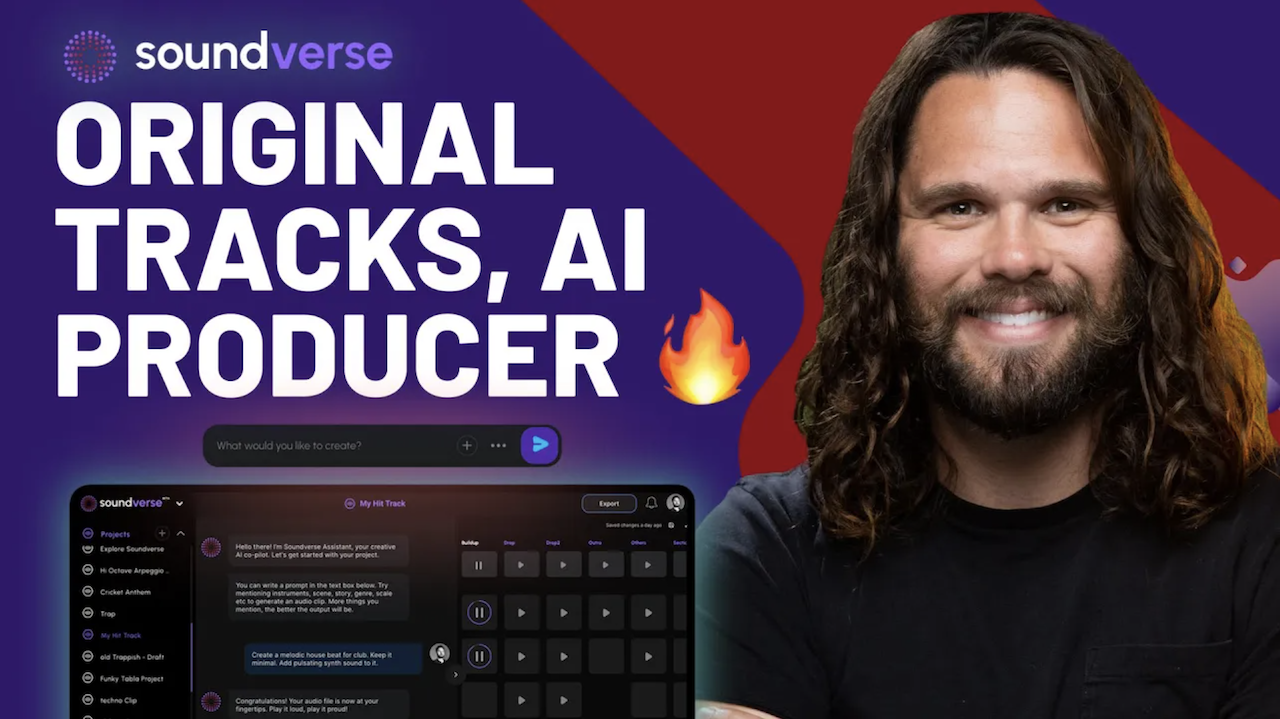
Here’s another long walkthrough of how to use Soundverse AI.
Text Guide
- To know more about AI Magic Tools, check here.
- To know more about Soundverse Assistant, check here.
- To know more about Arrangement Studio, check here.
Soundverse is an AI Assistant that allows content creators and music makers to create original content in a flash using Generative AI. With the help of Soundverse Assistant and AI Magic Tools, our users get an unfair advantage over other creators to create audio and music content quickly, easily and cheaply. Soundverse Assistant is your ultimate music companion. You simply speak to the assistant to get your stuff done. The more you speak to it, the more it starts understanding you and your goals. AI Magic Tools help convert your creative dreams into tangible music and audio. Use AI Magic Tools such as text to music, stem separation, or lyrics generation to realise your content dreams faster. Soundverse is here to take music production to the next level. We're not just a digital audio workstation (DAW) competing with Ableton or Logic, we're building a completely new paradigm of easy and conversational content creation.
TikTok: https://www.tiktok.com/@soundverse.ai
Twitter: https://twitter.com/soundverse_ai
Instagram: https://www.instagram.com/soundverse.ai
LinkedIn: https://www.linkedin.com/company/soundverseai
Youtube: https://www.youtube.com/@SoundverseAI
Facebook: https://www.facebook.com/profile.php?id=100095674445607
Join Soundverse for Free and make Viral AI Music

We are constantly building more product experiences. Keep checking our Blog to stay updated about them!