Can AI Create Microtonal Music? Exploring the Future of Alternative Tuning and Machine Learning Composition
Explore how AI is creating microtonal music and reshaping alternative tuning systems for composers and sound designers.
Can AI Create Microtonal Music?
Microtonal music has always occupied a fascinating niche in the world of experimental sound. As we stand in 2026, artificial intelligence has evolved from generating mainstream pop tracks to deeply exploring nontraditional tuning systems. The question that unites technologists and theorists alike is simple yet profound: can AI create microtonal music?
Microtonality—a system that uses intervals smaller than a semitone—has long been a realm of human creativity and cultural tradition, deeply rooted in Middle Eastern, Indian, and avant-garde Western practices. With the accelerating advancements in AI, machine learning composition, and timbre modeling, musicians are now uncovering how algorithms can navigate these intricate tonal spaces.
What is Microtonal Music and Why Does It Matter in 2026?
Microtonal music operates beyond the conventional twelve-tone equal temperament familiar to Western listeners. It includes divisions such as 19-TET, 24-TET, or even just intonation scales derived from natural harmonic ratios. In 2026, with experimental music entering mainstream platforms and creators demanding more personalized tonal control, microtonality has become a major trend among sound designers and AI composers.
Microtonal approaches give artists a way to challenge harmonic norms, evoke vivid cultural textures, and discover new psychoacoustic possibilities. As AI tools gain a deeper understanding of music theory, the limits of what machines can perceive—pitch accuracy, harmonic relationships, and tuning variation—are being expanded dramatically.
How Does AI Understand Microtonality?
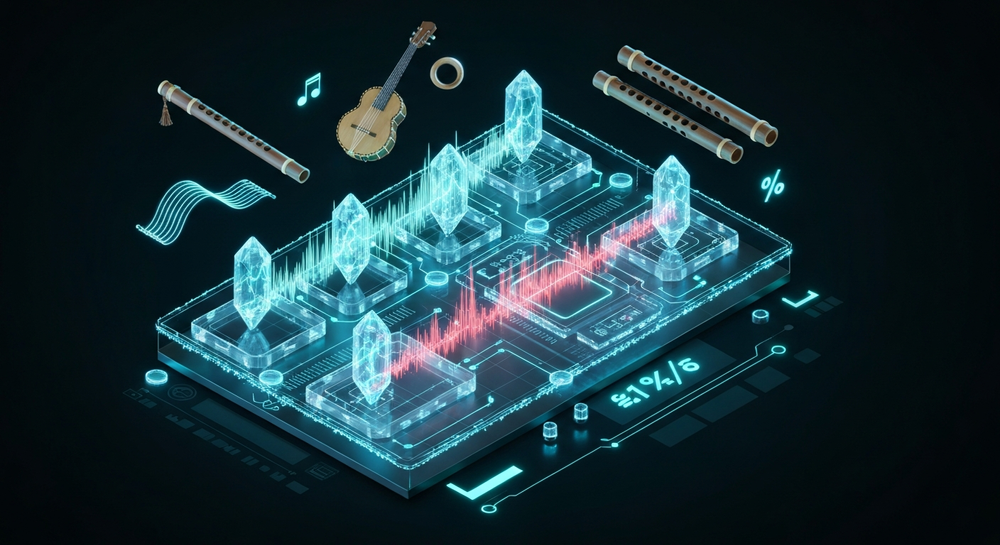
When AI systems process music, they interpret pitch data numerically. Traditionally, most machine learning composition models assume equal temperament values because of the availability of Western datasets. In the past, this limited results to conventional harmony. But projects throughout 2024 and 2025 started integrating datasets recorded in alternative tuning systems, including sitar ragas and experimental synthesizer patches.
By 2026, advanced architectures such as Soundverse DNA have demonstrated that neural networks can ingest pitch deviations and reproduce nonstandard tuning precisely. This leap stems from improvements in frequency-domain analysis and pitch-tracking algorithms that represent sound continuously instead of discretely. It means AI can now perceive quarter tones, blue notes, and non-equal divisions with high fidelity.
Why Are Musicians Turning to AI for Microtonal Composition?
Composing microtonal music often requires mastery of complex mathematics and custom instrument design. AI simplifies that process. Tools powered by artificial intelligence can analyze a user’s input—whether it’s humming, MIDI sketches, or raw tone sequences—and reinterpret it through microtonal frameworks. This capability opens doors for:
- Sound designers experimenting with non-Western scales.
- Artists bridging electronic production with world music traditions.
- Composers developing immersive audiovisual experiences using unconventional pitch spaces.
The music industry trends show an increasing appetite for originality beyond traditional tonality. AI-driven style modeling ensures this evolution isn’t limited to trained theorists, but accessible to every creator who wants to push musical boundaries.
How Does Machine Learning Composition Handle Alternative Tuning?
Machine learning thrives on pattern recognition. To create microtonal music, models must understand relationships in pitch not based on fixed intervals but on continuous frequencies. In practice, this means training algorithms on data derived from acoustic instruments tuned outside standard equal temperament and analyzing spectral features instead of discrete notes.
The result is that AI systems can adapt and learn to construct harmonies and melodies that breathe with microtonal nuance. By using timbre-based clustering and unquantized frequency mapping, modern AI composition engines interpret sound like a human ear rather than a rigid keyboard grid.
For a deeper dive, watch our Soundverse Tutorial Series - How to Make Music and Explore Tab walkthrough on YouTube.
How AI Microtonal Music is Changing Experimental Sound Design
The year 2026 has seen a shift: creators are embracing AI not merely as a production shortcut but as a creative collaborator. The integration of microtonality AI tools into digital workstations has encouraged hybrid roles where sound designers use neural networks to generate raw material, then fine-tune those sonic textures manually.
Platforms like Soundverse allow musicians to transform spoken ideas into unique tonal worlds. Even genres such as ambient electronic and post-classical music are incorporating microtonal elements generated algorithmically. Producers use this to craft tracks that sound simultaneously alien and organic.
For instance, projects inspired by world ethnic instruments—like bansuri or sitar—use the subtleties of microtonal bending and harmonics. AI not only models their timbre but can generate entirely new scales aligned with their acoustics.
What Role Does Artificial Intelligence Play in Modern Music Theory?
In 2026, artificial intelligence in music theory is no longer a hypothetical exercise. AI systems now complement human understanding of interval structures, harmonic progressions, and dynamic phrasing. Through analytical feedback loops, musicians can visualize scale relationships in unconventional systems. This fusion of theory and computation has democratized formerly academic areas of tuning research.
How AI-generated music is transforming the music industry highlights exactly this evolution—where deep learning expands theoretical foundations instead of replacing human intuition. Microtonality becomes a field where humans sculpt emotion, and algorithms ensure precision.
How to Make AI Microtonal Music with Soundverse Voice to Instrument
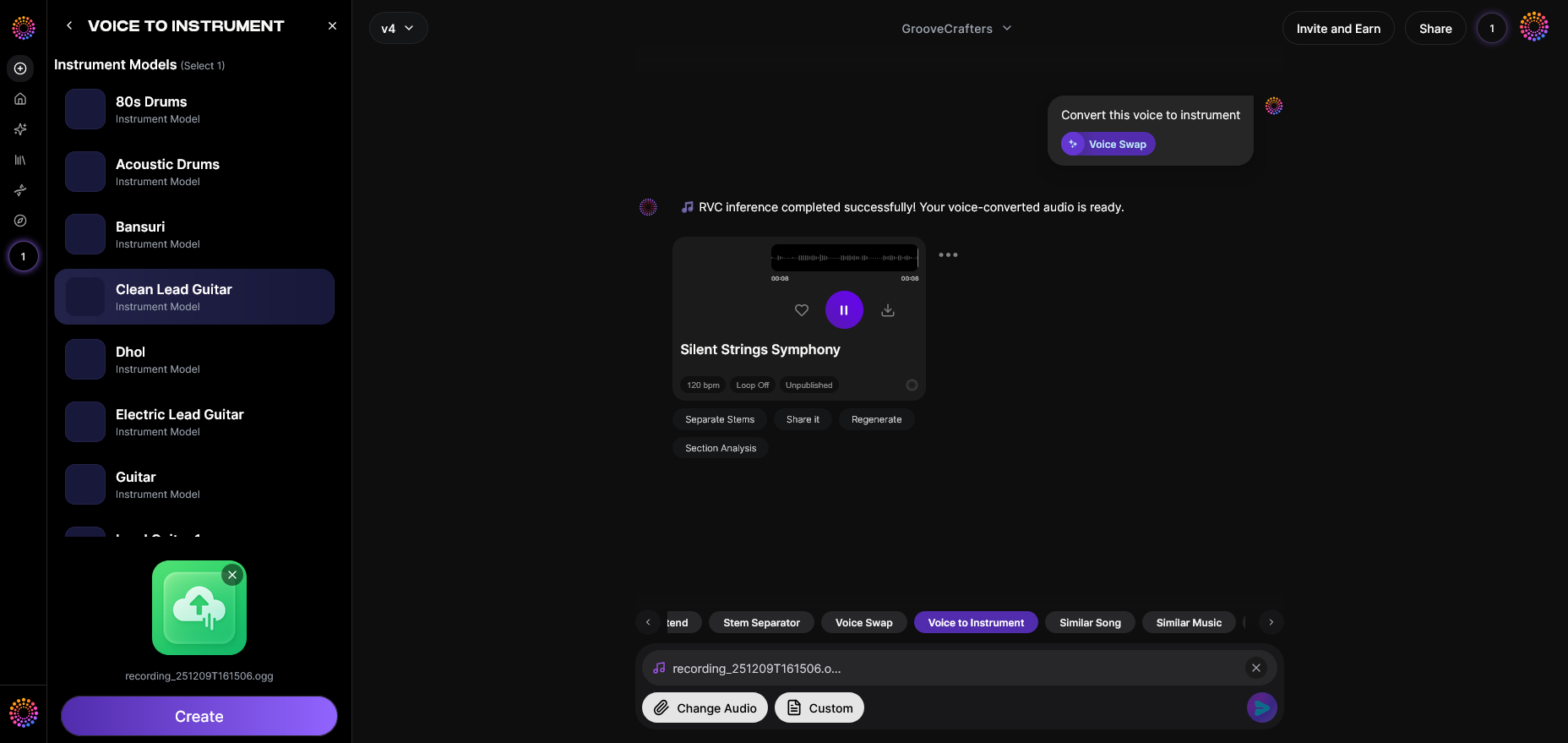
The Soundverse Voice to Instrument feature brings this vision to life by translating vocal ideas into instrumental outputs across global timbres. By 2026, it has become a go-to solution for artists exploring alternative tuning systems through accessible workflows.
Feature Overview:
Voice to Instrument converts vocal input—humming, beatboxing, or singing—into realistic instrumental sounds such as Guitar, Sitar, Drums, or Flute. Its timbre transfer ensures that pitch and phrasing are preserved while reflecting the chosen instrument’s acoustic fingerprint.
Core Capabilities:
- Timbre transfer maintaining expressive phrasing
- Expansive library of Western and ethnic instruments
- Support for melodic and rhythmic input
Using this tool, creators can sketch microtonal phrases with their voice and instantly reimagine them as intricate instrumental performances tuned beyond conventional scales.
Whether producing world music in sitar modes or generating quarter-tone orchestral textures, Voice to Instrument empowers non-instrumentalists to experiment freely. Combined with the AI Music Generator and Soundverse DNA systems, the ecosystem allows for full microtonal compositions—copyright-safe and consistent across sessions.
For example, a composer can hum an unconventional melody, choose a Sitar or Bansuri from the library, and generate an output reflecting authentic Eastern intonation. The output can then be arranged further using complementary tools like the Melody to Song Generator or processed with the Soundverse AI Magic Tools for additional sound design enhancements.
In contrast to older workflows that required manual pitch mapping, Soundverse provides an automated bridge between vocal expression and alternative tuning synthesis.
Future of Microtonality AI and Machine Learning Composition
In the next few years, researchers expect AI microtonal music models to integrate adaptive tuning frameworks that respond to emotional context. Machine learning composition is moving towards systems capable of morphing intonation in real-time based on dynamics or lyrical semantics.
By 2026, hybrid human-AI collaborations are redefining what creativity means. Artists no longer see artificial intelligence as a rigid rule-based engine, but as a responsive partner capable of interpreting expressive nuance—including pitch inflection that escapes traditional notation.
As seen across projects discussed in Soundverse introduces stem separation AI magic tool, AI’s acoustic understanding continues to grow broader, covering isolated stems, timbral balance, and harmonic precision. These developments pave the way for deeper experimentation in microtonality.
Create Your Own AI Microtonal Music Today
Explore Soundverse’s advanced AI tools to craft unique scales, tones, and textures beyond conventional Western tuning. Take your creativity to the next level with precision control over pitch and emotion.
Start Creating with AI
Related Articles
- How an AI Music Generator Inspires Creative Fusion: Discover how AI-driven tools empower creators to blend genres and styles for groundbreaking musical innovation.
- AI Music Generator and Human Composers: A Future Together: Explore how AI complements human creativity to shape the next era of musical expression and experimentation.
- The Benefits of Composing with AI Music Generator: Learn how AI composition tools streamline workflow and enable musicians to experiment with new tonal structures.
- The Role of AI Music in Film and Television: See how AI-created soundtracks are revolutionizing emotional storytelling through nontraditional harmonic approaches.
Here's how to make AI Music with Soundverse
Video Guide
Here’s another long walkthrough of how to use Soundverse AI.
Text Guide
- To know more about AI Magic Tools, check here.
- To know more about Soundverse Assistant, check here.
- To know more about Arrangement Studio, check here.
Soundverse is an AI Assistant that allows content creators and music makers to create original content in a flash using Generative AI.
With the help of Soundverse Assistant and AI Magic Tools, our users get an unfair advantage over other creators to create audio and music content quickly, easily and cheaply.
Soundverse Assistant is your ultimate music companion. You simply speak to the assistant to get your stuff done. The more you speak to it, the more it starts understanding you and your goals.
AI Magic Tools help convert your creative dreams into tangible music and audio. Use AI Magic Tools such as text to music, stem separation, or lyrics generation to realise your content dreams faster.
Soundverse is here to take music production to the next level. We're not just a digital audio workstation (DAW) competing with Ableton or Logic, we're building a completely new paradigm of easy and conversational content creation.
TikTok: https://www.tiktok.com/@soundverse.ai
Twitter: https://twitter.com/soundverse_ai
Instagram: https://www.instagram.com/soundverse.ai
LinkedIn: https://www.linkedin.com/company/soundverseai
Youtube: https://www.youtube.com/@SoundverseAI
Facebook: https://www.facebook.com/profile.php?id=100095674445607
Join Soundverse for Free and make Viral AI Music

We are constantly building more product experiences. Keep checking our Blog to stay updated about them!