AI Jazz Improvisation: Current Limitations and What’s Next in 2026
Explore the limitations of AI jazz improvisation and how Soundverse DNA is redefining creativity barriers for musicians in 2026.
AI Jazz Improvisation: Current Limitations
Artificial intelligence has undeniably changed the musical landscape, creating entire symphonies from text prompts and generating singer-specific styles in seconds. Yet, when it comes to jazz – a genre defined by human intuition, unpredictability, and improvisational depth – the cracks begin to show. As of 2026, AI jazz improvisation remains one of the most fascinating yet flawed intersections of music and technology.
What is AI jazz improvisation and why is it challenging?
AI jazz improvisation refers to the use of machine learning models to emulate the spontaneous creativity musicians display during live jazz performances. Traditional improvisation combines musical theory, emotional expression, and spatial awareness among band members. Human players don’t just follow patterns; they respond to real-time cues, bend harmonic rules, and express individuality through subtle rhythmic shifts.
However, AI systems generate improvisation through statistical prediction and pattern-based synthesis. They ‘guess’ what note or phrase might come next based on large datasets. While that can simulate stylistic familiarity, it struggles to recreate the emotional nuance that defines a legendary jazz solo.
In 2026, though numerous improvements have emerged in AI audio synthesis, the improvisation gap still remains. Generators like Magenta, MuseNet, and newer proprietary engines can compose jazz-like melodies, but what they often lack is deep interactivity – the ability to sense and respond dynamically to human emotion and ensemble energy in the moment. As discussed in The Syncopated Rhythms of Jazz Improvisation and AI Learning, both musicians and AI systems rely on predictive cues, but emotional depth remains unmatched.
How far has AI jazz improvisation evolved by 2026?
From 2024 to 2025, the focus in music AI shifted toward ethical data sourcing and style reproduction. Many models began training on licensed catalogs instead of scraping unlicensed music. The result in 2026 is a more responsible ecosystem, where AI-generated tracks respect artist consent.
Systems can now generate jazz ensembles with convincing swing rhythms and chord structures. Polyphonic control and timbre blending have improved significantly. Yet, the boundary between “sound-alike” jazz and genuine improvisational spirit still separates machine output from human artistry.
Models can mimic improvisational phrases from legends but struggle to adapt new phrasing when placed in novel harmonic conditions. In short, AI jazz improvisation today captures style—less so personal evolution or risk-taking. As explored in Phantom jam session: Can AI help musicians improvise? - AI for Good, researchers continue to test whether AI can participate dynamically in live improvisation environments.
What are the technical and creative barriers?
The current limitations of AI jazz improvisation can be understood in three key categories:
1. Temporal dynamics and real-time responsiveness
Jazz is inherently conversational; each performer interacts within split seconds. AI systems usually work asynchronously, processing prompts and returning audio outputs after computation. This lack of real-time responsiveness means the AI can’t genuinely improvise within a live setting—it only replicates the illusion of improvisation. As noted in Why AI Will NEVER Improvise Jazz - bettersax.com, timing and human intuition are obstacles that remain unsolved.
2. Emotional and aesthetic depth
Another limitation lies in the expressive layer. When John Coltrane experiments with chord progression, he’s not just creating music—he’s communicating philosophy. For AI, expression is mapped to data correlations. Without lived experience or intent, AI jazz improvisation feels technically accurate but emotionally hollow.
3. Data dependency and creativity barriers
Since AI learns from data, its creativity boundaries are defined by that dataset. A model trained primarily on bebop will reproduce bebop-style solos. It won’t invent a new subgenre of jazz unless explicitly directed. This poses a creativity barrier—AI struggles to transcend learned style limits. In jazz improvisation, artistic growth often means defying patterns; AI does the opposite, optimizing for pattern consistency.
Why do musicians and developers care about these limitations?
For musicians, understanding AI limits isn’t just a philosophical exercise—it’s a creative one. Jazz educators, developers, and performers are testing how AI might augment rather than replace improvisation. Some use AI as a ‘practice partner,’ providing baseline tracks that simulate complex harmony or rhythm structures. Developers use such experiments to study artistic co-creation where machines offer structure but humans lead spontaneity.
Meanwhile, ethical frameworks like Soundverse’s Ethical AI Music Framework gained traction since 2025, demanding that all generated music credit and compensate its stylistic sources. As the industry matures, the question shifts from “Can AI compose jazz?” to “Can AI collaborate honestly and creatively?” According to AI Acts at 2026 Festivals: Futuristic Showstoppers or Novelty Gimmick?, event producers and musicians alike are increasingly cautious about authenticity risks in AI-led shows.
For a broader understanding of applied techniques, watch our Soundverse Tutorial Series - How to Make Music to explore improvisation blending in AI-generated arrangements.
What do current systems do well—and where do they fall short?
While improvisation quality remains inconsistent, AI jazz tools handle some aspects remarkably:
- Pattern accuracy: AI can reflect correct jazz chord substitutions, modal transitions, and swing phrasing.
- Instrumental balancing: Machine learning models achieve consistent mix quality between piano, bass, and drums.
- Genre fidelity: Algorithms can emulate specific eras, such as hard bop or cool jazz.
However, they falter on:
- Surprise and innovation: AI rarely introduces fresh rhythmic or melodic ideas outside its training set.
- Emotional context: Lack of human sentiment means solos sound technically right but uninspired.
- Interactivity: No real-time ensemble adaptation – a critical element of improvisation.
For developers, these insights underscore the ongoing challenge—how to encode spontaneity.
How do researchers define 'quality' in AI improvisation?
In 2026, evaluating improvisation quality involves measuring musical coherence, originality, and emotional connectedness. Research papers now include “listener emotional response indexes” to gauge how audiences perceive AI solos. Findings show listeners often appreciate AI’s technical skill but find its emotional landscapes surface-level.
To push boundaries, some research labs integrate physiological feedback loops—training AI to respond to a performer’s tempo shifts or harmonic suggestions. But due to latency and computational constraints, these systems remain experimental.
See how ethically sourced AI models can bridge creativity and legality in AI music in the USA or explore broader music industry trends that shape these innovations.
For visual learners, explore our Soundverse Tutorial Series - “Explore” Tab to see how diverse jazz datasets can influence AI playback and exploration.
How to make AI jazz improvisation with Soundverse DNA
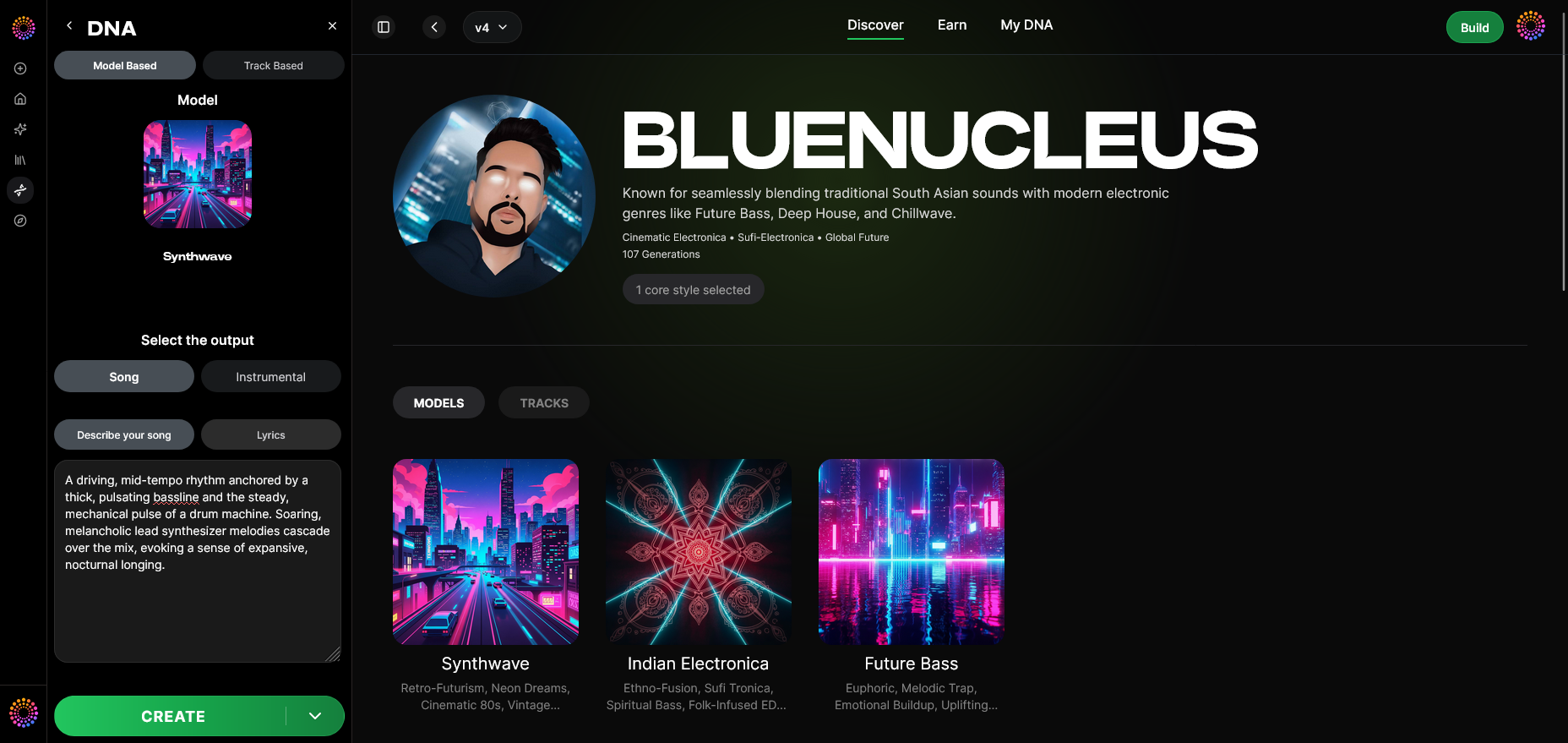
Soundverse DNA stands out in this challenge through its ethical and artist-centric approach. Instead of scraping unauthorized recordings, Soundverse trains its DNA models on licensed catalogs, preserving authenticity and monetization rights.
Soundverse DNA allows creators to build “sonic identities”—unique models replicating specific artist styles legally. Musicians can generate jazz-based tracks by licensing a professional’s DNA through the DNA Marketplace, ensuring both creative freedom and consent.
Core Capabilities Supporting Jazz Artists:
- Full DNA for entire jazz compositions and instrumentals.
- Voice DNA that captures distinct timbre and performance nuances.
- Sensitivity Selector that lets users cluster jazz datasets by eras—bebop, fusion, smooth jazz, etc.
- Private Mode ensuring secure co-creation sessions where musician and AI collaborate privately.
By generating consistent style-matched tracks, Soundverse DNA supports everything from film scoring to academic research. Musicians can use it to study improvisational phrasing within ethical frameworks.
Soundverse also interfaces with complementary platforms such as the AI Music Generator, offering full instrumental production, and Soundverse Trace for attribution tracking. These systems form part of the Ethical AI Music Framework ensuring transparency.
In this environment, AI jazz improvisation may not yet replicate the fluidity of live performance, but tools like Soundverse DNA ensure that every generated riff aligns with artist ethics and sonic precision.
Experience the Future of AI Jazz Creation
Unlock your creativity with Soundverse — generate dynamic jazz-inspired tracks, experiment with rhythms, and push the boundaries of AI improvisation. Step into the next era of intelligent music-making today.
Start Creating with Soundverse
Related Articles
- How to Create Jazz Music with Soundverse AI: Discover how Soundverse empowers you to compose smooth, authentic jazz pieces using AI tools designed for musical creativity.
- AI Music Generator and Human Composers: A Future Together: Explore the evolving collaboration between AI-driven composition and human creativity shaping the future of music.
- How an AI Music Generator Inspires Creative Fusion: Learn how AI tools inspire new genre-blending styles and ignite innovative approaches to music-making.
- The Role of AI Music in Film and Television: Understand how AI composition is reshaping scoring and soundtrack creation for visual media.
Here's how to make AI Music with Soundverse
Video Guide
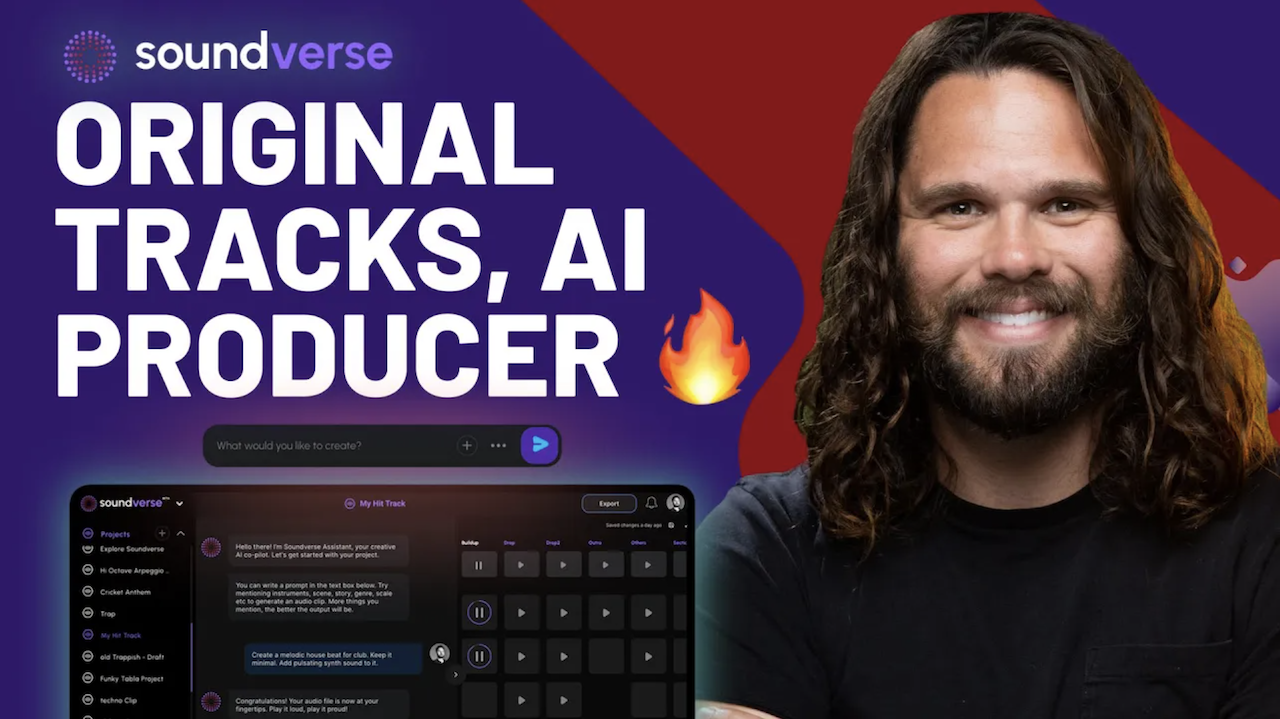
Here’s another long walkthrough of how to use Soundverse AI.
Text Guide
- To know more about AI Magic Tools, check here.
- To know more about Soundverse Assistant, check here.
- To know more about Arrangement Studio, check here.
Soundverse is an AI Assistant that allows content creators and music makers to create original content in a flash using Generative AI. With the help of Soundverse Assistant and AI Magic Tools, our users get an unfair advantage over other creators to create audio and music content quickly, easily and cheaply. Soundverse Assistant is your ultimate music companion. You simply speak to the assistant to get your stuff done. The more you speak to it, the more it starts understanding you and your goals. AI Magic Tools help convert your creative dreams into tangible music and audio. Use AI Magic Tools such as text to music, stem separation, or lyrics generation to realise your content dreams faster. Soundverse is here to take music production to the next level. We're not just a digital audio workstation (DAW) competing with Ableton or Logic, we're building a completely new paradigm of easy and conversational content creation.
TikTok: https://www.tiktok.com/@soundverse.ai
Twitter: https://twitter.com/soundverse_ai
Instagram: https://www.instagram.com/soundverse.ai
LinkedIn: https://www.linkedin.com/company/soundverseai
YouTube: https://www.youtube.com/@SoundverseAI
Facebook: https://www.facebook.com/profile.php?id=100095674445607
Join Soundverse for Free and make Viral AI Music

We are constantly building more product experiences. Keep checking our Blog to stay updated about them!