How to Detect If Music Is AI-Generated: A Complete Guide for 2026
Learn how to detect AI-generated music in 2026 using Soundverse Trace for accurate audio attribution and verification.
How to Detect If Music Is AI-Generated
In 2026, AI-generated music is everywhere—from viral TikTok tracks to background scores in films and podcasts. The ability to generate lifelike compositions using text-to-music prompts has accelerated the creative process, opening new possibilities for creators worldwide. However, with this explosion of AI-produced audio comes a pressing challenge: identifying which tracks are truly human-made and which have been synthesized by machines. This is where AI-generated music detection has become crucial for musicians, audio engineers, content creators, and enthusiasts seeking authenticity and proper rights attribution.
Why detecting AI-generated music matters in 2026
The boundary between human creativity and machine algorithms has never been thinner. AI music systems are now capable of mimicking complex emotional structures, layered instrumentation, and even stylistic nuances of well-known artists. The result? A global concern about originality, copyright safety, and ethical distribution.
For professionals in the music industry, AI music detection goes beyond curiosity—it’s essential for protecting rights and maintaining transparency. With more creators relying on tools like Soundverse and other AI music generators, we need advanced technologies to verify provenance, ensure ethical attribution, and prevent copyright infringement.

What makes AI-generated songs sound different?
The ability to identify AI songs often comes down to subtle sonic patterns and compositional logic. Here are a few traits that set machine-generated tracks apart:
- Predictable structures: AI models often follow symmetry-based algorithms, resulting in overly balanced chord progressions and rhythmic patterns.
- Emotional uniformity: Unlike human performance, which varies in emotion and dynamic flow, AI compositions can feel static despite technical precision.
- Transition inaccuracies: You might notice abrupt transitions or unnatural tonal shifts—signs of algorithmic blending.
- Pitch-perfect performances: Since AI models generate samples mathematically, the output might sound too clean or mechanically timed.
These indications, however, are not foolproof. Human composers can use AI tools for partial production, creating hybrid tracks that combine generated and organic elements. Detecting such nuances requires deeper technical analysis.

How does AI audio analysis work?
AI audio analysis involves examining the fingerprint of sound at both spectral and temporal levels. Detection systems compare waveform patterns, spectral signatures, and metadata to detect traces of AI generation. Methods include:
- Spectral decomposition: Identifying synthetic textures created by neural vocoders or diffusion models.
- Meta-tag validation: Tracking embedded metadata and export tags that show origin or tool usage.
- Dataset overlap scanning: Checking whether samples correspond to known AI training sets.
Professional detection relies on high-precision scanning algorithms rather than mere auditory perception. The goal is to establish verifiable data attribution and confirm whether a piece originated from an AI training model or a human source.
For a deeper dive, watch our guide on creating Deep House music or learn more from the Soundverse Tutorial Series on making music.
How to detect if music is AI-generated using Soundverse Trace
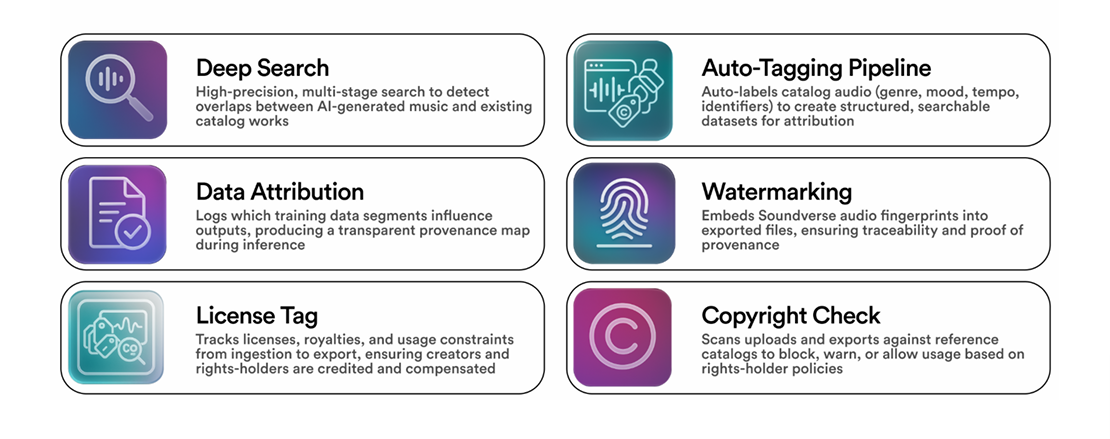
One of the most accurate technologies available in 2026 for AI-generated music detection is Soundverse Trace. Built as a trust layer for AI music, Soundverse Trace offers comprehensive tools that make verifying audio authenticity seamless.
Soundverse Trace Overview
Soundverse Trace embeds attribution, search, and rights protection into every stage of music creation—from dataset ingestion to final export. It serves musicians, rights holders, and platforms that need transparent verification.
Core capabilities include:
- Deep Search: High-precision scanning to detect 1:1 (exact copies) and 1:N (partial overlaps) matches across large audio datasets.
- Data Attribution: Logs which training data influenced each output, creating an auditable trail of creative input.
- Audio Watermarking: Embeds inaudible, robust fingerprints that remain intact through common audio transformations.
- License Tagging: Preserves rights metadata through every stage of creation, ensuring track provenance and perfect attribution.
Primary use cases:
- Preventing copyright infringement in AI outputs.
- Tracking catalog usage for royalty management.
- Verifying provenance of AI-generated music.
- Automating takedown or payout processes for rights-holders.
By using Soundverse Trace, creators and labels can analyze submitted tracks to confirm whether an audio file originated from AI systems or human production environments.
Step 1: Upload the Audio File for Verification
The process begins by uploading your track into Soundverse’s analysis environment. You can submit WAV, MP3, or AIFF formats for asynchronous scanning. Once uploaded, Soundverse Trace starts analyzing structure, watermark presence, and metadata for potential AI involvement.
Step 2: Initiate Deep Search
Soundverse Trace uses its Deep Search engine to perform high-precision scans against known music catalogs and AI datasets. It identifies any overlap or matching fingerprint linked to pre-trained AI generation models.
Step 3: Review Attribution Logs
Next, the system presents detailed Data Attribution logs, showing if your track has any influences from AI training data. This transparency helps determine whether the composition was machine-produced or human-originated.
Step 4: Validate Rights Metadata
Soundverse Trace performs License Tagging validation, checking for metadata continuity. Genuine human compositions typically have metadata traces from production software, instruments, or studio records. AI tracks usually contain generic tags or synthetic markers.
Step 5: Analyze Audio Watermark Results
Finally, the system displays watermark verification data. Soundverse’s Audio Watermarking identifies inaudible fingerprints embedded during AI generation—helping confirm provenance without altering the song’s sound.
Step 6: Download or Share the Verification Report
The tool produces a downloadable verification report summarizing attribution, watermark presence, and confidence levels. Creators can use these reports as evidence for copyright registration or digital distribution compliance.
Pro Tips for more accurate AI music detection
- Always check metadata consistency: AI tools may produce generic or missing metadata—an early signal of machine production.
- Compare with previous versions: Evaluating multiple takes or drafts helps spot AI-generated edits.
- Use stem analysis: With Soundverse’s Stem Separator, isolate components such as vocals or drums to detect tonal cloning or robotic mixing.
- Cross-reference results: Combine Soundverse Trace’s findings with independent waveform or dataset analyses for higher credibility.
- Follow ethical AI verification frameworks: Explore the Ethical AI Music Framework for transparent attribution standards.
The rise of AI audio integrity standards in 2026
In response to copyright concerns between 2024 and 2025, global organizations have formalized AI music auditing standards. These frameworks ensure datasets are documented and output attribution is preserved across all platforms. As a result, AI audio analysis technologies like Soundverse Trace are now integrated into digital music marketplaces.
If you regularly create AI music or distribute content online, review how AI-generated music is transforming the industry and consider adopting transparent tagging systems.
Start Detecting AI-Generated Music Now
Empower yourself with Soundverse’s advanced AI tools to analyze, detect, and create music authentically. Discover how technology can elevate your sound design and safeguard originality.
Try Soundverse Free
Related Articles
- How AI-Generated Music Is Transforming the Music Industry — Explore how AI composition tools are revolutionizing production, creativity, and copyright perspectives across today’s music landscape.
- What AI Can Generate Songs — Learn which AI platforms and algorithms can create high-quality songs—and how they stack up to human creativity.
- The Role of AI Music in Film and Television — Discover how artificial intelligence is transforming soundtrack creation for movie producers and content creators.
- AI Music Generator and Human Composers: A Future Together — Uncover how artists and AI can collaborate to produce emotionally resonant and imaginative music compositions.
Here's how to make AI Music with Soundverse
Video Guide
Here’s another long walkthrough of how to use Soundverse AI.
Text Guide
- To know more about AI Magic Tools, check here.
- To know more about Soundverse Assistant, check here.
- To know more about Arrangement Studio, check here.
Soundverse is an AI Assistant that allows content creators and music makers to create original content in a flash using Generative AI. With the help of Soundverse Assistant and AI Magic Tools, our users get an unfair advantage over other creators to create audio and music content quickly, easily and cheaply. Soundverse Assistant is your ultimate music companion. You simply speak to the assistant to get your stuff done. The more you speak to it, the more it starts understanding you and your goals. AI Magic Tools help convert your creative dreams into tangible music and audio. Use AI Magic Tools such as text to music, stem separation, or lyrics generation to realise your content dreams faster. Soundverse is here to take music production to the next level. We're not just a digital audio workstation (DAW) competing with Ableton or Logic, we're building a completely new paradigm of easy and conversational content creation.
TikTok: https://www.tiktok.com/@soundverse.ai
Twitter: https://twitter.com/soundverse_ai
Instagram: https://www.instagram.com/soundverse.ai
LinkedIn: https://www.linkedin.com/company/soundverseai
Youtube: https://www.youtube.com/@SoundverseAI
Facebook: https://www.facebook.com/profile.php?id=100095674445607
Join Soundverse for Free and make Viral AI Music

We are constantly building more product experiences. Keep checking our Blog to stay updated about them!