How AI Music Can Be Used Safely Across Multiple Platforms
Learn AI music safety across platforms with Soundverse Trace to protect rights & ensure compliance.
How AI Music Can Be Used Safely Across Multiple Platforms
The rise of AI-generated music has completely reshaped how musicians, content creators, and media managers produce and share their sound projects. By 2026, AI in music production has matured into a global ecosystem where creators can generate immersive tracks, symbolic soundscapes, and genre-bending compositions with ease. But with convenience comes responsibility—specifically, ensuring AI music safety. Without proper safeguards, creators risk copyright infringement, improper licensing, and platform takedowns. This blog explores comprehensive strategies for maintaining AI music safety across multiple platforms, highlighting how Soundverse Trace makes compliant distribution effortless.
Why is AI Music Safety Crucial in 2026?
AI-generated music is no longer an experimental novelty. Streaming platforms, social media applications, and virtual reality environments all host millions of AI-enhanced compositions. However, without standardized attribution and data protection, creators risk unintentionally violating the rights of human musicians whose material may have influenced training datasets. As regulators worldwide introduce more stringent copyright compliance rules—especially following legislative trends from 2025—AI music safety ensures longevity and integrity in digital production.
Safe music distribution means every AI composition has clear, traceable origins and rights metadata embedded from generation to publication. For producers and artists, the question isn't whether to use AI music—it's how to distribute and monetize it safely.

What Are Common Risks in Cross-Platform Music Licensing?
Music copyright compliance is complex even for traditional compositions, but AI-generated music introduces unique challenges such as:
- Dataset Ambiguity – If an AI training model used copyrighted material without consent, the generated audio might replicate recognizable harmonies or timbres.
- Attribution Loss – Many AI systems overlook original dataset contributors, creating ethical and legal ambiguity.
- Metadata Decay – When music is uploaded to multiple platforms, licensing metadata may become stripped or corrupted.
- Automatic Content ID Collisions – Streaming services can mistakenly flag AI-generated songs as infringing due to similarities with existing tracks.
- Fragmented Licensing Agreements – Different platforms require varying royalty structures and licensing disclosures.
Maintaining safe music distribution means addressing these points with transparent technical solutions.

How Can Creators Ensure AI Music Safety in Production?
The best strategy is embedding integrity into every step of the content pipeline—from creation to export. In 2026, music creators adopt ethical AI frameworks that guarantee original dataset contributors receive recurring royalty compensation. Many creators leverage systems such as the Ethical AI Music Framework, which introduces attribution transparency across all training stages. By pairing ethical data ingestion with robust algorithmic tracing, you protect your AI-generated tracks from future legal disputes.
When preparing music for upload, ensure all AI sound passages come with fully attributed dataset logs. Platforms like Soundverse already integrate compliance-first design philosophy, allowing seamless transfer and protection of metadata across ecosystems.
To explore further applications of generative sound design, consider reading How AI-generated music is transforming the music industry or AI Music in the USA for deeper insight into evolving legal frameworks.
How to Maintain Compliance When Distributing AI-Generated Music
Compliance extends beyond audio creation—it’s equally critical during publication. Whether you're distributing tracks to Spotify, YouTube, TikTok, or emerging Web3 music ecosystems, standardized audit trails of dataset attribution help prove originality and ownership. Embedding licensing details inside your exports makes enforcement straightforward if disputes arise.
Musicians increasingly combine tools like Soundverse’s suite with mechanical rights organizations to sync audio fingerprints across multiple content catalogs. Accurate attribution strengthens both brand credibility and monetization pathways. As creators explore innovative genres—like Lo-Fi, Ambient, or even hybrid Jazz AI compositions—they’re expected to maintain transparent copyright compliance.
For creative inspiration, read How to create Jazz Music with Soundverse AI or Creating a Faceless Valentine’s Day Video Message with Free AI Tools. For a deeper dive, watch our guide on creating Deep House music or how to make music on Soundverse to learn safe creative approaches.
How to Ensure Safe Music Distribution Across Multiple Platforms
AI music safety in 2026 revolves around embedding secure identifiers into each audio file. Safe distribution requires:
- Persistent Rights Metadata – Clear license tagging prevents accidental detachment when sharing.
- Automated Attribution Logs – Provenance verification ensures transparent data lineage.
- Audio Fingerprinting – Protects your AI tracks against unauthorized republishing or plagiarism.
When managing multi-platform distribution, integrate verification checkpoints using AI watermarking systems. These retain ownership information, making it easier for platforms to verify legitimate uploads and protect rights-holders. This approach has been outlined further in How AI Music Is Reviewed by YouTube, Meta, and TikTok.
How to Make Secure Cross-Platform AI Music with Soundverse Trace
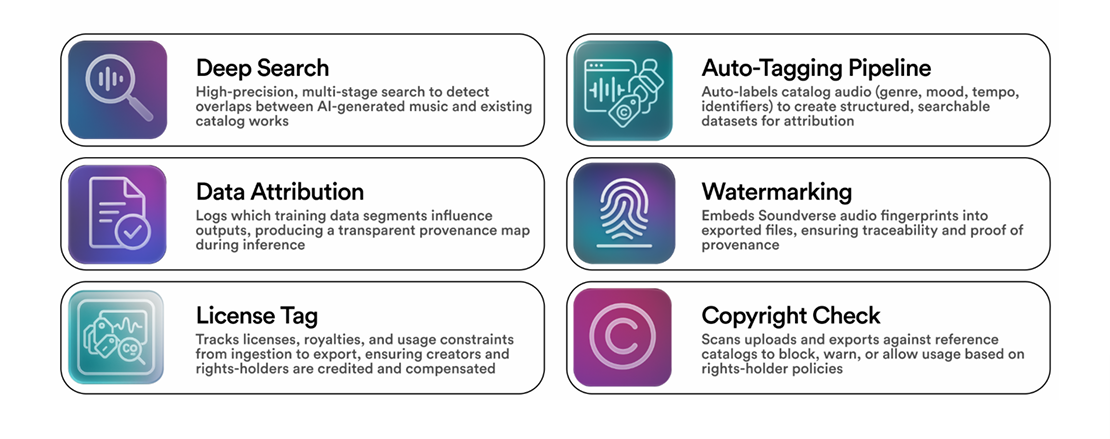
Soundverse Trace introduces a revolutionary trust layer for AI music safety. It functions as the invisible infrastructure ensuring your compositions remain compliant and fully traceable throughout their lifecycle. Its precision-targeted core capabilities include:
- Deep Search: A high-accuracy scanning system that detects overlaps across your dataset or audio exports through 1:1 or 1:N matching. It determines whether generated melodies overlap with existing catalog entries.
- Data Attribution: Soundverse Trace records which training datasets influenced your AI output, maintaining ethical credit and enabling royalty payouts.
- Audio Watermarking: It embeds inaudible, robust fingerprints in every exported file, ensuring ownership verification across every platform.
- License Tagging: Preserves rights metadata from ingestion to final export to ensure cross-platform integrity and copyright transparency.
This system builds on insights from How Music Companies Target Distribution Platforms in 2026 and A Practical Guide to AI Music Licensing for Startups and SaaS Teams, showing how attribution and metadata protection work together.
Creators can use Soundverse Trace as a built-in layer within Soundverse’s production ecosystem or attached to external distribution workflows. The system facilitates automated royalty tracking, legitimate takedowns, and transparent licensing management—critical steps toward reliable music copyright compliance.
To understand Soundverse’s broader creative capacity, explore Soundverse Introduces Stem Separation AI Magic Tool or Generate AI Music with Soundverse Text-to-Music to see how it integrates modern safety solutions seamlessly into musical innovation.
How Does the Ethical AI Music Framework Complement Soundverse Trace?
The Ethical AI Music Framework underpins the transparency model Soundverse Trace operates on. It replaces traditional black-box generation approaches with a six-stage pipeline that ensures all datasets used in AI generation are consent-based. When rights-holders opt into this system, they join the Content Partner Program, an initiative providing recurring, usage-based royalties determined through attribution tracking.
This approach aligns with research from Why Major Labels Are Buying Distribution Companies in 2026 and The Role of Human Curation in High-Quality AI Music Platforms, confirming that transparency and human oversight ensure ethical scalability in AI music creation.
For producers developing large content catalogs, integrating both frameworks constructs a full-chain rights protection mechanism—ethical ingestion, traceable processing, and verified export. By 2026, these two tools serve as industry standards defining responsible AI in music production.
What Are the Best Practices for AI Music Safety Going Forward?
To maintain lawful and ethical consistency, consider these guidelines:
- Always use platforms that disclose dataset sources and maintain licensing metadata.
- Embed persistent fingerprinting (watermarking) in your generated audio.
- Conduct copyright audits before distributing to commercial streaming platforms.
- Opt into transparent training frameworks that compensate rights-holders.
- Maintain proper documentation of each project’s AI origin, dataset linkage, and exported metadata.
In an era when cross-platform publishing blends traditional music architecture with generative innovation, these measures protect your work and ensure music copyright compliance.
Create Safe, Original Music with Soundverse AI
Generate royalty-free, copyright-safe tracks for social media, games, films, and more. Soundverse ensures every piece of AI music you create is legally sound and ready to share anywhere.
Start Creating Secure AI Music
Related Articles
- Copyright-Free vs Royalty-Free Music: What Creators Should Know — Understand the difference between copyright-free and royalty-free music so you can publish with confidence and avoid copyright strikes.
- Enhancing YouTube Content with Royalty-Free and Copyright-Free Music Using Soundverse AI — Learn how to safely enhance YouTube videos with AI-generated, copyright-safe music from Soundverse.
- Navigating the World of Royalty-Free and Copyright-Free Music Using Soundverse AI — Discover how Soundverse helps content creators use AI-generated music responsibly across video, podcast, and social platforms.
- The Role of AI Music in Film and Television — Explore how AI music tools are safely revolutionizing soundtrack production for film and TV without copyright worries.
Here's how to make AI Music with Soundverse
Video Guide

Here’s another long walkthrough of how to use Soundverse AI.
Text Guide
- To know more about AI Magic Tools, check here.
- To know more about Soundverse Assistant, check here.
- To know more about Arrangement Studio, check here.
Soundverse is an AI Assistant that allows content creators and music makers to create original content in a flash using Generative AI. With the help of Soundverse Assistant and AI Magic Tools, our users get an unfair advantage over other creators to create audio and music content quickly, easily and cheaply. Soundverse Assistant is your ultimate music companion. You simply speak to the assistant to get your stuff done. The more you speak to it, the more it starts understanding you and your goals. AI Magic Tools help convert your creative dreams into tangible music and audio. Use AI Magic Tools such as text to music, stem separation, or lyrics generation to realise your content dreams faster. Soundverse is here to take music production to the next level. We're not just a digital audio workstation (DAW) competing with Ableton or Logic, we're building a completely new paradigm of easy and conversational content creation.
TikTok: https://www.tiktok.com/@soundverse.ai
Twitter: https://twitter.com/soundverse_ai
Instagram: https://www.instagram.com/soundverse.ai
LinkedIn: https://www.linkedin.com/company/soundverseai
Youtube: https://www.youtube.com/@SoundverseAI
Facebook: https://www.facebook.com/profile.php?id=100095674445607
Join Soundverse for Free and make Viral AI Music
 We are constantly building more product experiences. Keep checking our Blog to stay updated about them!