AI Music for VR Experiences: How Artificial Intelligence is Redefining Immersive Audio in 2026
Explore how AI music for VR enhances immersive audio and 3D sound experiences in 2026.
AI Music for VR Experiences
Artificial intelligence has reached a point where it’s no longer just generating art or assisting in writing—it’s composing music that fully adapts to digital worlds. As VR continues its explosive growth in 2026, developers and creators are turning to AI music for VR to power the next generation of immersive audio experiences. This combination of machine learning and virtual reality sound design is redefining what users expect from digital presence, emotion, and interactivity.
Why is AI Music Transforming VR Experiences in 2026?
The synergy between artificial intelligence and virtual reality is reshaping entertainment, education, and enterprise. With more powerful headsets and 3D audio technology, users are demanding soundscapes that react dynamically to their movements and decisions. Traditional soundtrack production methods simply cannot keep up with the real-time personalization VR promises.

AI-generated soundtracks are meeting that demand by using algorithms trained on vast music datasets to automatically compose instrumental pieces that match specific moods, genres, or even narrative contexts. Whether in a cyberpunk racing simulation, a tranquil meditation world, or an interactive educational environment, AI music for VR ensures every listener experiences an adaptive and emotionally aligned sound world.
What Makes Immersive Audio Crucial in Virtual Reality?
In VR environments, sound isn’t just an accessory—it’s a vital sensory cue that guides spatial awareness and emotional immersion. Immersive audio involves capturing how we perceive sound direction, distance, and movement. The result is a three-dimensional sound field that moves with the user.
By 2026, major VR platforms like Meta Quest, Sony’s PSVR 3, and Apple Vision Pro 2 have fully adopted 3D audio technology to elevate their realism. Developers can now embed sound objects within spatial coordinates, meaning a buzzing drone behind the user will actually sound as if it’s hovering near their shoulder.
When this is paired with AI music systems, the sound environment can change fluidly. For instance, AI-driven adaptive scoring can subtly shift intensity as the player approaches a new environment or achieves an objective. Rather than static tracks, these soundscapes breathe and evolve. For creators interested in immersive soundscapes, check out the 2026 6th International Conference on Audio for Virtual and Augmented Reality and Immersive Games.
How Does Virtual Reality Sound Design Benefit from AI-Based Tools?
Traditional sound design demands extensive manual mixing, looping, and layering. AI dramatically accelerates that process. By analyzing VR scene data—like lighting cues, physics triggers, or story pacing—AI can propose or even auto-compose complementary soundscapes. This helps developers spend less time editing and more time crafting user experiences.
AI also supports procedural generation, meaning the same soundscape will never play twice in the exact same way. This feature has become central to interactive music experiences across games and cinematic VR productions. The result: a more organic, lifelike world for the player.
Moreover, because AI tools can automatically loop and adjust tempo or intensity, they are particularly useful for extended VR sessions, meditation experiences, or rhythm-based game modes where seamless audio repetition is needed. For a deeper dive, watch our guide on creating Deep House music.
What Are the Advantages of AI-Generated Soundtracks for VR Developers?
For audio engineers and VR creators, the biggest challenge has always been balancing creative control with scalability. AI-generated soundtracks deliver on both fronts. Key benefits include:
- Speed of Production: Instead of weeks spent scoring multiple environments, AI can generate unique background soundtracks in minutes.
- Cost Efficiency: Artists can focus on creative decision-making while AI handles the routine aspects of production.
- Interactivity: AI systems can be integrated into VR engines, allowing music to react dynamically to user interactions or movement.
- Consistency: AI ensures stylistic consistency across multiple levels or scenes.
- Customization: Developers can fine-tune soundtracks according to specific emotional tones, genres, or cultures—all through text-based descriptions.
As this technology matures in 2026, the convergence of procedural design, neural music models, and immersive storytelling is producing sound environments that feel alive. For comparison, see the Best AI Music Generators in 2026: Create Professional Audio with AI.
How Are Interactive Music Experiences Evolving Through AI?
Interactive music experiences are at the heart of the VR revolution. Unlike linear media, where the soundtrack is fixed, VR compositions can respond fluidly to the environment. Imagine walking through an ancient temple and the AI soundtrack subtly morphs from mystery to triumph as you discover hidden relics. Such adaptivity is made possible through AI systems that use VR event triggers and user telemetry to switch motifs, tempos, or tonalities.
This kind of AI adaptive scoring is not limited to gaming. Virtual art installations, digital concerts, and even mindfulness applications are now using intelligent composition networks to transform passive listening into a participatory sonic journey. The systems can adjust the music’s emotional register based on biometric data or user focus—an innovation most recently adopted in wellness-focused metaverse platforms. Learn more about such applications in CEEK | Your AI-Copilot to Earn, Create, and Connect to the Best Virtual Concerts.
How AI Music Supports 3D Audio Technology Advancements
3D audio means that sound can be experienced in three dimensions around a listener. Recent progress in head-related transfer function (HRTF) modeling and spatial rendering has allowed for precision placement of sound objects. AI contributes by predicting optimal spatial arrangements and creating harmonic layers that suit those positions.
VR creators can now pair AI-generated backing tracks with real-time object sounds mixed dynamically in 360 degrees. Combined, these technologies invent a hybrid future where every sound feels personal and alive.
AI is also simplifying what used to be complex engineering work. By guiding automatic balancing of ambient layers and reinforcement of transitions, AI ensures that the virtual world sounds coherent regardless of user paths. The result: a more immersive, emotionally cohesive environment.
One of the most exciting implementations is seen in collaborative virtual concerts, where AI music systems adjust reverb, tempo, and harmonic emphasis for each participant’s virtual position—something impossible through manual mixing alone.
How to Make AI Music for VR Experiences with Soundverse AI Music Generator
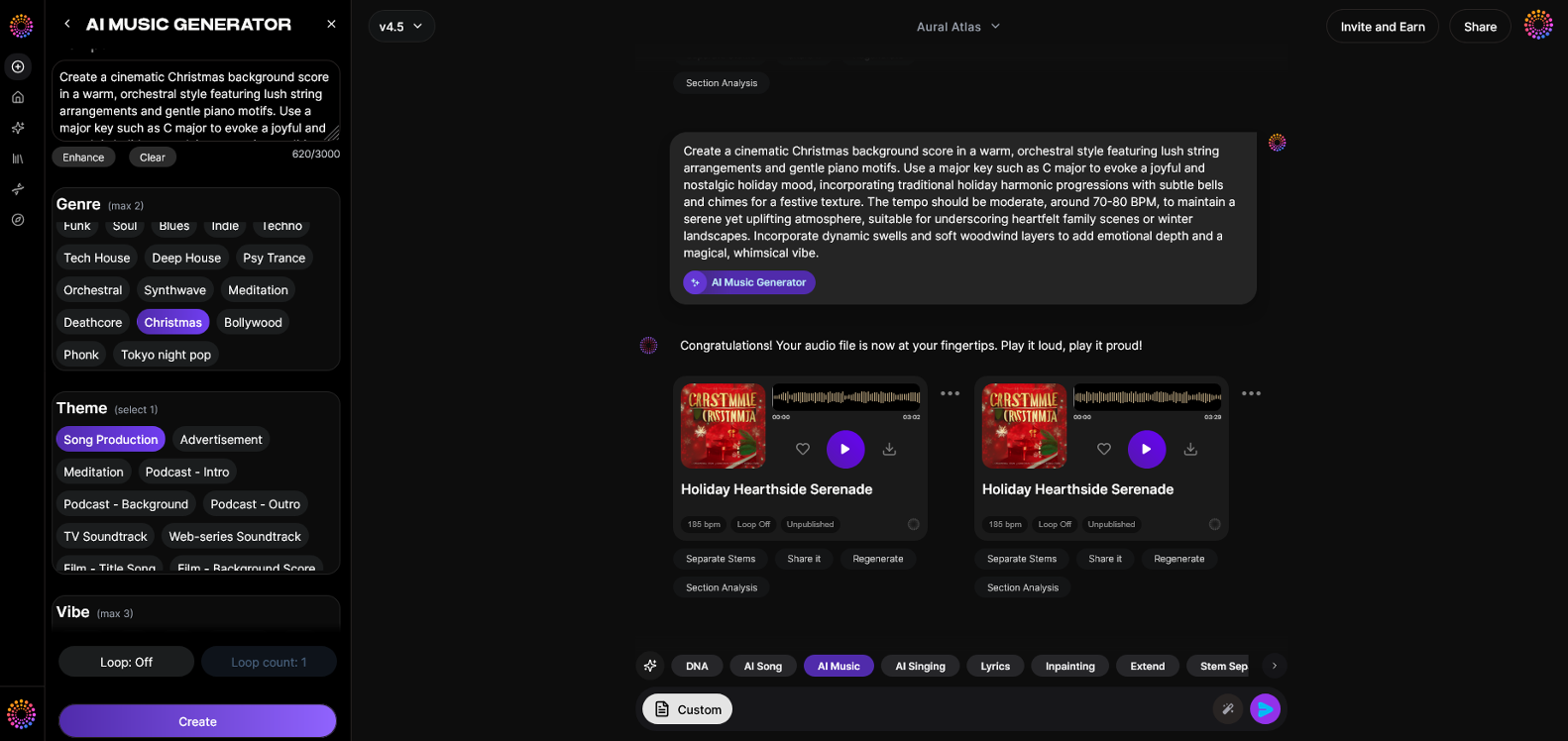
Soundverse’s AI Music Generator is purpose-built for creators who want professional-quality instrumental soundtracks tailored for immersive experiences—all without complex DAWs or excessive manual mixing.
Official Description: The AI Music Generator creates fully produced instrumental music from text prompts. It specializes in background tracks, beats, and soundscapes without vocals, offering Loop Mode for seamless repetitions. Users can control genres, instrumentation, and mood while choosing between V4 and V5 generation models.
Developers can type prompts like “futuristic underwater ambience with calm rhythmic pulses” or “high-tempo synthwave combat sequence.” The system then composes a polished, loopable soundtrack ready to integrate into a VR engine or sound middleware. Explore related insights in How to Make Music for AR Projection Experiences in 2026.
Core capabilities include:
- Text-to-music generation: Describe your desired soundtrack, and the AI produces it.
- Loop Mode: Perfect for endless VR environments or ambient experiences.
- Advanced control: Adjust genre, emotion, and instrumentation.
- Multiple model options: Choose between V4 and V5 for varying detail levels and stylistic control.
While initially built for video, wellness, and commercial media, this generator is now a go-to resource for VR developers. It aligns seamlessly with the trend toward procedural content generation by offering looping, mood control, and instrumental focus—all crucial for interactive applications.
For creators interested in exploring related tools, Soundverse’s Similar Music Generator allows the creation of compositions inspired by reference tracks. And with Soundverse DNA, artists can license and monetize their unique sonic signatures for compliant AI training. Finally, Extend Music seamlessly lengthens original pieces for adaptive VR scoring.
Practical Applications of AI Music for VR in 2026
The rise of generative music tools is giving developers new creative flexibility across disciplines:
- Gaming & Interactive Storytelling: Dynamic battle or exploration themes can shift as players move between environments.
- Corporate Training & Simulation: AI-generated background music can maintain focus and engagement.
- Virtual Tourism: Soundtracks can emulate cultural authenticity through regional musical patterns.
- Metaverse Events: AI assists DJs and performers in curating personalized mixes responsive to audience presence.
- Health & Wellness Experiences: Adaptive soundscapes enhance meditation and biofeedback loops.
These applications showcase how deeply integrated AI has become in VR development pipelines by 2026.
For deeper insight into generative music’s broader influence on content creation, explore Soundverse’s analysis of AI’s role in the music industry and innovative text-to-music prompt techniques.
Transform Your VR Worlds with AI Music Today
Generate stunning, adaptive music for your virtual experiences in minutes with Soundverse’s powerful AI. Bring emotion, depth, and realism to every scene effortlessly.
Start Creating with Soundverse
Related Articles
- The Role of AI Music in Film and Television: Discover how AI-generated music is reshaping soundtrack creation for cinematic and virtual experiences.
- Soundverse AI Revolutionizing Music Creation for New-Age Content Creators: Explore how Soundverse empowers creators to compose tailored tracks for gaming, VR, and multimedia projects.
- Generate AI Music with Soundverse Text-to-Music: Learn how to turn text prompts into immersive compositions perfect for VR soundscapes and interactive media.
- How an AI Music Generator Inspires Creative Fusion: Understand how AI-powered tools spark creativity and blend genres to enhance your virtual experience design.
Here's how to make AI Music with Soundverse
Video Guide

Here’s another long walkthrough of how to use Soundverse AI.
Text Guide
- To know more about AI Magic Tools, check here.
- To know more about Soundverse Assistant, check here.
- To know more about Arrangement Studio, check here.
Soundverse is an AI Assistant that allows content creators and music makers to create original content in a flash using Generative AI. With the help of Soundverse Assistant and AI Magic Tools, our users get an unfair advantage over other creators to create audio and music content quickly, easily and cheaply. Soundverse Assistant is your ultimate music companion. You simply speak to the assistant to get your stuff done. The more you speak to it, the more it starts understanding you and your goals. AI Magic Tools help convert your creative dreams into tangible music and audio. Use AI Magic Tools such as text to music, stem separation, or lyrics generation to realise your content dreams faster. Soundverse is here to take music production to the next level. We're not just a digital audio workstation (DAW) competing with Ableton or Logic, we're building a completely new paradigm of easy and conversational content creation.
TikTok: https://www.tiktok.com/@soundverse.ai
Twitter: https://twitter.com/soundverse_ai
Instagram: https://www.instagram.com/soundverse.ai
LinkedIn: https://www.linkedin.com/company/soundverseai
Youtube: https://www.youtube.com/@SoundverseAI
Facebook: https://www.facebook.com/profile.php?id=100095674445607
Join Soundverse for Free and make Viral AI Music

We are constantly building more product experiences. Keep checking our Blog to stay updated about them!