AI Music for UX Design: Enhancing Digital Experiences with Intelligent Soundscapes in 2026
Discover how AI music for UX design transforms user experiences through smart soundscapes and AI tools for designers.
AI Music for UX Design
In 2026, the intersection of artificial intelligence and user experience design has become one of the most exciting frontiers for creative professionals. As digital products evolve beyond visuals to become multisensory, the role of sound has grown tremendously. This transformation has given birth to an emerging field known as AI music for UX design — the art of shaping user experience audio with the help of intelligent generative models.
UX designers today are not limited to colors, typography, and motion. They are increasingly curating sonic experiences — short tones that guide actions, subtle loops that ease navigation, or immersive ambient tracks that make applications more emotionally engaging. And the best part? Designers no longer need to be musicians to craft effective audio environments. AI music generation tools now enable effortless creation of personalized, loopable, high-quality soundscapes tailored to specific design contexts.
What is AI Music for UX Design?
AI music for UX design refers to the use of artificial intelligence systems to create soundtracks, interface sounds, and background music that enhance the user experience of digital products. Rather than commissioning composers or relying on pre-made sound libraries, designers can input emotional or functional prompts such as “calm futuristic onboarding ambiance” or “energetic productivity dashboard loop.” The AI then interprets these inputs to generate coherent, mood-appropriate compositions.

This development syncs with broader 2026 design trends emphasizing personalization and emotional resonance. Designers want experiences that feel human yet data-driven. AI-generated background music bridges this gap by dynamically matching tone, pace, and mood to user interactions.
Why is Sound Important in User Experience Design?
Sound is one of the most powerful tools to influence how a user perceives a product. It adds texture, provides feedback, reduces cognitive load, and creates emotional continuity. Here are a few ways sound complements UX design:
- Feedback and Affordance: Audio cues let users know when an action has succeeded or failed — a concept borrowed from tactile interfaces.
- Brand Identity: Consistent sound design, such as custom notification tones or environmental loops, reinforces brand recognition.
- Accessibility: Thoughtfully designed audio can make apps more inclusive by communicating information to users who may not rely primarily on visuals.
- Immersion: Background sound effects or continuous ambient tracks provide atmosphere for immersive interfaces like AR and VR.

As interaction design becomes more adaptive, designers must also ensure sonic consistency across devices and contexts. AI-driven UX sound design offers scalable solutions to manage this complexity.
How Does AI Generate Music for UX Design?
AI relies on trained models that understand patterns in rhythm, harmony, genre, and instrument combinations. These systems are capable of translating textual or visual cues into complete tracks. For example, if a designer inputs: “soothing acoustic loop for meditation app background,” AI will interpret tempo, timbre, and mood and output a short, perfectly loopable track.
This process typically involves several technical layers:
- Prompt Interpretation: The AI converts text into musical vectors representing mood and genre characteristics.
- Composition Synthesis: The model composes original melodies and harmonies rather than remixing existing songs.
- Audio Rendering: The final stage generates realistic instrument sounds and exports them as downloadable audio files.
For a deeper dive, watch our tutorial on making music with AI or explore the “Explore” tab guide to see how designers experiment with generative loops. The advantage here is agility. Designers can experiment with multiple soundscapes in minutes before deciding which best fits the user journey.
What are the Benefits of Using AI-Generated Background Music in UX?
In the past, creating a soundtrack for an app or a website required hiring a composer or purchasing stock audio. Now, AI tools make this process instantaneous and customizable. Key benefits include:
- Speed and Efficiency: No need to wait for lengthy composition cycles.
- Uniqueness: Every generation is original, overcoming the repetition of stock libraries.
- Customization: Control over mood, duration, and intensity ensures harmonization with visual elements.
- Scalability: Ideal for large-scale ecosystems like e-commerce, gaming, or productivity suites that require diverse sound palettes.
Moreover, pairing AI-generated background music with targeted design intent helps craft emotionally intelligent products that adapt to the moment a user spends within the interface.
How to Make AI Music for UX Design with Soundverse AI Music Generator
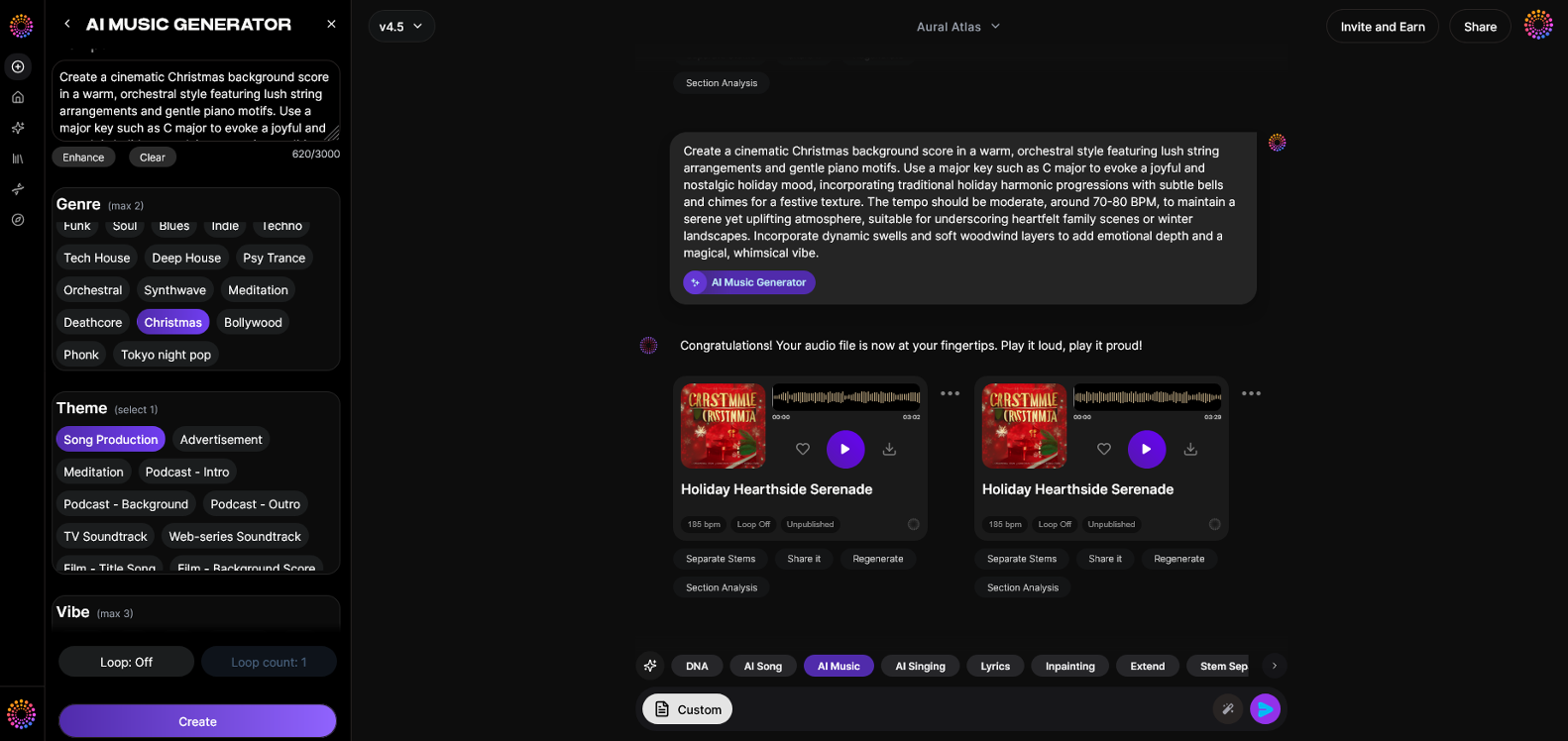
The most comprehensive platform for creators integrating sound into UX workflows is the Soundverse AI Music Generator. It is built for professionals who need well-produced, loop-ready music derived directly from design prompts.
Feature Overview
The AI Music Generator allows you to create fully produced instrumental music directly from text prompts. It specializes in background tracks, beats, and soundscapes without vocals — ideal for interface atmospheres and transitions. With options for seamless looping, precise control over genre, mood, and instruments, and the flexibility of multiple model versions (V4 and V5), Soundverse enables both experimentation and consistency.
Core Capabilities
- Text-to-Music: Transform a textual mood or UX concept into original compositions.
- Loop Mode: Generate seamless loops perfect for applications or dashboard environments.
- Detailed Control: Specify instruments, tempo, or tone to align audio identity with your interface style guide.
- Model Flexibility: Choose between V4 and V5 for varied musical interpretations and sonic detail.
Alongside the AI Music Generator, Soundverse also offers tools that complement creative workflows:
- Similar Music Generator: Generates music inspired by a reference track, perfect for matching brand styles.
- Soundverse DNA: Trains AI on licensed catalogs, ensuring ethical and consistent music creation.
- Agent: A conversational AI assistant that helps automate complex generation workflows from natural language prompts.
If you want to explore how AI fits across music creativity, check out Soundverse’s other insights such as how AI is transforming the music industry or discover practical techniques for creating lofi music with AI.
How Can UX Designers Integrate AI-Generated Audio into Their Design Process?
For designers adopting sonic strategies, integration typically follows these patterns:
- Ideation: Use concept prompts to define moods for onboarding, navigation, or celebration moments.
- Prototyping: Incorporate generated sounds into Figma or Adobe XD prototypes to test engagement.
- Testing: Evaluate whether generated audio improves perception of brand tone or usability.
- Deployment: Once approved, export final loops and embed them in production interfaces.
Soundverse makes this process straightforward because music generation outputs are royalty-free and optimized for repetition, fitting well within UX design systems.
What Trends Define Design Audio AI in 2026?
The 2026 landscape for design audio AI shows several definitive trends:
- Adaptive User Experience Audio: Apps now adapt background tone dynamically based on engagement patterns.
- Personalization at Scale: AI tools personalize auditory experiences for each user cohort.
- Sonic Branding via AI: Startups commission entire brand sound kits using AI’s consistency.
- Cross-Device Immersion: Designers harmonize mobile, AR, and web audio with consistent AI-driven themes.
If you want to compare existing AI tools, see our analysis of Mubert alternatives or discover what makes Soundverse the best AI music generator today.
How Soundverse Empowers Designers with AI Tools for UX Audio
Soundverse stands out because it merges creativity with accessibility. Whether you’re working on a smartwatch interface, a virtual reality installation, or a productivity app, the AI Music Generator enables you to:
- Craft ambient layers that loop seamlessly.
- Design audio concepts faster than traditional production.
- Maintain copyright-safe originality across every project.
- Collaborate between teams using a unified generation platform.
Soundverse’s modular ecosystem, including the Similar Music Generator and Soundverse DNA, ensures that brand consistency is maintained even when multiple designers contribute. The inclusion of Agent, the conversational assistant, further reduces friction, allowing teams to simply describe what they need instead of navigating complex controls.
To learn about related innovations like AI magic tools for accelerating content creation or how AI-generated soundscapes support video production, explore more from the Soundverse blog.
Start Enhancing Your UX with AI-Generated Music
Create personalized soundscapes that amplify your app or website experience. Soundverse helps designers craft seamless, mood-based audio using advanced AI-generation tools in minutes.
- The Role of AI Music in Film and Television — Discover how AI-generated music is reshaping sound design for visual storytelling in movies and TV.
- How an AI Music Generator Inspires Creative Fusion — Learn how AI tools spark innovation and bridge the gap between technology and artistic expression.
- The Benefits of Composing with AI Music Generator — Uncover how AI can streamline your workflow, boost creativity, and bring unique audio elements to life.
- How AI-Generated Music Is Transforming the Music Industry — Explore the ways AI is revolutionizing music creation, production, and digital sound experiences.
Here's how to make AI Music with Soundverse
Video Guide

Here’s another long walkthrough of how to use Soundverse AI.
Text Guide
- To know more about AI Magic Tools, check here.
- To know more about Soundverse Assistant, check here.
- To know more about Arrangement Studio, check here.
Soundverse is an AI Assistant that allows content creators and music makers to create original content in a flash using Generative AI.
With the help of Soundverse Assistant and AI Magic Tools, our users get an unfair advantage over other creators to create audio and music content quickly, easily and cheaply.
Soundverse Assistant is your ultimate music companion. You simply speak to the assistant to get your stuff done. The more you speak to it, the more it starts understanding you and your goals.
AI Magic Tools help convert your creative dreams into tangible music and audio. Use AI Magic Tools such as text to music, stem separation, or lyrics generation to realise your content dreams faster.
Soundverse is here to take music production to the next level. We're not just a digital audio workstation (DAW) competing with Ableton or Logic, we're building a completely new paradigm of easy and conversational content creation.
TikTok: https://www.tiktok.com/@soundverse.ai
Twitter: https://twitter.com/soundverse_ai
Instagram: https://www.instagram.com/soundverse.ai
LinkedIn: https://www.linkedin.com/company/soundverseai
Youtube: https://www.youtube.com/@SoundverseAI
Facebook: https://www.facebook.com/profile.php?id=100095674445607
Join Soundverse for Free and make Viral AI Music

We are constantly building more product experiences. Keep checking our Blog to stay updated about them!