AI Music and Fair Use Explained: What Musicians and Creators Need to Know in 2026
Understand AI music, fair use, and copyright in 2026.
AI Music and Fair Use Explained
In 2026, the conversation around AI music and fair use has become one of the most pressing discussions in both creative and legal circles. As artificial intelligence continues to reshape how music is composed, produced, and distributed, understanding copyright in AI, the limits of fair use, and the frameworks that govern AI-generated songs is essential for creators and professionals alike.
What is AI music, and why does it matter in 2026?
AI music refers to compositions or audio content generated wholly or partly through artificial intelligence models. These systems can analyze huge datasets of existing music to create harmonies, melodies, or even complete tracks. By 2026, platforms such as Soundverse have made AI music generation remarkably accessible—not only to producers but also to content creators and marketers.

The transformative impact of AI music is undeniable. It accelerates production cycles, enables cross-genre experimentation, and provides new monetization pathways. However, it also challenges long-standing norms around intellectual property in music and questions of authorship.
How does fair use apply to AI-generated music?
Fair use allows limited use of copyrighted works without permission for purposes such as commentary, research, or parody. However, when AI systems learn from protected music datasets, determining whether that constitutes fair use has become a complex issue.
In most jurisdictions in 2026, fair use is evaluated using four factors:
- Purpose and character of the use — Whether the use is transformative, adding new expression or meaning.
- Nature of the copyrighted work — Whether the work is creative or factual.
- Amount and substantiality — How much of the original work was used.
- Effect on the market — Whether the use affects the commercial value of the original work.
When an AI analyzes copyrighted songs to generate music, it raises questions: is this transformative, or is it derivative? Courts worldwide are still navigating where to draw the line. Unlike human composers, AI doesn’t interpret; it statistically reproduces patterns. Thus, even if the result isn’t a direct copy, the training process itself can sit in a legal gray area. To explore recent disputes, see Music and AI: 2025's developments that will shape 2026's disputes.
What are the key copyright challenges in AI music?
The core challenge is authorship. Who owns an AI-generated song — the model developer, the user who prompted the AI, or the rights holders of the data used for training?
In 2026, different nations provide different answers. For instance, some territories assign authorship to humans involved in the creative process, while others, like the U.S., have rejected copyright protection for fully autonomous AI outputs (How Copyright Office Guidance Applies to Music That Includes AI-generated Material). This affects music licensing, royalty collection, and even digital distribution platforms that rely on verified ownership data.
A related problem lies in dataset sourcing. If an AI model is trained on copyrighted music without consent, the output may be legally tainted, making it difficult for artists or brands to commercialize the result. This concern is why legally sound frameworks like Soundverse’s Ethical AI Music Framework are now central to compliance strategies. Similar legal principles are emerging globally as highlighted in AI copyright and licensing in 2026 explained.
How do musicians and content creators navigate music licensing for AI-generated songs?
Music licensing governs how songs can be used, distributed, or remixed. When working with AI-generated music, creators must ensure that both the model’s training data and the resulting composition are free from infringement issues.
Current best practices in 2026 include:
- Using licensed AI platforms: Choose platforms that clearly disclose data sourcing and usage rights.
- Reading the fine print: Verify whether generated outputs are royalty-free or subject to shared revenue.
- Maintaining attribution records: Keep metadata of generation prompts, timestamps, and AI tools used.
For creators exploring AI-assisted composition, understanding these nuances can make the difference between innovative production and legal exposure. For a deeper dive, watch our guide on creating Deep House music or learn from our how to make music tutorial.
To see how AI tools empower creators responsibly, check out guides like How to Create Country Music with Soundverse AI or explore trends in AI-generated music transforming the music industry.
How to make AI music responsibly and ethically in 2026?
Creating music with AI doesn’t just require creativity—it requires accountability. Ethical AI music creation is about aligning innovation with consent. That means respecting data rights, ensuring transparency in model training, and embedding proper attribution when distributing songs.
When creators use open or licensed datasets, they help sustain a fair compensation ecosystem. Conversely, relying on unverified sources may inadvertently exploit artists. Thus, ethical creation and fair use principles must go hand in hand. Learn more about future legislation in Dean, Moran Introduce Bipartisan Bill to Protect Creators outlining proposed rights for artists used in AI training.
How to make AI music with Soundverse The Ethical AI Music Framework
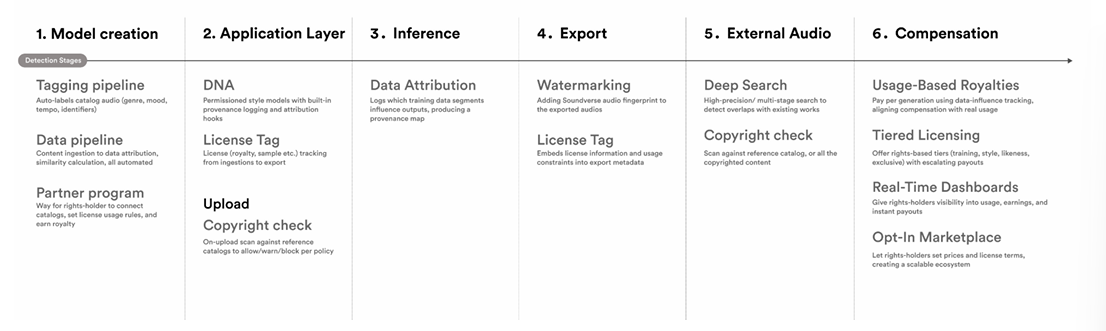
Soundverse bridges technology, ethics, and artistry through The Ethical AI Music Framework: an infrastructure built for transparent, rights-respecting AI generation. Unlike black-box systems, it uses a six-stage pipeline that guarantees open oversight and traceable compliance throughout the entire process.
The Six Core Capabilities
- Stage 1: Licensed Data Sourcing (No scraping) — All data used in training is properly licensed or contributed through the Content Partner Program, ensuring no unauthorized scraping or infringement.
- Stage 2: Permissioned Models (DNA) — Every AI model is trained under strict permission controls, linking back to its data “DNA.”
- Stage 3: Explainable Inference (Attribution) — Soundverse’s inference process provides clear attribution mapping so creators know which sources influenced an output.
- Stage 4: Traceable Export (Watermarking) — AI-generated songs are embedded with watermarking for traceability, ensuring transparency during distribution.
- Stage 5: Deep Search (External Scanning) — This function cross-checks AI outputs against public catalogs to prevent unintended similarity with copyrighted works.
- Stage 6: Recurring Compensation (Partner Program) — Rights-holders receive recurring, use-based royalties whenever their data or styles are utilized.
This structure safeguards both enterprise users and artists. By combining traceability, explainability, and compensation, the framework ensures that AI-generated music aligns with ethical and legal standards. This also extends into blockchain and NFTs, explored in Legal Issues With Selling AI Music as NFTs in 2026.
The Soundverse Trace system complements this approach by embedding attribution and rights data across each project’s lifecycle. Additionally, the Content Partner Program enables rights owners to participate in revenue generation by contributing licensed data for AI training. For technical creators, check out our Explore Tab tutorial showing AI music discovery workflows.
Creators can learn more about multi-tool creative workflows from resources like Soundverse AI Magic Tools: Create Content Quickly With AI and How AI-generated music is transforming content creation.
Why ethical frameworks will define the future of AI music
As regulations evolve through 2026, transparent frameworks like Soundverse’s are setting benchmarks for responsible innovation. Governments are drafting clearer AI copyright guidelines, and organizations are adopting tech platforms that document consent and model lineage.
For musicians and producers, this means greater confidence when using AI-based tools without fearing infringement. For legal professionals, it offers audit trails and verifiable metadata during licensing reviews.
Ultimately, the future of AI music will depend on creating ecosystems that respect human artistry as much as computational creativity. Frameworks that ensure recurring compensation and traceable attribution will define which AI platforms gain industry trust.
Start Creating Music with AI Today
Experience the future of music creation—compose, remix, and produce unique tracks in minutes using Soundverse’s intelligent AI music tools built for creators of all levels.
Generate Your First Track
Related Articles
- How AI-Generated Music Is Transforming the Music Industry — Explore how AI is reshaping the way professionals and hobbyists approach music production and licensing.
- Navigating the World of Royalty-Free and Copyright-Free Music Using Soundverse AI — Learn how to find and use music safely and legally in your creative projects with the help of AI-powered tools.
- Copyright-Free vs. Royalty-Free Music: What Creators Should Know — Understand the key differences between copyright-free and royalty-free music to protect your content and stay compliant.
- The Role of AI Music in Film and Television — Discover how AI-generated tracks are changing the cinematic landscape, from background scores to advertisement jingles.
Here's how to make AI Music with Soundverse
Video Guide

Here’s another long walkthrough of how to use Soundverse AI.
Text Guide
- To know more about AI Magic Tools, check here.
- To know more about Soundverse Assistant, check here.
- To know more about Arrangement Studio, check here.
Soundverse is an AI Assistant that allows content creators and music makers to create original content in a flash using Generative AI.
With the help of Soundverse Assistant and AI Magic Tools, our users get an unfair advantage over other creators to create audio and music content quickly, easily and cheaply.
Soundverse Assistant is your ultimate music companion. You simply speak to the assistant to get your stuff done. The more you speak to it, the more it starts understanding you and your goals.
AI Magic Tools help convert your creative dreams into tangible music and audio. Use AI Magic Tools such as text to music, stem separation, or lyrics generation to realise your content dreams faster.
Soundverse is here to take music production to the next level. We're not just a digital audio workstation (DAW) competing with Ableton or Logic, we're building a completely new paradigm of easy and conversational content creation.
TikTok: https://www.tiktok.com/@soundverse.ai
Twitter: https://twitter.com/soundverse_ai
Instagram: https://www.instagram.com/soundverse.ai
LinkedIn: https://www.linkedin.com/company/soundverseai
Youtube: https://www.youtube.com/@SoundverseAI
Facebook: https://www.facebook.com/profile.php?id=100095674445607
Join Soundverse for Free and make Viral AI Music

We are constantly building more product experiences. Keep checking our Blog to stay updated about them!