Legal Issues With Selling AI Music as NFTs in 2026
Explore AI music NFT legal issues, copyright, and blockchain music law in 2026.
Legal Issues With Selling AI Music as NFTs
In 2026, the intersection of artificial intelligence, music creation, and blockchain assets continues to reshape the digital entertainment landscape. One of the hottest and most controversial topics is the sale of AI-generated music as non-fungible tokens (NFTs). While AI tools have empowered creators to compose tracks in seconds, the complexities of NFT copyright and blockchain music law have introduced new questions about ownership, rights, and accountability.
Why are AI music NFTs facing legal challenges in 2026?
The excitement around AI-generated art, lyrics, and compositions hasn’t subsided since the NFT boom of 2021–2022. However, regulators, artists, and platforms have become much more vigilant about data ethics, source attribution, and fair compensation. When creators mint AI-generated tracks as NFTs, they are commercializing outputs that might contain elements derived from copyrighted works. This raises key legal risks:
- Unclear authorship: Who owns the rights to the track—the user prompt designer, the AI tool developer, or the underlying dataset contributors?
- Dataset legality: Many AI models were trained on copyrighted recordings without clear consent, leading to potential infringement.
- Derivative works: AI outputs that closely resemble original music could be classified as derivative, triggering licensing requirements.
- NFT permanence: Once data is minted on-chain, it’s immutable, amplifying the stakes for any copyright breach.
In 2026, these nuances have intensified, with courts across the US, EU, and parts of Asia issuing precedent-setting rulings establishing that AI models cannot hold copyright themselves. Ownership, therefore, must be traced either to the human prompter or to the creators of the training data—depending on how the tool functions.
What NFT copyright principles apply to AI-generated music?
AI-generated compositions often blend original algorithmic patterns with influences from human-created datasets. Under most copyright systems, creative works require human authorship to receive protection. This means that fully autonomous music generation lacks legal standing as human expression.
However, many musicians now provide structured prompts, style guides, and mix adjustments during the process. These human interventions can grant partial copyright protection if they significantly determine the final composition. Still, the grey area remains vast. The main copyright questions include:
- Can human users claim full ownership if the AI model uses protected training data?
- Are NFT buyers purchasing a legitimate musical work or just a unique digital token?
- How can blockchain metadata prove the originality of an AI track?
These matters directly affect NFT markets on platforms like OpenSea and Sound.xyz, where AI-assisted songs are increasingly traded. For creators interested in the craft itself, watch our guide on creating Deep House music and explore our tutorial on making music using AI.
How is blockchain music law adapting to AI integration?
Blockchain music law has evolved from a peripheral niche into a critical legal category in 2026. Legislators are drafting frameworks that address hybrid works where AI and human inputs coexist. Smart contracts embedded in NFTs now frequently reference creative source data, attribution logs, and usage rights.
This transparency is essential in verifying that track ownership is legitimate. It also helps distinguish between AI-generated ambiance music—often safe for general use—and derivative content that infringes existing sound recordings. Blockchain’s ability to encode these parameters into decentralized ledgers helps ensure accountability. However, it also means that if an AI-generated track violates copyright, the responsibility chain becomes difficult to untangle.
For in-depth insight into how AI music evolves, you can explore how AI-generated music is transforming the music industry or review the music industry trends shaping composition rights in a digital-first era.
What are the key legal risks for creators minting AI music NFTs?
For musicians and NFT artists, understanding the potential legal exposure is critical before selling or licensing AI music. The main risks include:
- Copyright infringement: Using an AI model trained on copyrighted materials without permission can expose creators to claims from rights-holders.
- Misleading provenance: NFT collectors could sue if a minted track is found not to be truly original.
- Loss of royalties: Without proper smart contract design, artists may forfeit recurring revenue from secondary sales.
- Jurisdictional uncertainty: Laws differ widely between countries, making global NFT transactions complex.
- Lack of model transparency: Creators often cannot see the data lineage or attribution map, preventing accurate due diligence.
As we move further into 2026, more NFT platforms and AI generation tools now require documentation proving licensed data sourcing and attribution, serving as a preemptive legal safeguard.
How can artists and producers protect themselves from legal exposure?
While AI tools introduce fascinating possibilities for composition, they also come with compliance responsibilities. Here are proactive measures creators can adopt:
- Use traceable, licensed datasets. Don’t mint content generated from unverified AI models.
- Retain metadata and audit logs. Blockchain may store proof of provenance, but keeping versioned data helps defend against claims.
- Add transparent attribution. Include details about the AI system used, the prompt inputs, and the creative role played by humans.
- Seek professional legal advice. Entertainment lawyers specializing in blockchain music law can review smart contracts and IP terms.
Before choosing an AI tool, artists can also compare frameworks in our resource: Mubert alternatives to learn how compliant data models differ. For more platform insights, you can also explore Soundverse’s “Explore” tab tutorial on YouTube.
How to make legally compliant AI music NFTs with Soundverse The Ethical AI Music Framework
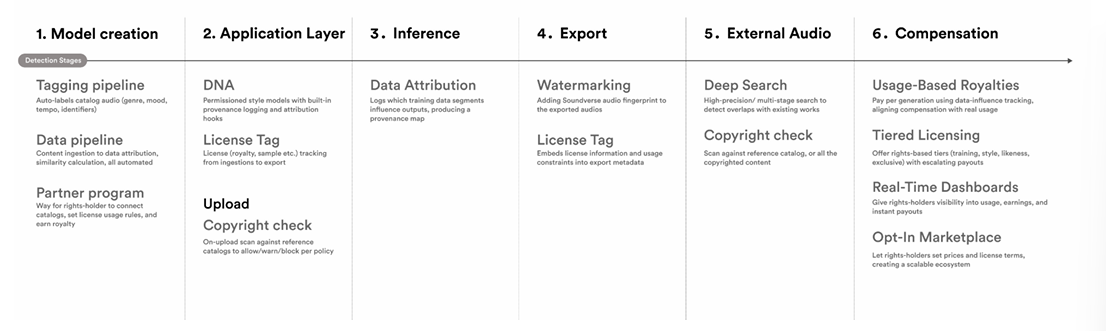
AI music generation doesn’t need to live in a legal gray zone. Soundverse offers an infrastructure designed specifically to bridge innovation and artist integrity: The Ethical AI Music Framework. It’s an end-to-end ecosystem that replaces opaque, black-box AI creation models with transparency, consent, and continuous compensation.
How the Framework Works
- Stage 1: Licensed Data Sourcing (No Scraping) – Every sound and vocal sample originates from licensors or opt-in partners, fully avoiding unauthorized data collection.
- Stage 2: Permissioned Models (DNA) – Models embed digital DNA, ensuring every generation remains tied to its source permissions.
- Stage 3: Explainable Inference (Attribution) – Each output includes auditable lineage, mapping which datasets influenced the results.
- Stage 4: Traceable Export (Watermarking) – All finalized tracks are watermarked on export for downstream identification.
- Stage 5: Deep Search (External Scanning) – AI scanning tools cross-verify whether generated music overlaps existing copyrighted works.
- Stage 6: Recurring Compensation (Partner Program) – Through the Content Partner Program, rights-holders receive royalties when their licensed data contributes to AI outputs.
This six-stage pipeline directly addresses the biggest AI music NFT legal issues—consent, attribution, and monetization. With transparent datasets and traceable exports, creators can confidently sell NFTs backed by verified provenance. Enterprises and independent producers can also join the Soundverse Trace system, which enforces downstream compliance across blockchain transactions.
You can discover additional innovations in tools like Soundverse’s AI Magic Tools, or explore how Soundverse enables custom style generation in articles such as Generate AI Music with Soundverse Text-to-Music.
What’s next for AI music and NFT law?
The future of NFTs and AI music is trending toward standardization. By late 2026, universal metadata standards for AI attribution and blockchain licensing are expected to emerge, driven by organizations such as WIPO and ISO. These efforts will formalize how AI models document provenance, making it easier for artists, lawyers, and collectors to verify legitimacy.
Commercial platforms that adopt verified frameworks like Soundverse’s Ethical AI Music Framework will likely gain a competitive edge by assuring legal compliance and offering sustainable revenue distribution.
Create, Sell, and Protect Your AI Music Today
Join Soundverse to generate original AI music, manage rights effectively, and mint your creations as NFTs without legal headaches. Build your creative brand with confidence using our AI music tools.
Related Articles
- Copyright-Free vs Royalty-Free Music: What Creators Should Know — Learn the difference between copyright-free and royalty-free music before selling or licensing your AI-generated tracks.
- AI Music in the USA — Explore how copyright laws apply to AI-generated music in the United States and what they mean for creators and NFT sellers.
- Navigating the World of Royalty-Free and Copyright-Free Music Using Soundverse AI — Discover how Soundverse AI simplifies music rights for creators producing digital compositions and NFT sound assets.
- How AI-Generated Music Is Transforming the Music Industry — See how AI music generation is reshaping ownership, creativity, and monetization across the digital music landscape.
Here's how to make AI Music with Soundverse
Video Guide
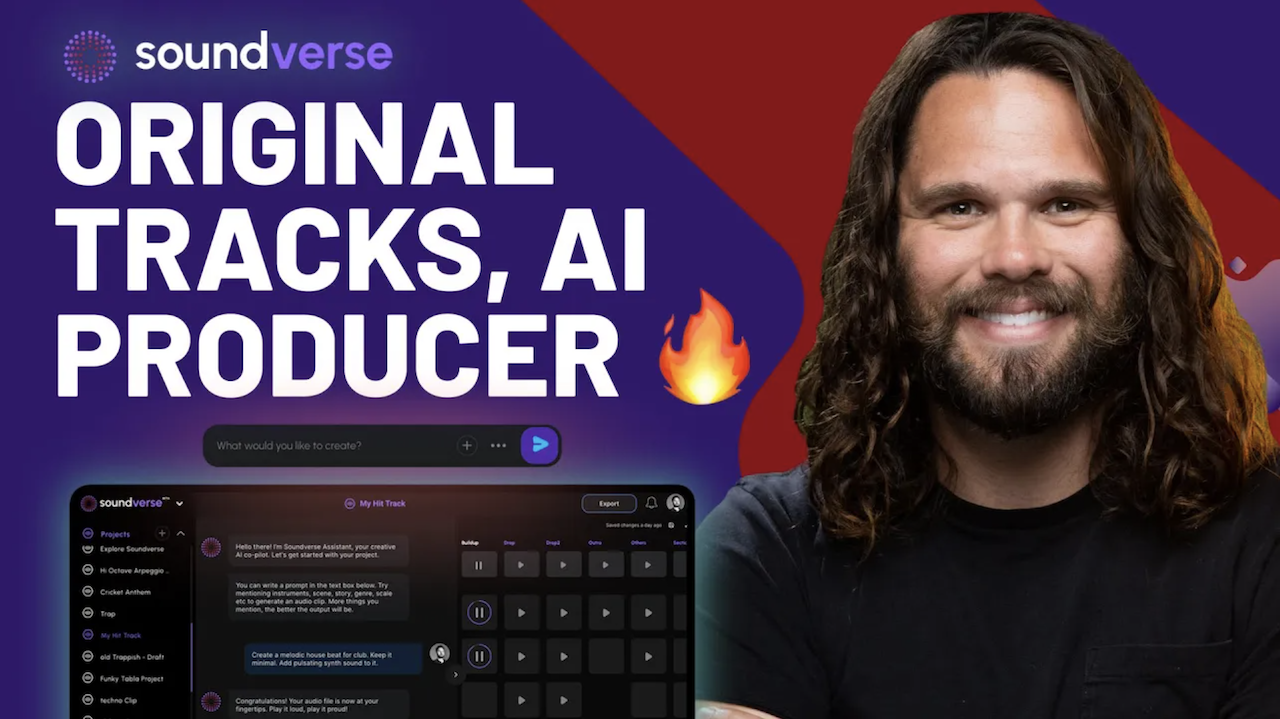
Here’s another long walkthrough of how to use Soundverse AI.
Text Guide
- To know more about AI Magic Tools, check here.
- To know more about Soundverse Assistant, check here.
- To know more about Arrangement Studio, check here.
Soundverse is an AI Assistant that allows content creators and music makers to create original content in a flash using Generative AI. With the help of Soundverse Assistant and AI Magic Tools, our users get an unfair advantage over other creators to create audio and music content quickly, easily and cheaply. Soundverse Assistant is your ultimate music companion. You simply speak to the assistant to get your stuff done. The more you speak to it, the more it starts understanding you and your goals. AI Magic Tools help convert your creative dreams into tangible music and audio. Use AI Magic Tools such as text to music, stem separation, or lyrics generation to realise your content dreams faster. Soundverse is here to take music production to the next level. We're not just a digital audio workstation (DAW) competing with Ableton or Logic, we're building a completely new paradigm of easy and conversational content creation.
TikTok: https://www.tiktok.com/@soundverse.ai
Twitter: https://twitter.com/soundverse_ai
Instagram: https://www.instagram.com/soundverse.ai
LinkedIn: https://www.linkedin.com/company/soundverseai
Youtube: https://www.youtube.com/@SoundverseAI
Facebook: https://www.facebook.com/profile.php?id=100095674445607
Join Soundverse for Free and make Viral AI Music
We are constantly building more product experiences. Keep checking our Blog to stay updated about them!