Why Prompt Quality Matters More Than Models in AI Music Creation
Discover why in 2026, prompt quality drives better AI music creation results than switching models.
Why Prompt Quality Matters More Than Models in AI Music Creation
In 2026, the conversation around AI music creation has matured beyond model comparisons. While early adopters focused on which model—V4, V5, or any competitor’s network—could generate the most realistic or genre-accurate tracks, today’s producers and researchers recognize something profound: model power isn’t everything. The real differentiator lies in prompt quality—how creators communicate their musical intent to the AI.
AI music tools such as Soundverse’s AI Music Generator have democratized access to professional-grade instrumental output. Yet, the variable separating an amateur result from a production-ready track is no longer just the model architecture; it’s the artistry of prompt engineering. Let’s explore why prompt quality dominates 2026’s generative audio landscape, and how you can leverage that understanding for superior AI music production.
What is AI Music Creation and Why Does Prompting Matter?
AI music creation refers to the process of using artificial intelligence to generate original compositions, instrumentals, and soundscapes from text or parameter-based prompts. Using systems trained on vast datasets of musical structures, genre characteristics, and timbral patterns, these tools convert natural language descriptions into professionally structured audio.
In 2024 and 2025, much of the discourse fixated on model evolution—new releases promising better style adaptation or enhanced dynamic range. But in 2026, after several production studies and creator testimonials, it’s become evident that even the most advanced models require human-level prompt precision to shine.
Think of it this way: every prompt acts as a creative script. When you describe your track—such as “an ambient piano soundscape evoking dawn in Kyoto”—you’re not just giving the AI a theme. You’re defining genre, texture, mood, and pacing. The more vivid and structured your description, the more aligned the generated music becomes with your intent.
How do Prompts Shape the Outcome in Generative Music?
Prompt engineering in audio, or prompt engineering audio, serves as the interface between creator imagination and algorithmic interpretation. Unlike visual or text models, audio generation unfolds over time, so temporal and contextual cues become crucial.
When you include terms like tempo, instrumentation, emotion, and scene association, you teach the model how to allocate frequency space and rhythmic logic. A vague prompt like “relaxing electronic track” can return a dozen unpredictable results. However, a refined prompt such as “90 BPM chillwave track with layered synth pads, mellow bassline, and soft vinyl textures” precisely steers the generative engine.
Thus, mastering music prompt design has become a core skill among AI composers. In production cycles, it now rivals mixing or mastering in importance. For a deeper dive, watch our guide on creating Deep House music or explore the Soundverse Tutorial Series - How to Make Music for hands-on insights.

Why the Focus Has Shifted from Models to Prompt Crafting in 2026
- Model Parity Has Increased: By 2026, leading AI music generators—Soundverse, Mubert, and Boomy—operate at near-identical fidelity levels. Their architectures have converged, producing impressively realistic instruments and genre awareness. What now differentiates creators is input design, not the raw power of models.
- Prompt Diversity Enables Originality: Producers discovered that innovative prompt structures yield more distinctive results. Instead of endlessly tweaking parameters, they experiment with semantic patterns, e.g., combining era, place, emotion, and medium references (“1980s television funk intro with retro drum machines”). This linguistic sophistication shapes model attention pathways.
- Reduced Need for Post-Editing: Better prompts mean cleaner outputs straight from generation. A thoughtfully engineered prompt minimizes unwanted instrument clashes or misaligned intensity levels, saving time in DAW editing.
- Cross-Model Compatibility: Quality prompts transfer effectively between platforms. A meticulously built prompt works similarly in Soundverse or other AI tools, demonstrating how the prompt itself—not the model—is the creative constant.
What Defines a High-Quality Prompt in AI Music Production?
A strong prompt integrates three pillars:
- Clarity: Specify genre (“deep house”), instrumentation (“analog bass, crisp hi-hats”), and purpose (“for meditation clips” or “game loop”).
- Emotion & Context: Enrich with narrative cues—“melancholic piano under foggy morning atmosphere.”
- Structure & Technical Guidance: Add BPM, duration, or looping intent to help the AI construct cohesive patterns.
When all three coexist, the output aligns remarkably well with the producer’s vision.
If you’re aiming to perfect this art, reading resources like 100 Text-to-Music Prompts That Will Help You Create Viral Music gives insight into composing richer, emotionally tuned descriptions.
How Does Prompt Engineering Enhance Creativity in Generative Music?
Prompt crafting isn’t mechanical—it’s deeply creative. Skilled producers now treat prompting like musical storytelling. Instead of adjusting knobs and sliders, they adjust semantic tone. For instance:
- Changing single adjectives (“energetic” to “wistful”) reshapes rhythmic intensity.
- Including cultural or spatial adjectives (“Brazilian street rhythm”, “oceanic ambient pulse”) situates the sonic environment.
- Referencing audio media (“film-score style”, “vinyl mix aesthetic”) infuses production character.
These micro-level articulations expand what’s possible in human-AI collaboration. Generative systems, when guided by poetic yet structured language, become mirrors of the user’s imagination.
Common Mistakes in Music Prompt Design
Even as awareness spreads, many creators still underutilize prompt engineering. Common issues include:
- Overgeneralization: Phrases like “cool instrumental” lack actionable direction.
- Contradictory Inputs: Mixing incompatible genres (“classical trap metal”) confuses structural inference.
- Ignoring Intention: Forgetting to specify looping, bpm, or application context (background use vs. dynamic scoring).
- Underdefining Transitions: Not mentioning build-ups, drops, or fade-outs when required.
Learning from these mistakes refines how we approach AI sound generation and speeds up the workflow toward usable results.
If you’d like to better understand prompt approaches across genres, see guides such as How to Create Jazz Music with Soundverse AI or How to Create EDM with Soundverse AI, each demonstrating how descriptive structure transforms outcomes.
How to Make Better Music with Soundverse AI Music Generator
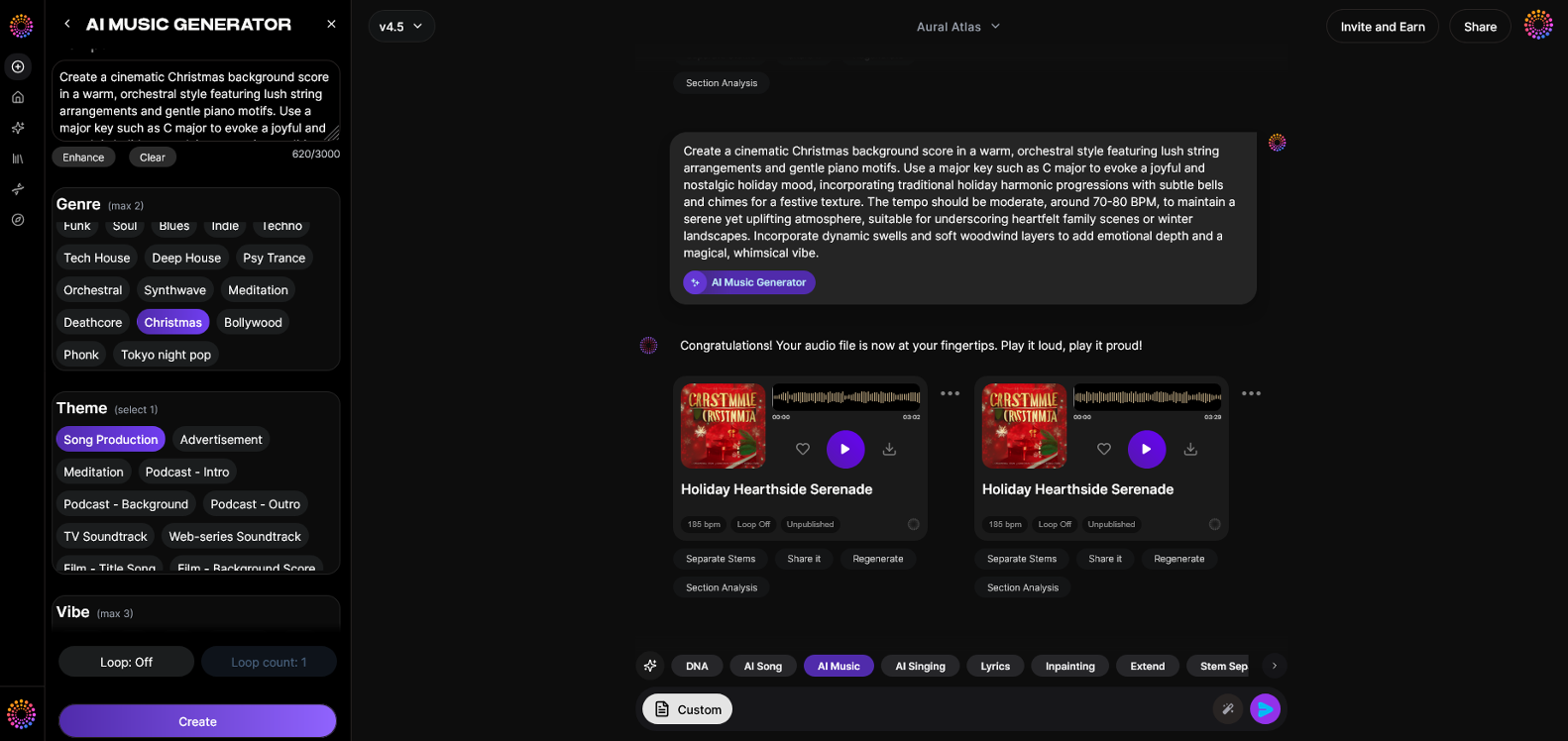
Soundverse’s AI Music Generator demonstrates why prompt quality outweighs model obsession. The platform enables users to create fully produced instrumental music from text prompts, specializing in background tracks, beats, and soundscapes without vocals. Features like Loop Mode and detailed genre/mood/instrument control make it a versatile tool for creators seeking control and clarity.
Whether producing game soundtracks, cinematic beds, meditation playlists, or ad scoring, the Soundverse interface interprets prompt details through adaptable V4 and V5 model options. But crucially, the difference in output precision depends far more on how clearly you describe your goals than on which model you select.
Because the workflow is asynchronous (input > process > output), you have time to refine your wording rather than toggling live settings. This encourages thoughtful, iterative prompt design, aligning perfectly with the idea that language precision drives audio excellence.
Through its extended ecosystem—including the AI Song Generator for vocal compositions and the Agent assistant for multi-step automation via conversational control—Soundverse carries forward an ethical philosophy. Its Ethical AI Music Framework ensures that innovation coexists with transparency, attribution, and fair artist compensation.
For those comparing generators, see the Best AI Music Generators in 2026 or explore tools referenced in AI Music Prompts Guide 2026: Suno & ElevenLabs Best Practices.
Final Thoughts: The Era of Prompt-Centric AI Music Creation
In 2026, successful AI music producers no longer chase the newest algorithm—they refine their communication. The shift away from “model-hunting” marks a creative milestone. Musicians, content creators, and researchers have realized that prompt engineering is the true cornerstone of generative artistry.
The tools are plateauing in technical capability, but user creativity with prompts continues to soar. Clarity, emotion, and context are the new levers of control. As we move forward, those mastering prompt engineering audio will define the next phase of digital composition.
Ready to explore? Visit the main Soundverse hub for more insights into how AI-generated music is transforming the industry, or learn how to generate AI music with Soundverse’s text-to-music capabilities. The future of AI music creation isn’t about which model you choose—it’s about how you tell your story through the prompt.
Start Creating Smarter with Soundverse AI
Discover how better prompts lead to professional-grade tracks. Unleash your creative potential and generate stunning music in seconds with Soundverse’s advanced AI tools.
Related Articles
- Generate AI Music with Soundverse Text-to-Music: Learn how to turn words into music using Soundverse’s intuitive text-to-music tool for effortless composition.
- How AI-Generated Music is Transforming the Music Industry: Explore the groundbreaking ways AI is redefining production, creativity, and collaboration in the global music scene.
- Soundverse Assistant: Your AI Music Co-Producer: Meet your new AI collaborator—Soundverse Assistant, designed to help you fine-tune prompts and create polished music faster.
- How an AI Music Generator Inspires Creative Fusion: Discover how AI tools inspire unique hybrid styles and unlock new artistic possibilities for modern creators.
Here's how to make AI Music with Soundverse
Video Guide

Here’s another long walkthrough of how to use Soundverse AI.
Text Guide
- To know more about AI Magic Tools, check here.
- To know more about Soundverse Assistant, check here.
- To know more about Arrangement Studio, check here.
Soundverse is an AI Assistant that allows content creators and music makers to create original content in a flash using Generative AI. With the help of Soundverse Assistant and AI Magic Tools, our users get an unfair advantage over other creators to create audio and music content quickly, easily and cheaply. Soundverse Assistant is your ultimate music companion. You simply speak to the assistant to get your stuff done. The more you speak to it, the more it starts understanding you and your goals. AI Magic Tools help convert your creative dreams into tangible music and audio. Use AI Magic Tools such as text to music, stem separation, or lyrics generation to realise your content dreams faster. Soundverse is here to take music production to the next level. We're not just a digital audio workstation (DAW) competing with Ableton or Logic, we're building a completely new paradigm of easy and conversational content creation.
TikTok: https://www.tiktok.com/@soundverse.ai
Twitter: https://twitter.com/soundverse_ai
Instagram: https://www.instagram.com/soundverse.ai
LinkedIn: https://www.linkedin.com/company/soundverseai
Youtube: https://www.youtube.com/@SoundverseAI
Facebook: https://www.facebook.com/profile.php?id=100095674445607
Join Soundverse for Free and make Viral AI Music

We are constantly building more product experiences. Keep checking our Blog to stay updated about them!