Why AI Music Transparency Will Shape Platform Winners in 2026
Explore why AI music transparency will decide which platforms lead in 2026's music industry.
Why AI Music Transparency Will Shape Platform Winners
In 2026, AI-driven music creation is no longer a novelty—it’s the backbone of how labels, artists, and platforms operate. Yet as generative systems compose, remix, and distribute at scale, one issue determines who thrives: AI music transparency. The platforms that can demonstrate ethical sourcing, explainable generation, and traceable outputs are separating from those that still rely on opaque data practices.
This article explores why AI music transparency is now the ultimate differentiator for music streaming innovation and how it redefines the competitive landscape for creators, rights-holders, and tech companies alike.
What does AI music transparency mean in 2026?
AI music transparency describes the ability of an AI music platform to show precisely how a track was generated—from dataset licensing and model choices to attribution and royalty tracking. In 2024 and 2025, transparency in AI-generated content was debated largely in theory. But by 2026, it has become a measurable compliance requirement in several regions, driven by the EU’s AI Act and the U.S. Digital Music Integrity Initiative.
For music streaming services and AI creation tools, transparency now means breaking open the black box. They must provide:
- Data lineage reports that specify which licensed catalogs trained the models.
- Attribution metadata that credits inspiration sources or human collaborators.
- Traceable output tokens (like audio watermarks) that identify AI involvement.
- Usage-linked royalties to compensate contributors continuously.
AI music transparency, therefore, sits at the crossroads of music industry ethics and technological accountability. It not only builds trust—it ensures survival under new AI-generated music regulations.

Why are regulators and creators demanding more transparency?
In 2026, regulatory pressure has intensified. The EU Commission’s music AI task force and the Recording Academy’s Global Rights Initiative have both emphasized that undisclosed training data and untraceable AI tracks harm both artists and consumers. Creators deserve recognition and economic participation, while platforms risk losing licensed content partnerships if they remain opaque.
For example, the implementation of AI-generated music regulation in Europe now requires disclosure of the datasets used during model training. Similarly, U.S. platforms must tag AI music with verifiable identifiers to maintain digital distribution rights on major streaming services. The TRAIN Act further reinforces these standards, pushing companies toward an era of explainable AI models.
Beyond compliance, there’s also cultural motivation. Artists who once resisted AI collaboration now engage willingly when transparency ensures fair use and recurring payment. Transparency, in this sense, is an ethical bridge—not a burden.

How transparency redefines winners among AI music platforms
AI music platforms that prioritized openness early have become trusted creative partners for record labels and publishers. In contrast, platforms that built their catalogs through web scraping or unverifiable models are struggling to attract enterprise users.
Here’s how transparency creates clear platform winners:
- Trust as a differentiator: In 2026, artists and producers choose tools that respect consent and attribution. Transparent pipelines establish confidence that creative DNA isn’t being misused.
- Regulatory readiness: Platforms with traceability systems, watermarking, and explainable inference are already compliant with upcoming global regulations.
- New monetization models: Transparent usage tracking allows creators to earn ongoing royalties. This transforms AI from a one‑time sale into a recurring revenue stream.
- Stronger brand equity: Consumers increasingly prefer music streaming services that show the origin of each track—human, AI-assisted, or fully generated. That labeling enhances credibility across listening apps.
Transparency, therefore, isn’t just legal armor—it’s a strategic advantage.
For readers who want to explore how AI tools are reshaping the industry more broadly, check related analyses such as How AI-generated music is transforming the music industry and Music industry trends.
For a deeper dive, watch our guide on creating Deep House music or explore our tutorial on the “Explore” tab in Soundverse.
What do ethical frameworks look like for AI music creation?
Ethical AI music frameworks define technical and operational standards for training, generating, and monetizing AI compositions. The most advanced systems in 2026 employ multi-stage transparency pipelines:
- Licensed data sourcing: Only approved, partner-provided catalogs feed model development.
- Permissioned model layers: Datasets come with embedded rights metadata, ensuring consent at the node level.
- Explainable inference: When music is generated, the model provides interpretability logs outlining stylistic influences and attribution data.
- Traceable export and scanning: Every audio file includes hidden watermarks that can be detected later if it circulates elsewhere.
- Recurring compensation: Automated royalty calculations distribute value proportionally to data contributors.
These ethical infrastructures form the backbone of transparent AI ecosystems—and Soundverse is among the platforms pioneering this approach.
How AI music transparency accelerates music streaming innovation
Streaming in 2026 is not just about discovering songs—it’s about understanding how they were made. Music apps showcasing AI transparency are winning new market segments. They allow users to sort tracks by generation type, model version, or contributing artist datasets. This level of detail deepens fan loyalty and enables data-driven playlisting for marketers and curators.
Moreover, transparent attribution engines open new B2B partnerships. Labels can track derivative use, sync agencies can verify AI originality, and ad networks can source confirmed ethical AI background scores. Transparency, therefore, underpins creative commerce.
To see how AI-powered tools foster innovation, check out insights like Soundverse AI Magic Tools: Create Content Quickly with AI or Generate AI music with Soundverse Text-to-Music.
For hands-on learning, explore our tutorial on music creation basics from the Soundverse Studio series.
How creator rights evolve under AI-generated music regulation
The most profound transformation lies in how transparency protects creator rights in AI music. In 2026, digital rights management no longer ends with copyright registration; it extends into training data governance and inference output tracking. With transparent frameworks, artists:
- Confirm where and how their recordings are used in model training.
- Receive continuous, micro-based royalties each time the AI generates music influenced by their data.
- Access audit dashboards that visualize attribution pathways.
This empowerment contrasts sharply with the uncertain landscape seen in 2024. Transparent regulation promotes human-AI collaboration grounded in mutual respect.
How to make AI music transparency a competitive metric with Soundverse The Ethical AI Music Framework
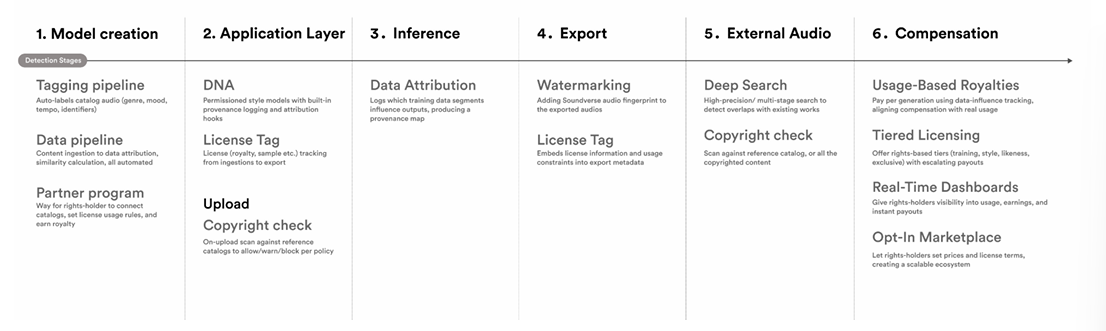
Soundverse’s The Ethical AI Music Framework represents a complete transparency infrastructure purpose-built for today’s evolving music ecosystem. It replaces black-box AI pipelines with a six-stage process focused on consent, attribution, and compensation.
Stage 1: Licensed Data Sourcing (No Scraping) – Only responsibly licensed data enters model training. This ensures that rights-holders remain integral participants.
Stage 2: Permissioned Models (DNA) – Each dataset carries permission metadata that tracks its presence through generation.
Stage 3: Explainable Inference (Attribution) – Soundverse clearly identifies which stylistic or structural elements contributed to a result, upholding explainability.
Stage 4: Traceable Export (Watermarking) – Outputs include watermark tokens enabling verification during distribution.
Stage 5: Deep Search (External Scanning) – A continuous scanning layer monitors for unlicensed derivative content across digital platforms.
Stage 6: Recurring Compensation (Partner Program) – Every identified use funnels proportionate royalties back to participating rights‑holders.
Together, these capabilities deliver clear benefits:
- Compliance readiness: The framework ensures lawful AI adoption for enterprise users and streaming platforms.
- Ethical guarantees: Artists retain visibility and revenue across the AI lifecycle.
- Sustainability: This model encourages long-term participation instead of adversarial standoffs between artists and AI systems.
Soundverse integrates this framework across its ecosystem through complementary tools like Soundverse Trace, which embeds attribution and watermarking, and the Content Partner Program, offering usage-based royalties.
To explore Soundverse’s ecosystem further, visit resources like Soundverse introduces Stem Separation AI Magic Tool or Join the Soundverse Affiliate Program.
Start Creating Transparent AI Music Today
Experience Soundverse’s cutting-edge tools built for ethical, creative, and transparent music generation. Join a growing community shaping the future of fair AI artistry.
Sign Up Free →
Related Articles
- How AI-Generated Music Is Transforming the Music Industry — Explore the rise of AI music and how technology is redefining creative standards across the global industry.
- Soundverse AI Revolutionizing Music Creation for New-Age Content Creators — Discover how Soundverse empowers creators with AI tools for authenticity and innovation in digital music.
- What AI Can Generate Songs — Learn which AI platforms are leading the way in song generation and how transparency drives user trust.
- AI Music Generator and Human Composers: A Future Together — Understand why collaboration and transparency between AI and human creators will define music’s next era.
Here's how to make AI Music with Soundverse
Video Guide

Here’s another long walkthrough of how to use Soundverse AI.
Text Guide
- To know more about AI Magic Tools, check here.
- To know more about Soundverse Assistant, check here.
- To know more about Arrangement Studio, check here.
Soundverse is an AI Assistant that allows content creators and music makers to create original content in a flash using Generative AI.
With the help of Soundverse Assistant and AI Magic Tools, our users get an unfair advantage over other creators to create audio and music content quickly, easily and cheaply.
Soundverse Assistant is your ultimate music companion. You simply speak to the assistant to get your stuff done. The more you speak to it, the more it starts understanding you and your goals.
AI Magic Tools help convert your creative dreams into tangible music and audio. Use AI Magic Tools such as text to music, stem separation, or lyrics generation to realise your content dreams faster.
Soundverse is here to take music production to the next level. We're not just a digital audio workstation (DAW) competing with Ableton or Logic, we're building a completely new paradigm of easy and conversational content creation.
TikTok: https://www.tiktok.com/@soundverse.ai
Twitter: https://twitter.com/soundverse_ai
Instagram: https://www.instagram.com/soundverse.ai
LinkedIn: https://www.linkedin.com/company/soundverseai
Youtube: https://www.youtube.com/@SoundverseAI
Facebook: https://www.facebook.com/profile.php?id=100095674445607
Join Soundverse for Free and make Viral AI Music

We are constantly building more product experiences. Keep checking our Blog to stay updated about them!