Why AI Music Is Becoming Core Infrastructure for Creators in 2026
Discover why AI music for creators is now foundational to the creative economy and how Soundverse leads with ethical innovation.
Why AI Music Is Becoming Core Infrastructure for Creators
Introduction
The landscape of modern music creation has undergone a seismic shift in 2026. What was once considered experimental technology is now central to the creative process. AI music for creators has evolved from a simple generative novelty into the backbone of the global creator economy. With rapid improvements in generative algorithms and ethical data sourcing, artists, producers, and developers are embracing artificial intelligence as core infrastructure — not just as a creative tool.
AI’s role in the creative industry now extends far beyond generating melodies or beats. It powers entire ecosystems, automates production pipelines, and provides rights-protected music generation that aligns with artists’ ethical and professional needs. The key advantage? Efficiency and transparency now coexist. As independent musicians and producers continue to multiply across digital platforms, AI music tools are the invisible engines enabling them to scale creativity without compromising authenticity.
What is Driving the Rise of AI Music for Creators in 2026?
Several factors have accelerated the mainstream adoption of AI-powered music creation in 2026:
- Increased demand for content – Social platforms, podcasts, and digital media outlets require vast libraries of original, copyright-safe music. AI systems now meet this continuous demand with cost-effective and fast turnaround results.
- Music production automation – With machine learning models capable of understanding musical structure, creators can automate aspects of arrangement, sound design, and mixing while focusing on artistic direction.
- Accessible tools – Platforms like Soundverse have made AI music creation accessible even to non-technical creators who can generate fully produced, royalty-safe instrumentals through text or style descriptors.
- Ethical and legal compliance – As copyright debates matured during 2025, transparency and licensed data became essential. Frameworks that ensured artist consent and fair compensation emerged as the new standard.
AI is not replacing musicians — it is augmenting them. Artists who integrate automation into their workflow report exponential creative throughput and improved quality consistency. According to PRS For Music, more than 70 percent of creators now understand how AI music creation works, highlighting its educational and industrial momentum.
How Has Artificial Intelligence Changed the Music Industry Landscape?
The artificial intelligence in the music industry marks a new paradigm in 2026. Unlike the first-generation tools that operated as black boxes, new infrastructures embed ethical compliance and traceability into every step of production.
Music generation models are now trained on verified, licensed datasets that preserve artistic identity and guarantee attribution. This development has restored trust between creators and tech companies. iMusician’s State of the Music Industry 2026 reported that by November 2025, platforms like Deezer were receiving over 50,000 fully AI-generated tracks daily — a clear indicator of adoption scale.
For independent producers, this means they can make professional-level compositions using large-scale AI systems without worrying about ownership or plagiarism. Labels, too, benefit from automated catalog expansion and monetization of artist-trained models.
Furthermore, AI’s presence in creator economy technology is now systemic. From AI-driven mastering engines to automated sync licensing systems, music generation no longer works in isolation. It ties into monetization models, performance analytics, and distribution channels. For an in-depth walkthrough, watch our Soundverse Tutorial Series - How to Make Music and Deep House creation guide.
Why Is Music Production Automation Essential for Modern Creators?
In 2026, the line between composing and coding continues to blur. Music production automation has matured to handle complex creative workflows that traditionally required teams of engineers.
Automation allows freelancers and small studios to produce large sound libraries in record time. For example, producers working on reels, ads, or game soundtracks can specify genre, tempo, and mood, and the algorithm handles the initial composition. This foundation frees them to refine or remix the results creatively. WifiTalents notes that 60% of independent musicians already use AI to assist in music production or live performance preparation.
Moreover, automation enables creators to integrate feedback loops — tracking audience reactions and letting AI recommend stylistic changes based on listener engagement. The result: AI becomes both a collaborator and an optimizer.
Still, the industry’s greatest challenge lies in balancing speed with ethics. Without transparent sourcing, creators risk using datasets that exploit original artists. This is where frameworks like Soundverse’s Ethical AI Music Framework redefine how automation aligns with artistry. For additional exploration, see our Explore Tab overview on the Soundverse YouTube channel.
How to Make Ethical and Scalable AI Music with Soundverse The Ethical AI Music Framework
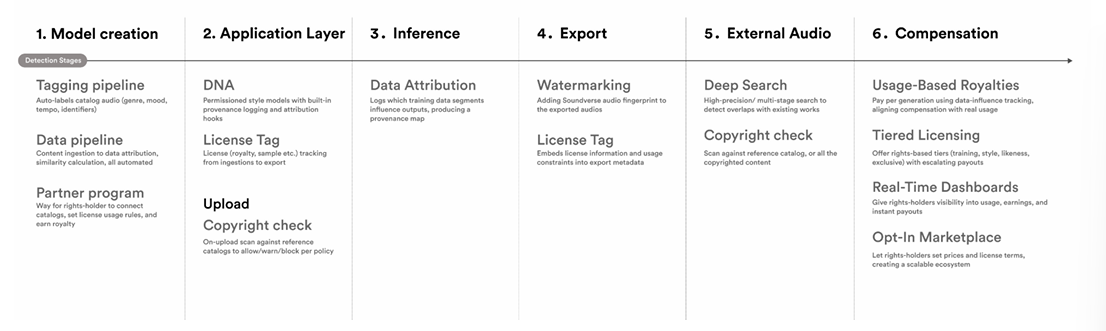
Soundverse established a new benchmark in 2026 with The Ethical AI Music Framework, a robust infrastructure bridging innovation and artist integrity. Rather than black-box creativity, it ensures transparency, consent, and equitable compensation across the entire AI music lifecycle.
Six-Stage Pipeline for Ethical AI Music
- Licensed Data Sourcing (Stage 1) – Soundverse never scrapes unlicensed material. Every dataset originates from rights-holders and approved libraries.
- Permissioned Models (Stage 2) – Each AI model is trained with explicit permissions, ensuring the resulting creative DNA respects artist contributions.
- Explainable Inference (Stage 3) – The system attributes model-generated results, so creators know whose data influenced the composition.
- Traceable Export (Stage 4) – All AI-generated outputs are watermarked, ensuring their source remains verifiable and tamper-proof.
- Deep Search (Stage 5) – Integrated scanning features detect potential external matches or overlap, maintaining copyright safety.
- Recurring Compensation (Stage 6) – Artists contributing data receive ongoing royalties via the Soundverse Partner Program, tying creative output directly to fair pay.
For creators, this framework translates into freedom with accountability. Producers can create confidently, knowing their tools honor the original artistry powering the AI. CISAC’s 2026 global report underscores how permissioned, transparent AI models are crucial for ensuring fair economic participation.
Related tools such as Soundverse Trace extend these protections into post-production and licensing, embedding attribution across platforms. Similarly, Soundverse DNA empowers artists to monetize their signature sound by training ethically-sourced, creator-specific AI engines. You can also review AI Music NFT Sales Data & Market Trends 2026 for insights into blockchain-based music economics.
What Makes Soundverse Different from Other AI Music Tools?
Unlike earlier solutions that approached music generation from a pure efficiency mindset, Soundverse prioritizes accountability. Each AI output can be traced back to its ethical origin, ensuring both compliance and creativity.
Platforms such as Mubert and Soundraw initially pioneered accessible AI music. However, creators in 2026 prefer frameworks like Soundverse that provide long-term sustainability by integrating licensed data ecosystems. For detailed comparisons of AI alternatives, explore this article on Mubert alternatives and Soundraw alternative insights.
Furthermore, Soundverse’s transparent architecture complements emerging trends discussed in music industry trends for 2026, ensuring users remain future-proof in a rapidly evolving environment. As Sonarworks has found, the future of production still relies on human creativity empowered by ethical AI augmentation.
How Is AI Music Reshaping the Creator Economy?
The creator economy technology evolution is inseparable from music. As video and content creation accelerate, AI-generated soundtracks have become vital utilities — similar to hosting or cloud storage. Creators need legally compliant, high-quality music instantly available within their workflow.
Platforms like YouTube Shorts, TikTok, and podcast networks now rely on AI-generated background music pools that adapt to mood requirements. What once took days of licensing coordination now happens in minutes through ethical frameworks.
In 2026, successful creators are those who integrate AI music for creators into their toolstack — automating intros, stream overlays, or background scores. Paired with platforms such as the Soundverse AI Magic Tool Suite, this process scales creativity safely and efficiently.
Transform Your Creative Process with AI Music
Experience the future of music production with Soundverse. Generate, customize, and collaborate on soundtracks effortlessly using advanced AI tools built for creators like you.
Start Creating Free AI Music
- How AI-Generated Music Is Transforming the Music Industry — Discover how artificial intelligence is reshaping the music industry, from composition to content creation.
- Soundverse AI: Revolutionizing Music Creation for New-Age Content Creators — Learn how Soundverse is empowering creators to produce professional-grade music through intuitive AI-driven tools.
- What AI Can Generate Songs — Explore the latest AI technologies capable of autonomously generating songs across genres and moods.
- AI Music Generator and Human Composers: A Future Together — Understand how AI tools and human creativity are merging to redefine the art of music composition.
Here's how to make AI Music with Soundverse
Video Guide

Here’s another long walkthrough of how to use Soundverse AI.
Text Guide
- To know more about AI Magic Tools, check here.
- To know more about Soundverse Assistant, check here.
- To know more about Arrangement Studio, check here.
Soundverse is an AI Assistant that allows content creators and music makers to create original content in a flash using Generative AI.
With the help of Soundverse Assistant and AI Magic Tools, our users get an unfair advantage over other creators to create audio and music content quickly, easily and cheaply.
Soundverse Assistant is your ultimate music companion. You simply speak to the assistant to get your stuff done. The more you speak to it, the more it starts understanding you and your goals.
AI Magic Tools help convert your creative dreams into tangible music and audio. Use AI Magic Tools such as text to music, stem separation, or lyrics generation to realise your content dreams faster.
Soundverse is here to take music production to the next level. We're not just a digital audio workstation (DAW) competing with Ableton or Logic, we're building a completely new paradigm of easy and conversational content creation.
TikTok: https://www.tiktok.com/@soundverse.ai
Twitter: https://twitter.com/soundverse_ai
Instagram: https://www.instagram.com/soundverse.ai
LinkedIn: https://www.linkedin.com/company/soundverseai
Youtube: https://www.youtube.com/@SoundverseAI
Facebook: https://www.facebook.com/profile.php?id=100095674445607
Join Soundverse for Free and make Viral AI Music

We are constantly building more product experiences. Keep checking our Blog to stay updated about them!