What the Next 5 Years of AI Music Will Look Like
Discover how artificial intelligence will define the future of music from 2026 to 2031.
What the Next 5 Years of AI Music Will Look Like
Artificial intelligence has completely redefined how we create, distribute, and experience sound. As we stand in 2026, the music industry has already evolved through major technological leaps from 2024 and 2025 — years that marked the mainstream adoption of AI music production tools and machine learning-based creative workflows. But what lies ahead? The next five years promise not just smarter algorithms, but deeper artistic collaboration, ethical governance of data, and a fully transparent creative ecosystem. This article explores the AI music future, examining how innovations in artificial intelligence in music, ethical frameworks, and data transparency will shape the path from 2026 to 2031.
What are the biggest music technology trends shaping the AI music future?
Between 2026 and 2031, AI-driven sound creation is expected to become standard practice across studios, live performances, and content platforms. Three technology pillars are leading this transformation: ethical AI frameworks, personalized sound modeling, and autonomous composition.

1. Ethical frameworks ruling AI music production
AI music generation in the early days was clouded by copyright controversies. Models trained on unlicensed datasets led to legal disputes and damaged trust between artists and AI developers. Today, ethical transparency is the top music technology trend. Platforms such as Soundverse and other innovators are establishing frameworks that replace opaque data usage with consent-driven pipelines. This move is not just moral but strategic: major labels and rights organizations demand certified licensing workflows before participating in AI collaborations.
2. Personalized AI sound identities
One of the defining features of the future of music industry innovation lies in personalization. Machine learning in sound creation is now advanced enough to understand an artist’s unique sonic DNA — timbre, rhythm, chord progressions, and emotional tone — and recreate original compositions while maintaining individuality. By 2031, AI co-producers will not replace musicians but operate as creative extensions, letting one producer multiply their distinctive sound across multiple collaborations simultaneously.
3. AI music production as a collaborative art form
Rather than producing music autonomously, AI is becoming a creative partner. Musicians can provide a description, reference stems, or vocal demos, and the AI interprets their vision using contextual data rather than random sampling. Upcoming AI interfaces will prioritize transparent attribution and give artists recurring royalties whenever their sonic fingerprint contributes to a generated piece. This shift marks the rise of a hybrid ecosystem — a future where creativity and technology merge ethically.
What challenges will artists and producers face with artificial intelligence in music?
As AI music becomes a standard production tool, challenges around authorship, attribution, and compensation will intensify. Artists are concerned that fully synthetic sound generation could dilute artistic authenticity. Meanwhile, the industry is grappling with how to track and remunerate contributions in a fragmented AI ecosystem.
1. Attribution and ownership tracking
By 2028, tracking who contributed what portion of data to a model will be crucial for royalties. Unlike traditional copyright registration, AI songs are created with billions of data points, making ownership nearly impossible to define without traceable metadata. Ethical AI frameworks must therefore embed clear attribution layers.
2. Dataset licensing compliance
Companies relying on scraped or unauthorized catalogs will face growing legal barriers. Regulators in Europe and North America are already tightening AI data usage laws. For enterprise-grade users, compliance will shift from voluntary to mandatory. As seen in AI music in the USA, transparent data sourcing will become a global prerequisite.
3. Artist sustainability and compensation
Recurring compensation will replace one-time licensing deals. Labels and creators will prefer models that provide continuous, usage-based royalties. The ability to participate in AI training datasets while ensuring steady monetization will define success in the next five years.
How will machine learning evolve in sound creation?
Machine learning models for music will advance from recognizing genres and instruments to predicting emotional context. By 2030, sound generation will no longer depend solely on text-to-music prompts — systems will interpret mood, tempo, and narrative suggestions from creators in real time.
The next phase involves multi-modal learning: integrating lyrics, visuals, and performance data into music generation. Tools will analyze existing recordings not only for melody patterns but for expressive intensity and production style. AI will understand not just what makes pop sound like pop, but why a specific artist's performance moves people emotionally. This evolution aligns with advancements already visible in Soundverse’s AI Magic Tools, which accelerate content creation without sacrificing artistic quality. For a deeper dive, watch our guide on creating Deep House music or explore our tutorial on how to make music from the Soundverse Tutorial Series.
How will the future of music industry adapt to AI-driven sound creation?
Music distribution models are already shifting. As AI generates millions of royalty-free and customizable tracks, markets are moving away from blanket licensing toward micro-compensation systems that pay creators based on transparent attribution records.
- Labels as data curators – By 2027, record labels will merge roles of rights administrators and data brokers. They will manage licensed datasets for training ethical AI models.
- Creators as share holders – Artists will directly profit from how their sonic styles influence AI compositions, similar to stock dividends.
- AI audit systems – Every generated track will carry trackable metadata proving its source. This concept is already expanding through technologies like Soundverse Trace, ensuring data integrity across the AI music lifecycle.
The convergence of human artistry and machine learning will eventually produce a new economic class — the AI composer. This hybrid role combines algorithmic design with creative intuition, producing works that engage both fans and algorithms. To better navigate this hybrid future, check out our Explore Tab tutorial for workflow tips.
How to make the AI music future ethical and sustainable with Soundverse The Ethical AI Music Framework
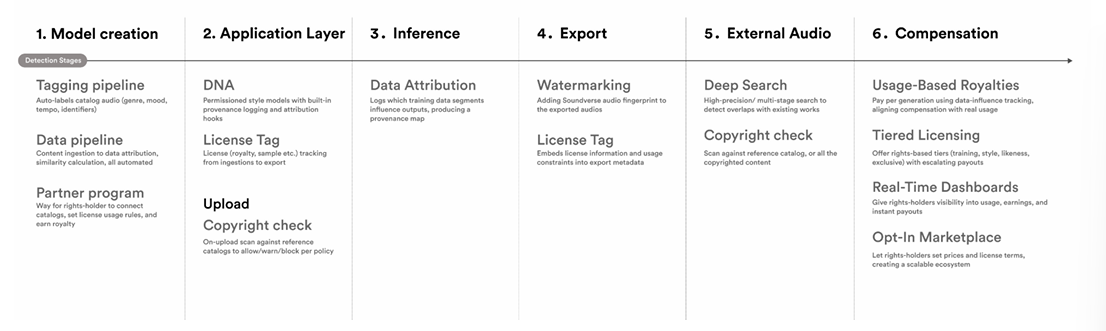
At the heart of the next five years of AI music innovation stands Soundverse’s Ethical AI Music Framework — a transparent, secure infrastructure that bridges creativity and integrity.
Transparent six-stage pipeline
- Stage 1: Licensed Data Sourcing – Only legally obtained and consented catalogs are used; Soundverse entirely avoids scraped or unlicensed material.
- Stage 2: Permissioned Models (DNA) – Artists define how their sound DNA is used, ensuring stylistic consistency and ethical boundaries.
- Stage 3: Explainable Inference (Attribution) – Every AI-generated track includes documented attribution layers to identify whose artistry contributed.
- Stage 4: Traceable Export (Watermarking) – Watermarks guarantee provenance, ensuring downstream protection in distribution networks.
- Stage 5: Deep Search (External Scanning) – This capability scans the wider internet for unauthorized use or AI replicas of licensed content.
- Stage 6: Recurring Compensation (Partner Program) – Through the Content Partner Program, rights-holders earn ongoing royalties whenever their material supports generation.
Soundverse DNA and Soundverse Trace
Complementing the framework are Soundverse DNA, which enables artist-trained, style-specific music generation, and Soundverse Trace, the trust layer that secures attribution. These systems collectively ensure compliance and sustainability in enterprise usage. Together, they replace traditional licensing with data-responsible innovation, allowing professionals to explore creativity without legal risk.
Professionals interested in advanced AI generation workflows can also explore Soundverse Arrangement Studio, a companion environment for blend-based composition, or evaluate Mubert alternatives to understand how ethical data frameworks outperform older generation models.
What does the AI music future from 2026 to 2031 look like?
By 2031, AI-driven creativity will likely reach four distinct milestones:
- Total transparency in AI datasets – Every commercial AI track will have verifiable lineage and artist consent embedded.
- Creator-centric revenue distribution – Automated attribution and micropayments will ensure every contribution earns recurring revenue.
- Emotion-aware AI composition – Models will create scores based on real-time sentiment analysis drawn from video or listener feedback.
- Collaborative virtual music studios – Multiple creators and AI systems will co-produce cross-genre works asynchronously worldwide.
Ethical frameworks such as Soundverse’s six-stage pipeline serve as the foundation for this era. They ensure that machine learning in sound creation uplifts the future of music industry rather than disrupts it. Instead of an AI takeover, we’ll experience an AI collaboration renaissance — a next-generation ecosystem where creativity is not replaced but enhanced.
Experience the Future of AI Music Creation Today
Harness cutting-edge AI tools to compose, mix, and produce music that fits your vision in minutes. Explore how Soundverse is redefining the future of creative sound generation.
Start Creating with Soundverse
Related Articles
- How AI-Generated Music Is Transforming the Music Industry: Discover how AI composition tools are reshaping the creative process across genres and production workflows.
- AI Music Generator and Human Composers: A Future Together: Explore the potential for harmony between human creativity and artificial intelligence in the studio.
- AI Music in the USA: Get insights into how the American music landscape is evolving with the rapid adoption of AI technologies.
- Soundverse AI Revolutionizing Music Creation for New-Age Content Creators: Learn how Soundverse empowers modern creators with intuitive AI tools to innovate faster than ever.
Here's how to make AI Music with Soundverse
Video Guide

Here’s another long walkthrough of how to use Soundverse AI.
Text Guide
- To know more about AI Magic Tools, check here.
- To know more about Soundverse Assistant, check here.
- To know more about Arrangement Studio, check here.
Soundverse is an AI Assistant that allows content creators and music makers to create original content in a flash using Generative AI. With the help of Soundverse Assistant and AI Magic Tools, our users get an unfair advantage over other creators to create audio and music content quickly, easily and cheaply. Soundverse Assistant is your ultimate music companion. You simply speak to the assistant to get your stuff done. The more you speak to it, the more it starts understanding you and your goals. AI Magic Tools help convert your creative dreams into tangible music and audio. Use AI Magic Tools such as text to music, stem separation, or lyrics generation to realise your content dreams faster. Soundverse is here to take music production to the next level. We're not just a digital audio workstation (DAW) competing with Ableton or Logic, we're building a completely new paradigm of easy and conversational content creation.
TikTok: https://www.tiktok.com/@soundverse.ai
Twitter: https://twitter.com/soundverse_ai
Instagram: https://www.instagram.com/soundverse.ai
LinkedIn: https://www.linkedin.com/company/soundverseai
Youtube: https://www.youtube.com/@SoundverseAI
Facebook: https://www.facebook.com/profile.php?id=100095674445607
Join Soundverse for Free and make Viral AI Music
 We are constantly building more product experiences. Keep checking our Blog to stay updated about them!