What Makes an AI Music Tool Trustworthy in 2026?
Explore key traits of trustworthy AI music tools and learn how Soundverse Trace ensures ethical, transparent music creation.
What Makes an AI Music Tool Trustworthy?
In 2026, artificial intelligence has secured its place in nearly every corner of music production, from song composition to sound design and vocal synthesis. AI music creation tools have given rise to revolutionary workflows, empowering producers and creators to build rich musical experiences faster than ever. But as this innovation advances, one crucial question remains: what makes an AI music tool trustworthy?
The conversation around trustworthy AI music tools isn't just about output quality anymore. It's about ethics, rights protection, and accountability across the entire creative process. Producers and developers now prioritize ethical AI tools that respect artist integrity and follow responsible AI practices.
Why Is Trustworthiness Crucial in AI Music Creation in 2026?
Over the past few years, debates around music technology ethics have intensified. By 2024 and 2025, industry players began realizing that talent wasn't the only ingredient shaping AI-powered creativity — transparency was. In 2026, trustworthiness sits at the intersection of creativity and technology ethics.
When music producers use AI, they're not simply generating sound; they're building on datasets derived from thousands of recorded works. If these underlying datasets are opaque or infringe copyrights, creators could unknowingly produce content that threatens artist rights. Trustworthy AI music tools counter that risk with traceability, consent-driven data, and verifiable attribution.

What Defines a Trustworthy AI Music Tool?
To understand what gives AI music software credibility, consider five key pillars:
- Data Transparency: The system should clearly document where training materials come from. Trustworthy tools don’t hide behind vague labels — they offer provenance and full dataset visibility.
- Attribution Tracking: Responsible AI in music must recognize which influences shaped an output. Attribution logs allow stakeholders to trace creative lineage, ensuring fairness and legal compliance.
- Rights Management Integration: A trustworthy AI must embed licensing data and watermarks that travel through each export stage, preserving ownership metadata accurately.
- Ethical Use Policies: Platforms embracing music technology ethics protect creators from misuse, offering frameworks that balance innovation with moral responsibility.
- Security and Verification: Audio security ensures files remain authentic, unchanged, and free from deepfake manipulation.
By following these principles, trustworthy AI music tools empower users to compose confidently while respecting all involved contributors.

How Have Ethical AI Frameworks Evolved Between 2024 and 2026?
In 2024 and 2025, music AI development often revolved around speed and style variety. However, the missing component was ethical transparency. By 2026, top platforms integrate principles rooted in responsible AI, ensuring creators understand the origin and protection status of every sound they use.
The rise of initiatives like Soundverse’s Ethical AI Music Framework marks this transition. This framework replaces opaque black-box generative models with transparent, consent-based pipelines. Every output connects to a source, providing opportunity for attribution-linked royalties and verified provenance.
Industry analysts have observed that these frameworks align with the broader cultural demand for authenticity. As audiences become more aware of AI-generated art, they value platforms proving ethical intent and technical integrity. That’s where tools like Soundverse Trace demonstrate measurable trust.
For a deeper dive, watch our guide on how to make music and explore the “Explore” tab tutorial on YouTube.
How to Make AI Music Creation Responsible and Reliable in 2026
Responsible AI in music begins with the alignment of data use and creative rights. Here's how this ethical process unfolds today:
- Consent-based Datasets: Rights-holders voluntarily contribute materials through licensing programs, receiving royalties proportional to usage. Soundverse’s Content Partner Program exemplifies this, offering fair compensation tied directly to data attribution.
- Lifecycle Protection: From ingestion to export, metadata and fingerprints remain embedded, enabling seamless rights enforcement.
- Auditable Attribution Trails: Exterior platforms and users can verify output lineage, reinforcing accountability between developers and artists.
Together, these innovations form the core of modern music technology ethics, reducing infringement risks and strengthening artist relationships.
How to Make AI Music Trustworthy with Soundverse Trace
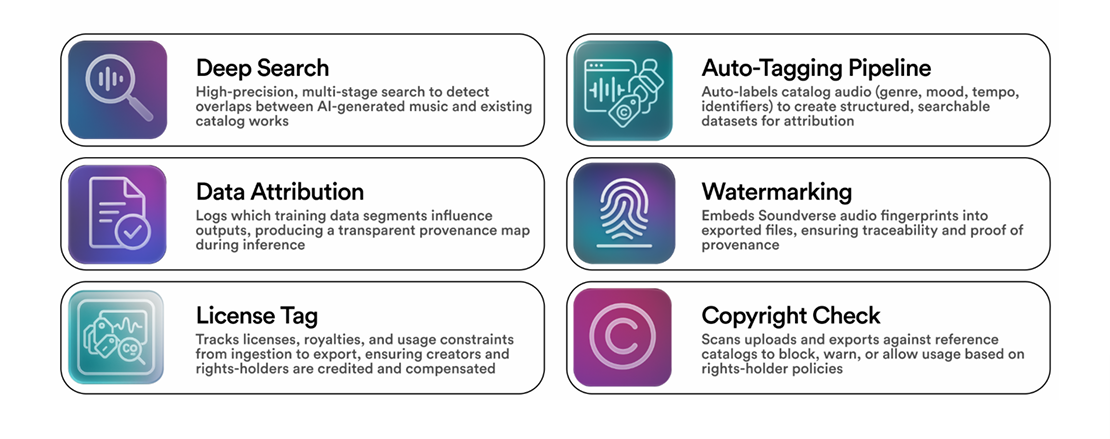
Soundverse Trace is Soundverse’s comprehensive trust layer for AI-generated music. It embeds attribution, deep search, and rights protection through the entire lifecycle — from dataset creation to the final exported track.
Key Capabilities:
- Deep Search: Uses high-precision scanning (both 1:1 and 1:N) to detect overlaps between generated audio and original copyrighted material. This function safeguards users from accidental duplication.
- Data Attribution: Logs precisely which training data influenced outputs. This empowers rights-holders to claim usage-based royalties while protecting producers from copyright disputes.
- Audio Watermarking: Embeds robust yet inaudible fingerprints inside compositions. These act as permanent verification tags across streaming and distribution platforms.
- License Tagging: Preserves rights metadata from dataset ingestion to export, ensuring provenance integrity. This means artists never lose their ownership trail even if tracks are remastered or edited later.
Primary Use Cases:
- Preventing copyright infringement in AI outputs.
- Tracking catalog usage for royalties.
- Verifying provenance of AI-created audio.
- Automating takedown requests or payouts for rights-holders.
Soundverse Trace transforms trust from a buzzword into an engineering standard. By integrating deep search and watermarking into creative workflows, it makes ethical AI music creation tangible instead of theoretical.
To learn more about how Soundverse shapes the AI music landscape, explore resources like How AI-generated music is transforming the music industry, AI music generator and human composers: a future together, and Music industry trends.
What Are the Broader Implications of Trustworthy AI Music Tools?
In the larger picture, trustworthy AI music creation influences more than just licensing dynamics — it reshapes audience engagement and creative distribution. Musicians want assurance that their works are respected, and consumers want to know that artists are compensated fairly.
This year, regulatory bodies have expanded efforts to formalize music AI accountability. Ethical compliance audits are gradually becoming industry standards. As a result, AI developers integrating trust architectures like Soundverse Trace gain reputational advantage and market stability.
Investors and enterprise studios also value transparent attribution frameworks. When combined with ethical AI tools, they minimize legal uncertainty and foster creative confidence.
The Future of Responsible AI in Music
Looking ahead into late 2026 and beyond, the combination of ethical infrastructure and creative automation will define the next stage of music evolution. Trustworthy AI tools will empower artists not only to produce efficiently but also to maintain moral and legal sovereignty over their sounds.
We can expect new partnerships between artists, developers, and rights organizations that reinforce participatory licensing systems. These collaborations will further advance morally conscious AI music ecosystems.
Platforms integrating trust layers like Soundverse Trace will spearhead this movement toward collective responsibility and long-term sustainability. As ethical music technology solidifies globally, creators can finally enjoy the creative freedom that AI promised — without sacrificing authenticity or fairness.
Start Creating Music You Can Trust
Experience how Soundverse’s AI empowers creators with transparency, reliability, and creative control. Generate unique, royalty-free tracks built on ethical AI innovation.
Related Articles
- How AI-Generated Music Is Transforming the Music Industry: Discover how AI tools are reshaping professional music production and empowering artists worldwide.
- Soundverse AI Magic Tools: Create Content Quickly with AI: Learn how Soundverse’s suite of Magic Tools simplifies music creation and accelerates workflow.
- AI Music Generator and Human Composers: A Future Together: Explore how human creativity and AI-powered tools collaborate to create music that feels authentic and original.
- Best AI Music Generator: Top Picks and Review: Find out which AI music generators lead the market and how to choose one you can truly rely on.
Here's how to make AI Music with Soundverse
Video Guide

Here’s another long walkthrough of how to use Soundverse AI.
Text Guide
- To know more about AI Magic Tools, check here.
- To know more about Soundverse Assistant, check here.
- To know more about Arrangement Studio, check here.
Soundverse is an AI Assistant that allows content creators and music makers to create original content in a flash using Generative AI. With the help of Soundverse Assistant and AI Magic Tools, our users get an unfair advantage over other creators to create audio and music content quickly, easily and cheaply. Soundverse Assistant is your ultimate music companion. You simply speak to the assistant to get your stuff done. The more you speak to it, the more it starts understanding you and your goals. AI Magic Tools help convert your creative dreams into tangible music and audio. Use AI Magic Tools such as text to music, stem separation, or lyrics generation to realise your content dreams faster. Soundverse is here to take music production to the next level. We're not just a digital audio workstation (DAW) competing with Ableton or Logic, we're building a completely new paradigm of easy and conversational content creation.
TikTok: https://www.tiktok.com/@soundverse.ai
Twitter: https://twitter.com/soundverse_ai
Instagram: https://www.instagram.com/soundverse.ai
LinkedIn: https://www.linkedin.com/company/soundverseai
Youtube: https://www.youtube.com/@SoundverseAI
Facebook: https://www.facebook.com/profile.php?id=100095674445607
Join Soundverse for Free and make Viral AI Music

We are constantly building more product experiences. Keep checking our Blog to stay updated about them!