What Makes an AI Music Generator Sound Less Robotic in 2026
Discover how AI music generators in 2026 create realistic, human-like music that sounds less robotic.
What Makes an AI Music Generator Sound Less Robotic
Artificial intelligence has undeniably transformed the soundscape of modern music production. From algorithmic beat making to full instrumental arrangements, the technology behind the AI music generator has evolved at a rapid pace. Yet one question continues to echo among producers and creators in 2026: how do we make AI-generated music sound less robotic and more emotionally authentic?
In this article, we'll explore what defines realism in AI music, how modern AI systems have improved, and why achieving natural, human-like qualities is now the core challenge in AI music composition. We'll then reveal how Soundverse, one of the leading innovators in the space, is shaping the future of realistic AI music through its next-generation technology.
Why do AI music generators sound robotic in the first place?
Early AI music models between 2020 and 2024 primarily focused on mathematical precision rather than musical emotion. These systems excelled at creating structured melodies, but their results often lacked the subtle timing variations, harmonic imperfections, and expressive dynamics that human musicians naturally deliver.
This robotic quality stemmed from three main limitations:
- Rigid pattern-based generation: The models favored repetition and fixed timing over organic variation.
- Limited expressive nuance: They produced static velocity and volume, missing the touch sensitive details of real performances.
- Non-contextual genre training: Many AI tools were trained on small, genre-specific datasets, causing them to replicate musical tropes rather than innovate within a style.
As a result, producers found themselves needing to humanize output through manual editing, layering, or post-processing. That gap between machine precision and human imperfection is what defined the early years of automated composition.
What makes realistic AI music possible in 2026?
By 2026, AI music production has matured. The key difference lies in how newer models understand style, mood, and instrumentation as dynamic relationships rather than fixed parameters. Advanced architectures now account for musical phrasing, transitions, and ornamentation that add personality.
Here are the factors driving the shift toward human-like AI music:
1. Temporal dynamics and expressive timing
Modern models focus on microtiming—the milliseconds of variation between notes that give rhythm its feel. These temporal fluctuations are essential for realistic groove and emotional flow. AI engines that incorporate tempo modulation no longer sound metronomic but fluid and alive.
2. Multi-layer instrument modeling
Rather than generating a flat mix, newer AI music composition systems build instruments as layered sound entities, simulating depth, resonance, and interaction. For example, when an AI piano's sustain pedal subtly blends overtones, or when an electronic hi-hat has random frequency variation, realism drastically improves.
3. Genre-contextual training
Training datasets now include full-length songs with contextual markers—intro, verse, bridge, and outro—which enables systems to emulate arrangement progression. Instead of looping endlessly, today’s AI music generators understand musical storytelling.
4. Emotion-aware text prompting
Text-to-music models have benefited from more descriptive input. In 2026, creators use prompts like “calm ambient guitar with wistful tones for sunrise meditation” rather than “ambient guitar,” allowing AI to infer emotion and dynamic intent.
For more examples of creative prompting, see 100 Text-to-Music Prompts That Will Help You Create Viral Music and its follow-up guides.
5. Style transfer and sonic identity preservation
AI systems increasingly use “artistic DNA” models that preserve style identity. This approach, pioneered in tools such as Soundverse DNA, captures the fingerprint of an artist’s sonic character. It’s a decisive step toward ethical realism—music that feels authentic without copying copyrighted works.
How do producers enhance natural sounding AI songs?
Professional producers working with human-like AI music employ several strategies to enhance output realism:
- Post-humanization: Slightly adjusting timing, velocity, or swing factors can warm up machine-perfect patterns.
- Analog-style mixing: Running the generated stems through saturation or analog filters adds texture and unpredictability.
- Layering live instruments or field recordings: Combining organic sound sources introduces the imperfections that AI models still struggle to recreate perfectly.
- Arranging dynamically: Changing motifs across sections—introducing tone variation, rhythmic shifts, and harmonic modulation—creates the sense of a living composition.
Explore more professional insights in How an AI Music Generator Inspires Creative Fusion, where hybrid workflows are explained in detail.
For a deeper dive, watch our guide on creating Deep House music and tutorial on how to make music from the Soundverse channel.
What role does text-to-music technology play in realism?
Text-to-music generation, arguably the most transformative area of AI music in 2026, allows creators to translate emotion, scenario, or even narrative directly into sound. When combined with looping capabilities, this form of composition becomes both practical and expressive.
The balance of machine learning precision and creative unpredictability is where realism thrives. The more descriptive and mood-driven the input text, the more nuanced the harmonic and rhythm patterns produced.
For background scoring, meditative soundscapes, or cinematic loops, this approach makes the AI music generator not only a time-saving tool but an artistic collaborator.
How to make less robotic AI music with Soundverse AI Music Generator
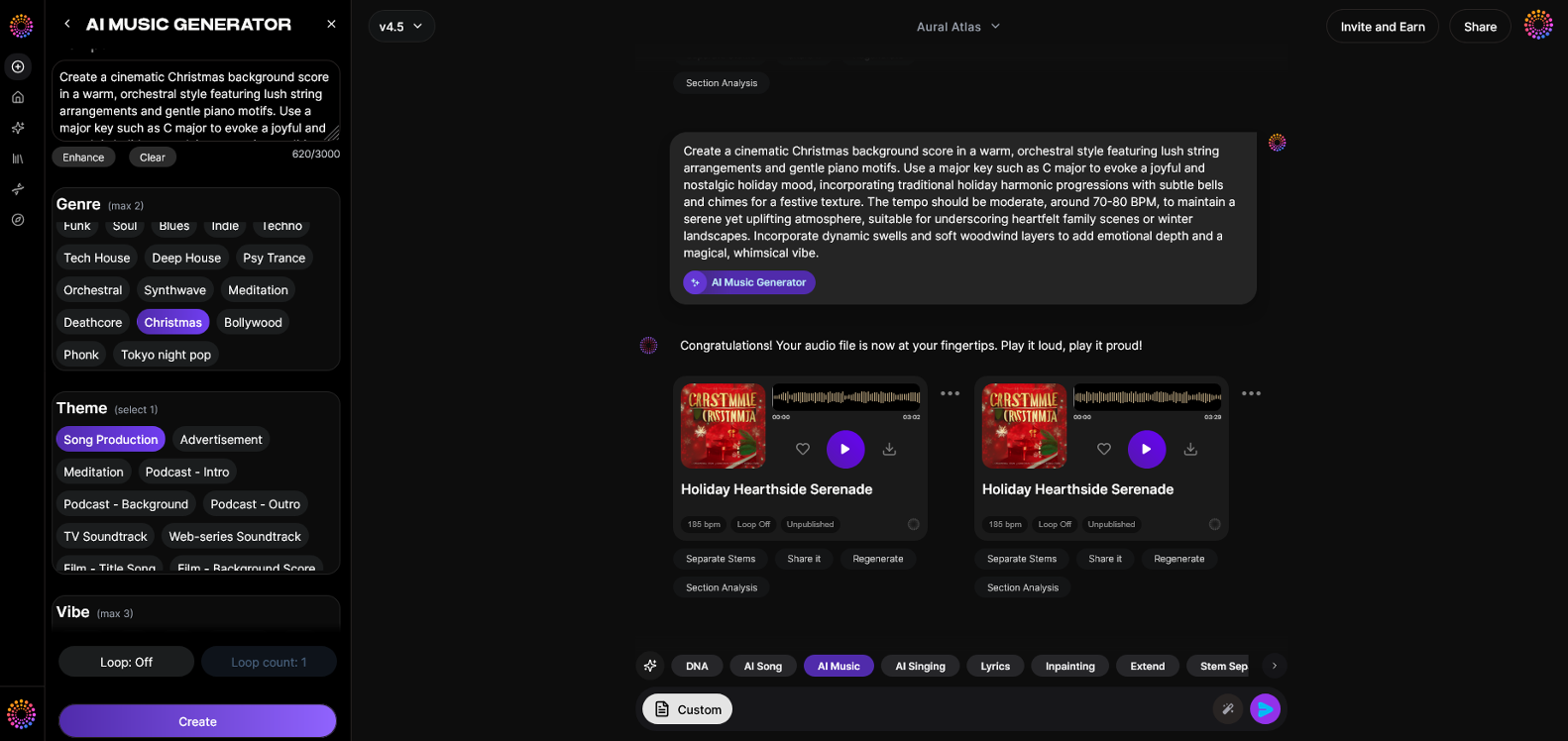
Soundverse’s AI Music Generator is a specialized platform built for creating fully produced instrumental tracks from text prompts. It shines in areas such as background music, advertisements, wellness soundscapes, and game loops—all without requiring manual audio engineering.
Key Capabilities:
- Text-to-Music: Convert descriptive prompts into complete instrumental compositions.
- Loop Mode: Generate seamless, recurring segments perfect for commercial or game use.
- Genre/Mood/Instrument Control: Tailor the sound precisely to a project context.
- Model Options (V4/V5): Choose between stylistic accuracy or avant-garde sonic exploration.
Unlike earlier systems, Soundverse focuses on emotional fidelity. The V4 and V5 models are trained to simulate human perception of harmony and timbre, resulting in natural sounding AI songs that fluidly evolve within a piece.
For creators who need stylistic consistency and originality, Soundverse DNA complements the generator by producing music based on artist-licensed sonic identities. This ensures copyright-safe realism—an essential consideration across 2026’s digital media landscape.
Discover more tools for creative professionals at Soundverse Assistant: Your AI Music Co-Producer and learn how automatic tool selection enhances workflow.
Why Soundverse stands out in 2026’s AI music landscape
While numerous competitors like Mubert, Soundraw, or Udio offer generative engines, Soundverse differentiates itself by merging technology with artistry rather than algorithmic rigidity.
Three qualities define its approach:
- Human-like phrasing: Each generated track carries expressive timing variations and microdynamics.
- Creative ethical foundation: Licensed training catalogs maintain integrity and monetization for human artists.
- Flexible workflow: From meditative scores to high-energy commercial backing tracks, the system adapts to purpose-driven realism.
For readers evaluating the best platforms, visit Best AI Music Generator: Top Picks and Review to see detailed comparisons and workflow benefits.
The future of emotional AI music
In 2026, the conversation around realism in AI music is shifting from “Can a machine replicate human sound?” to “Can a machine express human intention?” The next frontier isn’t about mimicking imperfection—it’s about integrating emotion-aware feedback loops where the AI learns from listener response data to adjust melodic tension and release patterns.
This progression will continue blurring the distinction between artist and algorithm. The tools are becoming so advanced that producers may soon collaborate with AI systems as co-composers capable of genuine improvisation.
To explore this cultural and technological transformation further, read How AI Generated Music Is Transforming the Music Industry, which examines how creative workflows are evolving across professional studios.
Start Composing Human-Sounding Tracks with AI
Discover how Soundverse’s advanced AI music generator creates natural, emotion-driven compositions that resonate with listeners. Join creators already transforming their workflow with our intelligent music tools.
Related Articles
- The Benefits of Composing with an AI Music Generator: Explore how using an AI music generator enhances creativity, efficiency, and overall musical quality for modern producers.
- AI Music Generator and Human Composers: A Future Together: Learn how AI and human creativity merge to create music that balances precision and emotion.
- How an AI Music Generator Inspires Creative Fusion: Discover how AI music tools spark new forms of collaboration and inspire unique sonic experiments.
- Best AI Music Generator: Top Picks and Review: Compare the leading AI music generators and find the perfect one to fit your creative needs.
Here's how to make AI Music with Soundverse
Video Guide

Here’s another long walkthrough of how to use Soundverse AI.
Text Guide
- To know more about AI Magic Tools, check here.
- To know more about Soundverse Assistant, check here.
- To know more about Arrangement Studio, check here.
Soundverse is an AI Assistant that allows content creators and music makers to create original content in a flash using Generative AI.
With the help of Soundverse Assistant and AI Magic Tools, our users get an unfair advantage over other creators to create audio and music content quickly, easily and cheaply.
Soundverse Assistant is your ultimate music companion. You simply speak to the assistant to get your stuff done. The more you speak to it, the more it starts understanding you and your goals.
AI Magic Tools help convert your creative dreams into tangible music and audio. Use AI Magic Tools such as text to music, stem separation, or lyrics generation to realise your content dreams faster.
Soundverse is here to take music production to the next level. We're not just a digital audio workstation (DAW) competing with Ableton or Logic, we're building a completely new paradigm of easy and conversational content creation. TikTok: https://www.tiktok.com/@soundverse.ai Twitter: https://twitter.com/soundverse_ai Instagram: https://www.instagram.com/soundverse.ai LinkedIn: https://www.linkedin.com/company/soundverseai Youtube: https://www.youtube.com/@SoundverseAI Facebook: https://www.facebook.com/profile.php?id=100095674445607
Join Soundverse for Free and make Viral AI Music

We are constantly building more product experiences. Keep checking our Blog to stay updated about them!