What Happens When Two Creators Use the Same AI Music Model?
Explore how shared AI music models impact creativity, copyright, and originality in 2026.
What Happens When Two Creators Use the Same AI Music Model?
In 2026, the evolution of generative music stands at a fascinating crossroad: what happens when two creators use the same AI music model? As AI-generated music becomes an everyday tool in music production technology, collisions between artistic identity, copyright fairness, and model overlap are increasingly frequent. The idea of two musicians drawing from the same digital DNA raises pressing questions about creativity, ownership, and sonic originality. Whether you’re composing electronic tracks with an AI music model or scoring a film using AI soundscapes, understanding this dynamic has become essential for modern creators.
What is an AI Music Model, and Why Does It Matter?
An AI music model is a machine learning system trained to generate music autonomously or semi-autonomously. Instead of relying on genre presets or pre-recorded loops, these models learn from datasets to understand tone, structure, rhythm, and even emotional nuance. In the past, creators worried about plagiarism and dataset bias, especially when songs appeared excessively similar. However, in 2026, ethical models like Soundverse DNA have transformed this landscape, providing licensed, attribution-safe frameworks for creativity.
When two creators use the same AI model, they share a foundational sonic space. Their compositions might bear recognizable stylistic traits—specific chord progressions, rhythmic patterns, or timbral qualities—but the outputs remain uniquely influenced by each creator’s prompt choice and creative intent. Just as two photographers can shoot distinct portraits using the same camera, two artists can produce entirely different pieces from the same AI template.
How Does Duplicate AI Music Occur?
Duplicate AI songs emerge when prompts, seed values, or datasets lead to similar music outputs. In early AI music platforms before 2025, lack of dataset diversity resulted in repetitive melodies circulating across platforms. With the rise of ethical models, however, modern systems employ architectural safeguards—like prompt randomization, sensitivity controls, and metadata tagging—to reduce duplication.
Interestingly, duplication can happen intentionally. Some producers use similar stylistic outputs to ensure brand continuity, particularly in advertising or game scoring. Here, duplicate sounds are a feature, not a flaw. But for independent artists, accidental similarity could pose challenges around recognition or ownership.
What Are the Copyright Challenges in Shared AI Music Models?
Music copyright in AI generation is one of the most discussed legal debates in 2026. Since AI tools contribute to authorship, distinguishing between creative ownership and algorithmic replication becomes complex. If two creators use the same AI music model and produce remarkably similar tracks, who truly owns the composition? Historically, courts leaned toward human users as primary rights holders, but model-originated replication introduces grey zones.
Platforms like Soundverse bridge this gap with built-in trust systems such as Soundverse Trace—a technology layer embedding attribution into every AI-generated file. By linking generation trails to user profiles, this system ensures that even identical-sounding songs have clear provenance. Rights can be traced back to the specific prompt and DNA model used, creating transparency in a space that was once opaque.
For a deeper dive into the subject, check out Music and AI: 2025's developments that will shape 2026's disputes, which discusses how ongoing industry disputes inform new rights frameworks.
How Shared AI Models Influence Creativity
Shared AI music models foster collaboration and evolution more than competition. When two creators use the same sonic DNA, they effectively participate in a new musical dialogue. Variations emerge through personal interpretation, sample integration, or structural editing. Rather than limiting creativity, shared models encourage communal exploration—a concept central to modern AI-generated music.
There’s also a philosophical layer to this: creativity in AI is no longer about originating from nothing but about iterating meaningfully. When two creators share a model, they co-create within an artistic continuum defined by parameters and human emotion. Music producers today exploit this balance to achieve genre-defining innovation, especially when layering model-based vocals over hybrid instrumentals.
To explore how AI tools are influencing genre creation, watch our Soundverse Tutorial Series - 9. How to Make Music, which dives into creative variations between prompts.
What Are the Ethical and Monetization Implications?
In AI music ecosystems, monetization and ethics go hand in hand. When artists license their sonic identity for model training, they expect fair royalties each time that model is used. This raises critical questions: if two users draw from the same registered artist-trained model, how are revenues tracked? Systems with integrated attribution layers, like Soundverse DNA’s Marketplace, automatically record usage events and distribute payments accordingly.
This model represents a paradigm shift in creative economics. Unlike pre-2024 platforms where datasets were scraped, Soundverse DNA ensures licensed participation. This not only resolves ethical concerns but also encourages creators to embrace shared model usage, knowing their IP is protected.
You can learn more about this evolution in How AI Music Impacts Music Licensing in 2026 - Soundverse AI, which outlines how legal and revenue systems have evolved for better transparency.
Why Do Overlaps Still Happen Despite Licensed Training?
Even in ethically managed ecosystems, sonic overlap persists due to stylistic consistency within trained models. When an artist licenses their sound, the core identity—harmonic tendencies, rhythmic motifs, vocal tone—remains constant across generations. Consequently, multiple users can produce tracks evoking the same artistic atmosphere.
However, platforms mitigate this through personalization controls. Soundverse’s Sensitivity Selector clusters catalogs into eras, enabling creators to generate outputs from specific points in an artist’s development—say, their early acoustic phase versus their later synth-centric stage. This minimizes duplication and maximizes creative range.
How to Make Music Fearlessly with Soundverse DNA
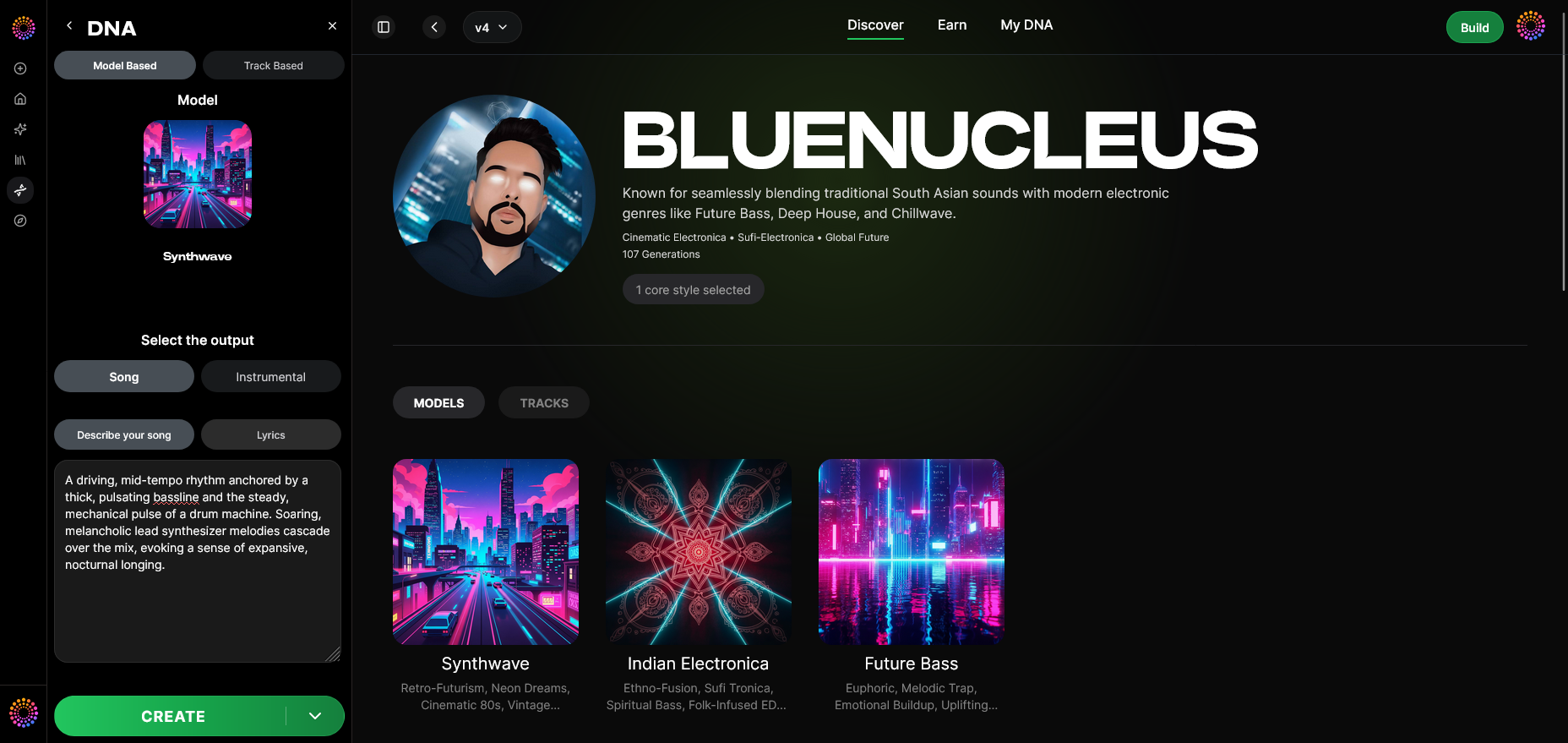
Soundverse DNA is an artist-trained AI music model that lets creators design music built on distinct sonic identities while safeguarding originality and copyright. Its foundation lies in ethical data training—licensed catalogs that let artists monetize their style while users generate consistent, copyright-safe audio.
Key Capabilities of Soundverse DNA
- Full DNA and Voice DNA – Generate both complete instrumentals and vocal textures influenced by the artist’s style.
- DNA Marketplace – License sonic DNA directly from contributing artists and receive full usage rights.
- Sensitivity Selector – Choose how closely your generation aligns with the artist’s catalog era, ensuring creative variation.
- Private Mode – Secure co-creation environments, safeguarding unreleased projects and brand-sensitive content.
- Soundverse Trace Integration – Embedded attribution ensures ownership clarity across every exported track.
Whether you produce trap, classical, or country themes (explore AI country music creation here), Soundverse’s system empowers individuality even when models are shared. As collaborative music continues to flourish through AI, creators can maintain confidence that their identity and rights remain intact.
The Future of AI Creativity and Music Production Technology
By 2026, music production technology is fully integrated into creative workflows. AI creativity is no longer a futuristic concept—it’s a standard practice from amateur beat-makers to major studios. Using shared AI models has become an accepted part of digital culture. Producers now view it like using DAW templates or sample packs, except with infinitely dynamic results.
As generative intelligence advances, distinctions between identical models will further blur. The real differentiator will be the creator’s vision, prompts, and interpretation. Thus, even if ten users employ the same artist DNA, ten distinct emotional narratives will emerge.
Create Original Music with Soundverse AI Today
Transform your creative process with Soundverse’s powerful AI music model. Generate unique tracks, customize stems, and bring your sound to life in just minutes—no prior music experience needed.
Related Articles
- How an AI Music Generator Inspires Creative Fusion: Explore how AI tools blend artistic ideas and spark new levels of musical innovation.
- AI Music Generator and Human Composers: A Future Together: Discover how AI and human creativity are shaping the next era of music production.
- The Role of AI Music in Film and Television: Learn how AI music models are transforming scoring, sound design, and storytelling in visual media.
- How AI-Generated Music Is Transforming the Music Industry: Uncover the trends and technologies redefining creativity and distribution through AI-generated music.
Here's how to make AI Music with Soundverse
Video Guide

Here’s another long walkthrough of how to use Soundverse AI.
Text Guide
- To know more about AI Magic Tools, check here.
- To know more about Soundverse Assistant, check here.
- To know more about Arrangement Studio, check here.
Soundverse is an AI Assistant that allows content creators and music makers to create original content in a flash using Generative AI. With the help of Soundverse Assistant and AI Magic Tools, our users get an unfair advantage over other creators to create audio and music content quickly, easily and cheaply. Soundverse Assistant is your ultimate music companion. You simply speak to the assistant to get your stuff done. The more you speak to it, the more it starts understanding you and your goals. AI Magic Tools help convert your creative dreams into tangible music and audio. Use AI Magic Tools such as text to music, stem separation, or lyrics generation to realise your content dreams faster. Soundverse is here to take music production to the next level. We're not just a digital audio workstation (DAW) competing with Ableton or Logic, we're building a completely new paradigm of easy and conversational content creation.
TikTok: https://www.tiktok.com/@soundverse.ai
Twitter: https://twitter.com/soundverse_ai
Instagram: https://www.instagram.com/soundverse.ai
LinkedIn: https://www.linkedin.com/company/soundverseai
Youtube: https://www.youtube.com/@SoundverseAI
Facebook: https://www.facebook.com/profile.php?id=100095674445607
Join Soundverse for Free and make Viral AI Music

We are constantly building more product experiences. Keep checking our Blog to stay updated about them!