What Happens If Two Creators Generate Similar AI Music?
Explore what happens when creators generate similar AI music and how Soundverse Trace ensures originality and protection.
What Happens If Two Creators Generate Similar AI Music?
In 2026, artificial intelligence has redefined how music is composed, produced, and distributed. As algorithmic creativity becomes mainstream, questions surrounding ownership and originality have become increasingly complex. A situation that music producers, AI creators, and intellectual property experts often debate is: what happens if two creators generate similar AI music? This topic goes deep into AI music copyright issues, exploring how originality is measured, the role of training data, and the technological solutions available to verify true authorship.
Why Are Similarities in AI Music Becoming More Common?
AI models trained on large datasets of existing compositions often generate songs that mirror familiar melodies, chord progressions, or rhythmic patterns. As generative systems evolve, overlaps are an inevitable outcome of shared data influences. For instance, two creators using similar models and prompts may end up producing music tracks that sound remarkably alike.

This overlap raises the fundamental question of AI-generated content originality. In traditional music copyright law, originality is tied to the unique expression of an idea. But when an AI contributes significantly to that expression, the boundaries between coincidence, similarity, and infringement blur.
What Defines Originality in AI Music Creation?
Originality in AI-generated compositions depends on creative inputs, dataset diversity, and algorithmic variation. Human creators guide the generation process through prompts, reference tracks, or stylistic directions. The music produced is then partly a reflection of the AI’s learned patterns.
However, as more creators employ similar tools, originality can be statistically diluted. In 2026, the legal benchmark for originality now emphasizes the uniqueness of dataset lineage and attribution transparency rather than merely the surface-level sound.
How Do AI Music Copyright Issues Emerge?
AI music copyright disputes tend to arise when several distinct creators claim ownership over highly similar compositions. These disputes can be triggered by:
- Overlapping Training Data: Two users rely on models trained from identical or intersecting music libraries.
- Prompt Similarity: Comparable text prompts or stylistic tags yield correlated structures.
- Identical Output Vectors: Machine learning systems may reproduce segments of audio due to deterministic generation patterns.
For lawyers and digital rights specialists, this complexity has become one of the newest frontiers in intellectual property. The landscape of intellectual property in AI music shifted in 2025, when several high-profile cases established that attribution records are critical in proving authorship for machine-generated works. The U.S. Copyright Office recently clarified that AI-generated work can be copyrighted when it embodies meaningful human authorship.
What Happens When Two AI-Composed Songs Sound Alike?
When two creators unintentionally produce similar AI compositions, determining which piece is protected depends on metadata traceability and provenance records. In most jurisdictions in 2026, courts no longer rely solely on waveform comparisons. Instead, they examine the data lineage — what training sources, algorithm versions, and user prompts contributed to the final piece.
Creators without transparent attribution systems risk losing claims over ownership. Conversely, platforms integrating watermarking and rights metadata can provide verifiable proof of origin. The TRAIN Act has strengthened this requirement by giving copyright holders access to training records used in AI systems.
Are Ethical Concerns in AI Art Escalating?
Yes. Ethical concerns in AI art are tied to questions of fairness, consent, and compensation. Musicians worry that generative systems may unwittingly remix or reuse their copyrighted compositions without acknowledgment. Similarly, visual and audio artists fear the erosion of individual creative identity in an era of algorithmic abundance.
Organizations are responding with frameworks that emphasize transparency and shared authorship. Soundverse’s Ethical AI Music Framework, for example, ensures consent-driven dataset inclusion and automatic recurring compensation for contributing artists.
What Are the Broader Implications for Music Creators and AI Developers?
For music creators, AI has opened up exponential possibilities for inspiration and production speed. Yet it also demands new knowledge of digital law. As content generation accelerates, creators must navigate an increasingly intricate set of AI music copyright issues — ensuring their works are protected even when created partly by algorithms. As Complete Music Update reports, AI will remain a major talking point in the music industry all through 2026.
AI developers, on the other hand, shoulder the necessity of integrating ethical alignment. Dataset transparency, license tagging, and auditing must now be standard features rather than optional add-ons.
Professionals interested in further developments can explore current music industry trends or gain insights on how AI-generated compositions are transforming the industry.
For a deeper dive, watch our guide on creating Deep House music and the tutorial on exploring AI music features from Soundverse’s YouTube channel.
How the Legal Landscape Has Evolved by 2026
Between 2024 and 2025, lawmakers began drafting blueprints for regulating AI creativity. Now, in 2026, several countries officially recognize co-authored rights between users and AI platforms. Originality is tracked not through subjective judgment but through objective digital fingerprints and attribution logs.
This shift supports accountability while reducing disputes over similar outputs. Institutions often recommend using traceable AI ecosystems like Soundverse to prevent plagiarism and automate royalty allocation. As Arranger for Hire notes, if you use AI vocals, you must disclose them during distribution to avoid removal due to “synthetic content” violations.
How to Resolve Ownership Conflicts in AI Music
When two pieces of AI-generated music exhibit similarity, professionals typically follow this three-step resolution approach:
- Analyze Metadata: Examine embedded watermarks and license tags to identify which creator or AI model contributed to the fabrication.
- Compare Data Attribution Logs: Review documented influences within the used dataset to detect overlapping segments.
- Evaluate Human Input: Consider the prompts, genre direction, and stylistic choice provided by the creator.
Platforms equipped with trace verification simplify this process, ensuring fair redistribution of royalties and minimizing disputes.
You can learn more about AI generation workflows in related guides like Generate AI Music with Soundverse Text-to-Music or explore editing functions such as Soundverse’s AI Magic Tools.
How to make Similar AI Music Attribution Clear with Soundverse Trace
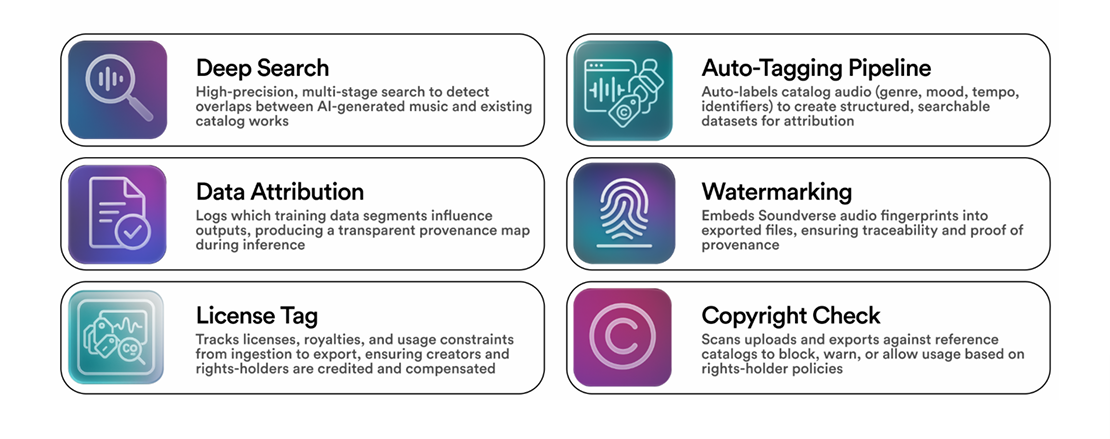
Soundverse Trace is designed as an intelligent trust layer specifically to combat these challenges. It embeds verification mechanisms directly into every stage of the music creation lifecycle — from dataset ingestion to final export.
Key Capabilities:
- Deep Search: Performs high-precision 1:1 and 1:N scans to detect overlaps among AI compositions, ensuring creators identify similarity before publishing.
- Data Attribution: Logs precisely which training data influenced an output, providing transparent provenance for every generated track.
- Audio Watermarking: Integrates inaudible fingerprinting in every AI-generated piece, making proof of authorship traceable.
- License Tagging: Preserves and transfers rights metadata consistently throughout production, preventing metadata loss or misattribution.
For content creators, this ensures they retain undeniable ownership verification and reduces the risk of dispute even if another artist produces a comparable track. For legal professionals, it offers forensic-level insights for protecting rights and verifying authenticity.
Soundverse Trace also complements solutions like the Similar Song Generator, which enables the creation of inspired compositions without infringing existing copyrights. By combining ethical frameworks, watermarking, and attribution logs, Soundverse delivers the industry’s most comprehensive response to AI music copyright issues.
Those interested in adopting best practices can further explore Soundverse Assistant and Soundverse Stem Separation AI to enhance workflow transparency.
Create Original AI Music with Confidence
Generate copyright-safe music with Soundverse and unleash your creativity without worrying about overlapping compositions. Start making unique, professional-quality tracks in minutes.
Start Creating Today
Related Articles:
- Copyright-Free vs. Royalty-Free Music: What Creators Should Know — Discover the difference between copyright-free and royalty-free music, and learn how to protect your creative works effectively.
- Navigating the World of Royalty-Free and Copyright-Free Music Using Soundverse AI — Learn how Soundverse AI makes it simple to create original tracks while navigating music licensing and copyright challenges.
- How AI-Generated Music Is Transforming the Music Industry — Explore how AI tools are reshaping how artists, producers, and creators approach music creation and authenticity.
- AI Music Generator and Human Composers: A Future Together — Understand how AI and human creativity can coexist, paving the way for collaborative musical innovation.
Here's how to make AI Music with Soundverse
Video Guide

Here’s another long walkthrough of how to use Soundverse AI.
Text Guide
- To know more about AI Magic Tools, check here.
- To know more about Soundverse Assistant, check here.
- To know more about Arrangement Studio, check here.
Soundverse is an AI Assistant that allows content creators and music makers to create original content in a flash using Generative AI.
With the help of Soundverse Assistant and AI Magic Tools, our users get an unfair advantage over other creators to create audio and music content quickly, easily and cheaply.
Soundverse Assistant is your ultimate music companion. You simply speak to the assistant to get your stuff done. The more you speak to it, the more it starts understanding you and your goals.
AI Magic Tools help convert your creative dreams into tangible music and audio. Use AI Magic Tools such as text to music, stem separation, or lyrics generation to realise your content dreams faster.
Soundverse is here to take music production to the next level. We're not just a digital audio workstation (DAW) competing with Ableton or Logic, we're building a completely new paradigm of easy and conversational content creation.
TikTok: https://www.tiktok.com/@soundverse.ai
Twitter: https://twitter.com/soundverse_ai
Instagram: https://www.instagram.com/soundverse.ai
LinkedIn: https://www.linkedin.com/company/soundverseai
Youtube: https://www.youtube.com/@SoundverseAI
Facebook: https://www.facebook.com/profile.php?id=100095674445607
Join Soundverse for Free and make Viral AI Music

We are constantly building more product experiences. Keep checking our Blog to stay updated about them!