Voice Swap vs Voice Cloning: Key Differences Explained
Discover the differences between voice swap and voice cloning technologies in 2026 and how creators use them in content production.
Voice Swap vs Voice Cloning: Key Differences Explained
Understanding the nuances between Voice Swap and Voice Cloning has become essential for content creators and AI developers in 2026. As synthetic voice generation reshapes music, gaming, and digital storytelling, knowing how these technologies differ helps creators choose the right tools for their projects. Both techniques fall under the umbrella of AI voice technology but operate in distinct ways.
What is Voice Cloning?
Voice cloning refers to the process of training an AI model to replicate a specific person’s voice – including tone, accent, and timbre. This technology captures the essence of a speaker through recorded samples and uses machine learning to recreate speech patterns accurately. In the past, voice cloning gained traction for virtual assistants and audiobooks, but by 2026, it has matured into a broader industry standard for personalization in entertainment and brand identity.
How does voice cloning work?
Voice cloning models analyze voice data to understand the performer’s vocal anatomy, micro-expressions, and phrasing habits. Through neural network training, the AI reproduces the sound of that voice speaking any text input. This is called synthetic voice generation. Developers utilize this approach for customer service bots and personalized content, but ethical considerations—particularly consent and copyright—remain central.
What is Voice Swap?
Voice Swap, on the other hand, transforms an existing vocal performance into a different voice signature. Instead of generating a new voice from text, it replaces the vocal identity within an existing audio track while keeping original timing and emotion intact. This is particularly important for music producers and voice actors looking to explore different styles without re-recording.
By swapping voices, a creator uploads an audio file containing vocals, and the AI processes it to return an output featuring a chosen voice model—be it a celebrity, a fictional character, or a custom-designed Soundverse DNA. It’s not a real-time voice changer; rather, it’s an asynchronous transformation process. This distinction is what separates Voice Swap from common voice changer tools.
Why is Voice Swap so popular in 2026?
In the past two years, creators have demanded tools that maintain performance authenticity while exploring varied vocal styles. Voice Swap meets that need perfectly. It lets content creators test ideas for demos, create parody videos, or design character voices for games without compromising emotional delivery. This trend mirrors the evolution seen in AI music technology and stems from the increasing desire for flexible creative workflows. For deeper insights on production workflows, watch our Soundverse Tutorial Series - How to Make Music.
Voice Swap vs Voice Cloning: What’s the Core Difference?
While both techniques rely on AI-driven voice synthesis, the key lies in their purpose and workflow:
- Origin of Input – Voice cloning starts with data training on recorded samples to generate a full synthetic voice. Voice swap starts with an existing vocal track and replaces its voice identity.
- Creative Control – Cloning builds a brand-new vocal asset from scratch. Swapping fine-tunes or transforms existing performances.
- Use Case Alignment – Cloning benefits companies and virtual avatars requiring consistent voices. Swapping benefits musical artists, streamers, and animators testing multiple styles.
- Ethics & Permissions – Cloning requires direct permission from the original voice owner due to potential duplication. Swapping often utilizes publicly available or licensed voices (such as Soundverse’s Community Voices).
Professionals in sound design often integrate both technologies. For example, one might clone a company spokesperson’s voice while using Voice Swap to adapt their performances across different languages or moods.
How do creators use AI voice technology effectively?
Voice cloning comparison videos and audio demos gained traction on platforms like YouTube during 2025, but in 2026, creators focus more on hybrid workflows. Combining voice swap with text-to-music generation enables efficient storytelling. Some music producers even pair Voice Swap outputs with Soundverse DNA to produce consistent songs that match unique vocal and instrumental identities.
Synthetic voice generation tools have also evolved in terms of accessibility. Platforms now focus on clear ethical boundaries—establishing systems for user consent and licensed data training. This change helps avoid controversies that plagued earlier cloning solutions.
Emerging tools shaping 2026’s AI voice landscape
Several competitor platforms like Respeecher, Voicemod, and ElevenLabs serve various segments of the AI voice market. They range from entertainment to business communication. Yet for creators in music and multimedia, Voice Swap from Soundverse stands out for its deep integration into audio production. For those wanting practical examples, explore our Soundverse Tutorial - Explore Tab.
The debate: Is voice cloning or voice swapping more creative?
The answer depends on workflow needs. Voice cloning revolutionizes personalization and accessibility, allowing brands and individuals to scale voice communication. Voice Swap, meanwhile, leans toward artistic flexibility—enabling vocal experiments without extensive datasets.
A music producer might clone their own voice for consistent releases but use Voice Swap when experimenting with character vocals or narrative demos. A game designer may clone a narrator’s voice for continuity across seasons but use Voice Swap for diverse NPC voice sets. For hands-on creative inspiration, check our deep house creation tutorial.
How Soundverse brings ethical and creative balance
Soundverse’s system prioritizes ethical data use and creativity through licensed catalogs and artist-driven AI models. Tools like the Similar Singing Generator support artists who want consistent singing styles. Combined with Soundverse DNA, creators achieve reliable results without copyright risks—a feature crucial in today’s content ecosystem.
Soundverse not only facilitates swapping vocals but also integrates seamlessly with AI music generation to provide end-to-end audio content creation. This makes it ideal for creators crafting complex multimedia experiences.
How to make voice swap and voice cloning projects with Soundverse Voice Swap
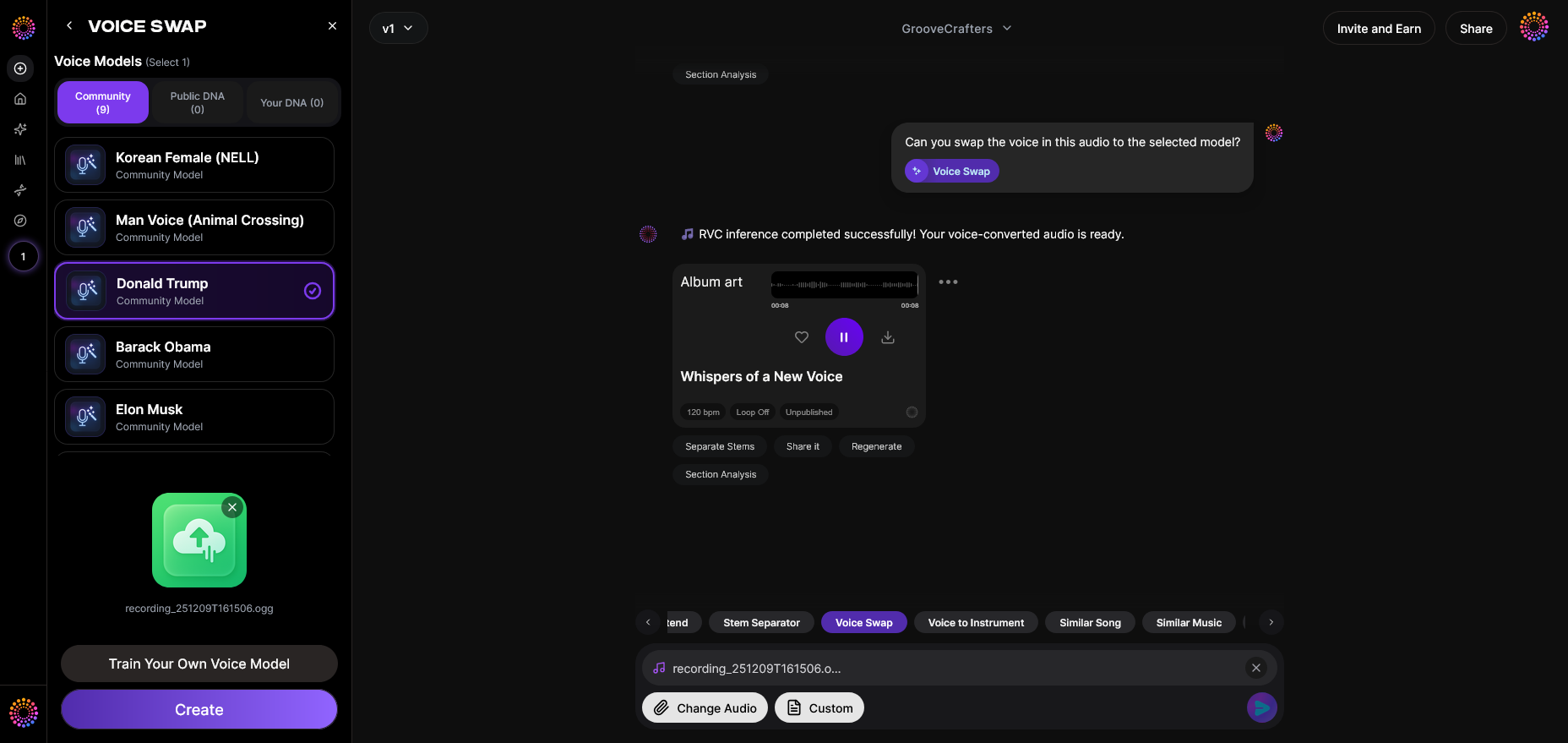
Soundverse Voice Swap allows creators to upload any vocal track and replace its vocal identity with various models. It supports Community Voices (Celebrities or Characters) and both Public and Personal DNA. Users can transform guide vocals for demos, craft parody material, or design game character dialogues without extensive re-recording.
The process is simple: upload the recorded performance, choose a target voice model, and generate the swapped output once processed. The original emotional nuances and timing remain intact, ensuring natural-sounding results. It’s the perfect blend of human artistry and AI precision.
For deeper projects, creators can integrate Voice Swap outcomes with Soundverse’s AI Magic Tools for instrument layering, stem separation, and mastering. This workflow makes Soundverse not just an AI voice changer but a holistic creative suite.
Why Soundverse Voice Swap defines the 2026 era of AI audio
The difference between voice swap vs voice cloning ultimately reflects the advancement of AI voice technology. Voice Swap amplifies flexibility and style, Voice Cloning perfects replication, and both represent modern storytelling methods. As platforms evolve, ethical considerations will remain key—especially when generating recognizable voices.
For creators who want authenticity, diversity, and emotion in their projects, Soundverse provides tools that adhere to creative freedom and legal compliance. If you’re exploring AI music trends or planning careers in sound design, Voice Swap gives your projects a unique edge.
Create AI Voices and Music with Soundverse
Experience the future of audio creation—generate lifelike vocals, experiment with AI voices, and craft professional-quality soundtracks in minutes. Perfect for musicians, content creators, and producers alike.
Related Articles
- Soundverse Introduces Stem Separation AI Magic Tool: Discover how Soundverse’s AI tool can isolate vocals and instruments, giving you complete creative control.
- Soundverse Saar: The AI Voice Assistant: Learn how Soundverse Saar helps creators generate realistic AI voices and streamline music production effortlessly.
- AI Music Generator and Human Composers: A Future Together: Explore how AI complements human creativity in modern music composition and production.
- How AI-Generated Music is Transforming the Music Industry: Uncover how AI-generated content is reshaping the soundscape for producers and creators worldwide.
Here's how to make AI Music with Soundverse
Video Guide

Here’s another long walkthrough of how to use Soundverse AI.
Text Guide
- To know more about AI Magic Tools, check here.
- To know more about Soundverse Assistant, check here.
- To know more about Arrangement Studio, check here.
Soundverse is an AI Assistant that allows content creators and music makers to create original content in a flash using Generative AI.
With the help of Soundverse Assistant and AI Magic Tools, our users get an unfair advantage over other creators to create audio and music content quickly, easily and cheaply.
Soundverse Assistant is your ultimate music companion. You simply speak to the assistant to get your stuff done. The more you speak to it, the more it starts understanding you and your goals.
AI Magic Tools help convert your creative dreams into tangible music and audio. Use AI Magic Tools such as text to music, stem separation, or lyrics generation to realise your content dreams faster.
Soundverse is here to take music production to the next level. We're not just a digital audio workstation (DAW) competing with Ableton or Logic, we're building a completely new paradigm of easy and conversational content creation.
TikTok: https://www.tiktok.com/@soundverse.ai
Twitter: https://twitter.com/soundverse_ai
Instagram: https://www.instagram.com/soundverse.ai
LinkedIn: https://www.linkedin.com/company/soundverseai
Youtube: https://www.youtube.com/@SoundverseAI
Facebook: https://www.facebook.com/profile.php?id=100095674445607
Join Soundverse for Free and make Viral AI Music

We are constantly building more product experiences. Keep checking our Blog to stay updated about them!