Using AI Music Tools Without Violating Grammy Authorship Rules in 2026
Learn how to use AI music tools ethically while staying compliant with Grammy authorship rules in 2026.
Using AI Music Tools Without Violating Grammy Authorship Rules
In 2026, the intersection of artificial intelligence and musical creativity is more complex than ever. With AI-powered composition tools reshaping production workflows, artists and producers now face an important challenge: how to create with AI without violating Grammy authorship rules or music copyright laws. The Recording Academy’s updated eligibility guidelines, introduced in late 2024 and implemented fully by 2025, make it clear — AI can assist, but it cannot author. This nuance is critical as technology continues to advance through platforms like Soundverse, which have developed frameworks ensuring musicians remain both compliant and creative.
Why Are Grammy Authorship Rules Important in the Age of AI?
The Grammy Awards have always centered on recognizing human artistry. As of 2026, the official rules specify that only human creators may receive authorship and songwriting recognition. While AI-assisted music production is allowed, eligibility depends on the ratio of creative control held by the human artist. For example, if you generate a backing track through a system trained on licensed data, and then refine it manually, the composition remains eligible. However, if an AI composes full songs autonomously, you cannot claim authorship for categories like Song of the Year.

This clarity aligns with broader ethical AI music principles, emphasizing consent, transparency, and data integrity. Musicians must now focus on maintaining authorship traceability, ensuring that their AI collaborations comply with these Grammy rules while still allowing efficient creative workflows.
What Do 2026 Grammy Rules Say About AI Music Authorship?
The 2026 Grammy guidelines reaffirm a position that matured throughout 2025: AI cannot be credited as an author, songwriter, or producer. The human must demonstrate creative input and decision-making. The Recording Academy now requires proof of creative authorship during submission, which may include:
- Documentation of human-led decisions.
- Description of AI’s role as an assistive tool.
- Verification that generated music has transparent licensing.

These conditions affect everyone from indie producers to top-tier artists experimenting with platforms mentioned on Soundverse’s blog. They signal a new era of accountability, in which technology supports but never replaces the artistic individual. According to the official Grammy rulebook, only human creators are eligible for nomination or consideration, reinforcing the importance of visible human authorship.
How Ethical AI Music Aligns With Grammy Eligibility Standards
Using ethical AI music tools isn’t just about award compliance — it’s also about supporting sustainable artistry. Right now, ethical AI music frameworks emphasize three pillars:
- Licensed training data: ensuring no unauthorized catalogs are used.
- Transparent attribution: knowing where the sonic material originated.
- Fair monetization: rewarding rights-holders for ongoing participation.
Ethical AI music fosters a responsible community where innovation respects creative labor. That’s why solutions like Soundverse Trace and Soundverse DNA have become critical infrastructures for professional creators.
How to Make Ethical AI Music With Soundverse The Ethical AI Music Framework
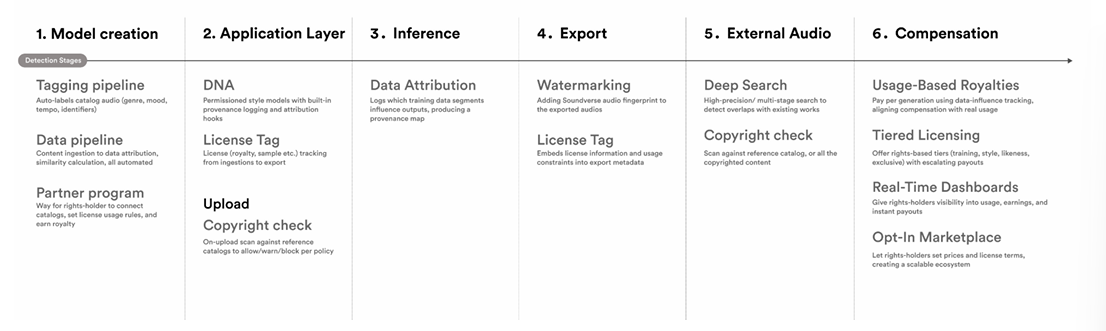
Soundverse’s Ethical AI Music Framework provides the structure musicians and producers need to stay compliant with both Grammy authorship rules and global copyright principles.
Transparent Six-Stage Infrastructure
This end-to-end architecture guarantees creative control, consent, and attribution. Here’s how it works:
- Licensed Data Sourcing (Stage 1): Soundverse only uses audio obtained through official licensing. There’s no scraping from public sites, ensuring all datasets comply with copyright law.
- Permissioned Models (Stage 2): Each AI engine carries encoded DNA metadata validating that participating artists fully consented to training usage.
- Explainable Inference (Stage 3): Generated music includes traceable attribution, confirming sources and influences.
- Traceable Export (Stage 4): Final tracks include unique watermarking for identification and compliance audits.
- Deep Search (Stage 5): The system can scan external spaces to detect unauthorized usage or overlapping works.
- Recurring Compensation (Stage 6): Rights-holders are paid continuously through an opt-in partner program that registers AI usage data.
The framework bridges innovation and integrity. Musicians gain access to next-generation efficiency while remaining Grammys-eligible. It ultimately ensures ethical AI music creation without compromising human authorship recognition.
How Does AI in Songwriting Change Creative Roles?
AI has moved from instrument emulation to full composition assistance. By 2026, many producers use AI tools for melody generation, harmonic structuring, or instrumental layering. However, the artistic core — intent, message, and emotion — remains human. Tools like Soundverse DNA allow artists to define their signature sound in ethical ways by training models on licensed catalogs and personal sonic identities.
AI in songwriting can accelerate workflow. Instead of spending hours building initial drafts, creators can outline themes and moods and let the AI suggest chord progressions or rhythmic variations. The human artist then curates, arranges, and edits. This human-in-the-loop approach satisfies Grammy authorship standards because the artist retains final creative control. For an applied overview of these processes, check out the Soundverse Tutorial Series - 9. How to Make Music or Deep House Music tutorials.
What Are the Common Mistakes When Using AI in Music Production?
Even with ethical technology available, musicians sometimes make costly errors that risk disqualification or copyright disputes. Here are common pitfalls to avoid:
- Letting AI determine authorship: If the AI designs entire songs without human revision, you cannot claim authorship under Grammy standards.
- Using scraped or unlicensed datasets: Always check that your AI platform sources music legally, as unlicensed samples may violate copyright.
- Ignoring attribution requirements: Every output should trace back to its training source, significantly when submitting for publication.
- Failing to record creative interventions: Keep logs showing how you directed or edited AI outputs.
Ethical compliance can be maintained easily using Soundverse Trace, which embeds invisible watermarks for verification. It’s a safeguard ensuring transparency across production stages.
Why Is Music Copyright and AI Becoming Intertwined?
Music copyright and AI are now inseparable topics. The rise of generative models means creators must know exactly how their data is used. As evidenced by discussions in industry trend analyses, the legal landscape favors platforms that prioritize protection and attribution. Laws in the EU and US increasingly demand identifiable datasets and audit trails for AI-generated music.
For Grammy eligibility, intellectual property integrity directly impacts awards consideration. If you use AI-generated instrumental layers, every sound must stem from a lawful source — otherwise, eligibility can be revoked. This interdependence between music copyright and AI ethics underscores why frameworks like Soundverse’s are shaping music’s sustainable future.
How Can Producers Maintain Compliance and Creativity in 2026?
Being compliant doesn’t mean limiting innovation. It’s about understanding boundaries. Producers can follow this simplified roadmap:
- Select ethical AI tools — like Soundverse’s suite, which guarantees licensed data.
- Document creative actions — when you edit, arrange, or mix, record those steps.
- Attribute AI assistance — don’t hide it; transparency increases credibility.
- Join partner programs — such as Soundverse’s Content Partner Program, to monetize AI-generated works legally.
Maintaining compliance while unlocking creativity is the balance modern artistry demands. By doing so, musicians preserve both recognition and reward.
How Soundverse Helps You Stay Grammys-Eligible While Using AI
Soundverse provides a scalable, ethical backbone for modern music production. Through the Ethical AI Music Framework, it replaces opaque processes with transparent, traceable infrastructures built around six certifiable stages. With Soundverse DNA, musicians can safely train AI on personal styles; with Trace, they can audit every output. Combined, these tools transform AI from a potential risk into a trusted collaborator. For full platform usage, explore the Explore Tab tutorial on Soundverse’s YouTube channel.
If you’re exploring new genres, Soundverse’s AI Magic Tools offer cross-genre adaptability while keeping creative authorship intact. Whether you’re producing country tracks (guide here) or experimenting with electronic sound design (EDM workflow), Soundverse ensures full transparency.
Create Music the Smart and Legal Way with Soundverse
Explore AI music creation tools designed to empower artists while respecting authorship rules. Start producing unique, Grammy-ready tracks that remain ethically and legally compliant.
Start Creating with Soundverse
Related Articles
- How AI-Generated Music Is Transforming the Music Industry: Discover how artificial intelligence is reshaping music production, performance, and distribution worldwide.
- AI Music Generator and Human Composers: A Future Together: Learn how AI tools and human creativity can collaborate to produce groundbreaking musical compositions.
- Copyright-Free vs. Royalty-Free Music: What Creators Should Know: Understand the crucial distinctions between copyright-free and royalty-free music when producing AI-generated tracks.
- AI Music in the USA: Get insights into how AI music creation intersects with U.S. copyright laws and creative ownership rights.
Here's how to make AI Music with Soundverse
Video Guide

Here’s another long walkthrough of how to use Soundverse AI.
Text Guide
- To know more about AI Magic Tools, check here.
- To know more about Soundverse Assistant, check here.
- To know more about Arrangement Studio, check here.
Soundverse is an AI Assistant that allows content creators and music makers to create original content in a flash using Generative AI.
With the help of Soundverse Assistant and AI Magic Tools, our users get an unfair advantage over other creators to create audio and music content quickly, easily and cheaply.
Soundverse Assistant is your ultimate music companion. You simply speak to the assistant to get your stuff done. The more you speak to it, the more it starts understanding you and your goals.
AI Magic Tools help convert your creative dreams into tangible music and audio. Use AI Magic Tools such as text to music, stem separation, or lyrics generation to realise your content dreams faster.
Soundverse is here to take music production to the next level. We're not just a digital audio workstation (DAW) competing with Ableton or Logic, we're building a completely new paradigm of easy and conversational content creation.
TikTok: https://www.tiktok.com/@soundverse.ai
Twitter: https://twitter.com/soundverse_ai
Instagram: https://www.instagram.com/soundverse.ai
LinkedIn: https://www.linkedin.com/company/soundverseai
Youtube: https://www.youtube.com/@SoundverseAI
Facebook: https://www.facebook.com/profile.php?id=100095674445607
Join Soundverse for Free and make Viral AI Music
 We are constantly building more product experiences. Keep checking our Blog to stay updated about them!