The Ultimate Future of AI Music Ecosystems: Ethics, Innovation, and the Creator Economy in 2026
Explore the evolution of AI music ecosystems in 2026, ethical innovation, and how Soundverse leads creator economy trends.
The Ultimate Future of AI Music Ecosystems
In 2026, AI music ecosystems have transitioned from experimental platforms to fully integrated creative infrastructures that redefine the global music industry. The convergence of artificial intelligence, ethical frameworks, and creator-centric economic models is shaping a new era of music technology innovation. This transformation impacts not only producers and artists but also record labels, streaming platforms, and AI researchers driving the boundaries of digital sound.
What are AI music ecosystems and why do they matter in 2026?
AI music ecosystems describe interconnected frameworks where artificial intelligence tools, licensing systems, and creative communities interact seamlessly to produce and distribute music ethically. These ecosystems integrate composition AI, digital rights management, content attribution, and monetization channels. By 2026, this concept has evolved beyond isolated generators; instead, platforms now function as transparent collaborative networks where artists, labels, and technologies coexist to sustain creative growth.
As the creator economy continues its upward trend, these ecosystems ensure fair participation. Traditional music production models are being replaced by cloud-based AI studios capable of interpreting complex musical patterns and creating adaptive sounds unique to each user. Instead of static royalty systems, creators engage in dynamic, usage-based compensation enabled by blockchain-style reporting and consent-driven training protocols. According to AI Music 2026: Global Adoption, Market Trends & Creative Evolution, the year 2026 stands as a watershed moment in the music industry's relationship with artificial intelligence.
How are creator economy trends influencing AI music ecosystems?
The creator economy in 2026 thrives on the principle of creative ownership and digital transparency. Musicians and content creators increasingly prefer platforms that offer clear attribution and continuous earnings. Unlike the early AI models of 2024 and 2025—which often faced criticism for non-consensual data scraping—modern AI infrastructures are permission-based, returning control to artists.
In this environment, musicians become part of recurring royalty networks rather than one-time licensing systems. AI researchers and music technologists collaborate within these digital ecosystems to align ethical AI development with creative freedom. Each algorithmic layer is audited, ensuring data provenance and equitable usage. As creators build trust in these transparent systems, the adoption of enterprise-grade AI solutions accelerates, driving new creator economy trends discussed in this Soundverse article.
What drives innovation in music technology in 2026?
Music technology innovation in 2026 hinges on three fundamental pillars: efficiency, ethics, and experience. AI-powered music production tools like Soundverse DNA blend these attributes seamlessly. AI networks are now capable of generating entire soundscapes through context-aware composition, adjusting mood, and style based on the creator’s artistic identity.
Advancements in neural audio modeling have made “style transfer” reliable and copyright-safe. Platforms increasingly depend on licensed datasets where artists opt-in to share their musical DNA. Unlike previous generative models, these frameworks maintain traceability from dataset to output through watermarking and deep search capabilities.
To explore how genre-specific AI methods contribute, watch our guide on how to make music, or read this analysis on AI-generated music. It showcases how transparent ecosystems are powering creative independence for next-gen musicians.
How does AI-powered music production change the creative workflow?
In 2026, AI-powered music production tools are not simply automating sound generation—they are augmenting human creativity. Producers use text-to-music prompts or structured descriptions to create fully mixed tracks in minutes. Tools within the Soundverse ecosystem enable users to input keywords such as genre, theme, or vibe, much like in this guide on generating music with filters.
This shift produces immediate creative feedback and customization opportunities. Digital creators can produce content-tailored soundtracks for gaming, film, or virtual reality experiences while maintaining ethical integrity through permissioned models. By leveraging transparent AI frameworks, creators avoid copyright conflicts and establish lasting audience trust. For a deeper dive, watch our tutorial on creating Deep House music.
How are digital creators using AI music ecosystems for brand development?
Digital creators in 2026 engage with AI music ecosystems as brand-building engines. Music is no longer just a background feature—it forms part of a creator’s identity. AI tools that analyze visual tone, audience demographics, and engagement metrics help artists maintain consistent sonic branding across platforms. Ethical frameworks uphold this process by guaranteeing creators retain rights while collaborating with AI.
Innovative integration across content formats—including short-form videos, virtual performances, and metaverse exhibitions—demands scalable, copyrighted-safe audio. Soundverse’s system ensures that creators using AI-generated compositions can issue attribution automatically, solving long-standing licensing challenges existing before 2025.
How to make ethical and sustainable AI music ecosystems with Soundverse The Ethical AI Music Framework
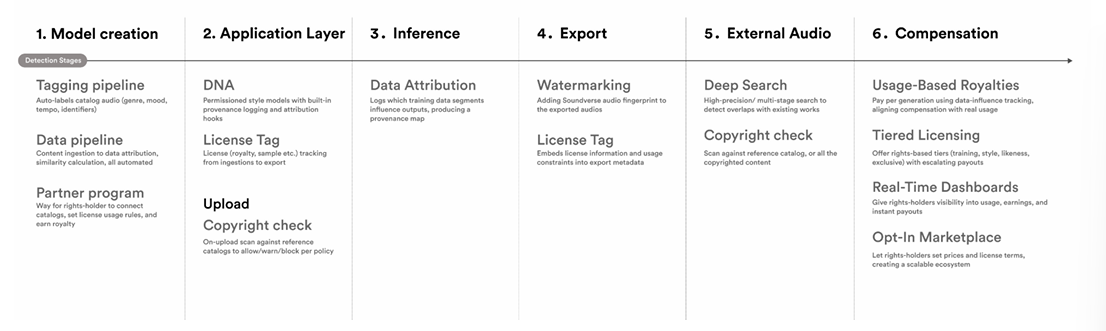
The Ethical AI Music Framework by Soundverse serves as the cornerstone for constructing ethical, transparent, and scalable AI music ecosystems in 2026. It is an end-to-end infrastructure that bridges innovation with artist integrity, replacing traditional black-box models with a six-stage transparent process ensuring consent, attribution, and recurring compensation.
Six Stages of the Ethical AI Music Framework
- Licensed Data Sourcing (No Scraping): Ensures all training datasets originate from legally licensed sources, eliminating copyright risk.
- Permissioned Models (DNA): Employs artist-verified style data so that creators can monetize their sonic DNA while maintaining authenticity.
- Explainable Inference (Attribution): Provides detailed attribution maps linking generated sound outputs back to contributing artists.
- Traceable Export (Watermarking): Every exported track contains invisible watermark tags, enabling identification and audit during distribution.
- Deep Search (External Scanning): Continuously scans external platforms for unlicensed copies or derivatives.
- Recurring Compensation (Partner Program): Through the Content Partner Program, creators receive recurring royalties each time their trained model contributes to a generation.
This structured framework empowers labels and production studios to scale ethically. It aligns with the growing need for transparency and sustainability within enterprise AI music solutions. As noted in The Future of AI Music in Web3 Ecosystems, blockchain-based infrastructures will play a pivotal role in ensuring transparency and ownership verification in this process.
Why Soundverse DNA and Soundverse Trace define the future of sound design
Soundverse DNA takes the personalization of AI-generated music to new heights. By utilizing licensed catalogs from participating artists, it guarantees legal compliance and stylistic consistency. It helps creators develop modular sonic elements adaptable across genres—from EDM to meditation tracks—much like the methods explained in this article on meditation music creation.
Soundverse Trace complements DNA by functioning as a trust layer. It embeds attribution and rights protection across a track’s entire lifespan—from dataset creation through to export. Together, these tools fortify the creator economy by replacing guesswork and copyright anxiety with verifiable transparency.
What is the future of sound design and AI creative collaboration?
By 2026, sound design is moving toward generative co-creation where human intuition meets machine intelligence. Instead of AI replacing the artist, AI behaves as a co-producer—one that understands creative goals while adhering to ethical guidelines. Deep learning models in music now interpret spatial, emotional, and cultural cues, extending beyond basic rhythm or melody generation.
Future sound design trends emphasize modularity: the blending of human-recorded layers with AI-produced harmonics and textures. This collaborative workflow creates immersive audio suitable for virtual and augmented realities. As more creators integrate traceable frameworks, the distinction between digital and organic sound continues to blur, creating an entirely new auditory aesthetic. For creators exploring new creative environments, try our Explore Tab tutorial on Soundverse’s YouTube channel.
Start Creating Music with AI Today
Experience the future of sound creation with Soundverse’s powerful AI tools that help you generate original tracks, separate stems, and refine vocals—all within seconds.
Related Articles
- How AI-Generated Music Is Transforming the Music Industry: Explore how artificial intelligence is redefining creativity, production, and collaboration in the music industry.
- AI Music Generator and Human Composers: A Future Together: Discover how AI complements human creativity to shape the evolution of modern music composition.
- Soundverse Assistant: Your AI Music Co-Producer: Meet your intelligent music-making partner—Soundverse Assistant—designed to amplify your production workflow.
- AI Music in the USA: Learn how AI music is influencing America’s creative landscape and the key players driving innovation.
Here's how to make AI Music with Soundverse
Video Guide

Here’s another long walkthrough of how to use Soundverse AI.
Text Guide
- To know more about AI Magic Tools, check here.
- To know more about Soundverse Assistant, check here.
- To know more about Arrangement Studio, check here.
Soundverse is an AI Assistant that allows content creators and music makers to create original content in a flash using Generative AI. With the help of Soundverse Assistant and AI Magic Tools, our users get an unfair advantage over other creators to create audio and music content quickly, easily and cheaply. Soundverse Assistant is your ultimate music companion. You simply speak to the assistant to get your stuff done. The more you speak to it, the more it starts understanding you and your goals. AI Magic Tools help convert your creative dreams into tangible music and audio. Use AI Magic Tools such as text to music, stem separation, or lyrics generation to realise your content dreams faster. Soundverse is here to take music production to the next level. We're not just a digital audio workstation (DAW) competing with Ableton or Logic, we're building a completely new paradigm of easy and conversational content creation.
TikTok: https://www.tiktok.com/@soundverse.ai
Twitter: https://twitter.com/soundverse_ai
Instagram: https://www.instagram.com/soundverse.ai
LinkedIn: https://www.linkedin.com/company/soundverseai
Youtube: https://www.youtube.com/@SoundverseAI
Facebook: https://www.facebook.com/profile.php?id=100095674445607
Join Soundverse for Free and make Viral AI Music

We are constantly building more product experiences. Keep checking our Blog to stay updated about them!