The Future of AI Music in Web3 Ecosystems: Ethics, Ownership, and Innovation in 2026
Explore how AI music in Web3 is redefining artist rights, blockchain music, and creative ownership in 2026.
Future of AI Music in Web3 Ecosystems
Introduction
In 2026, the convergence of artificial intelligence (AI) and blockchain continues to reshape the creative landscape. Nowhere is this transformation more visible than in the rise of AI music in Web3—a movement where generative music models meet decentralized ownership infrastructures. The resulting synergy is giving rise to transparent revenue systems, artist-first licensing frameworks, and community-driven production models that redefine the very meaning of authorship and creativity.
As AI music tools evolve, discussions once limited to innovation now encompass ethics, consent, and attribution. The decentralized nature of Web3 helps ensure that artists, developers, and listeners can all interact without centralized intermediaries, enabling a new economy where creativity and technology harmonize.
Before exploring the key advancements, let’s first understand why Web3 is poised to become the ethical and economic foundation for AI-driven music production.
What is AI music in Web3 and why does it matter in 2026?
AI music in Web3 refers to generative music systems that rely on blockchain-based infrastructures for transparency, ownership verification, and fair royalty distribution. In this paradigm, AI doesn’t replace artists—it amplifies their creative autonomy while blockchain guarantees data traceability and financial fairness.
In 2025, the music industry faced rising concerns about unauthorized AI model training. Many generative systems had relied on unlicensed samples, raising copyright disputes. By 2026, however, Web3 protocols have introduced tokenized ownership, smart contracts, and proof-of-origin mechanisms that ensure artists are properly credited and compensated.
For example, decentralized music platforms can now issue NFTs that represent not just ownership but verifiable lineage of musical data—ensuring both human and AI contributors receive attributable credit. The Choruz AI Web3 platform illustrates how creators can generate, own, and monetize music directly as NFTs, demonstrating the expanding frontier of music innovation tied to Web3.

How blockchain is shaping the future of AI-generated music
Blockchain’s role in AI music in Web3 is far more than infrastructure—it is an ethical framework. By leveraging smart contracts, artists can set terms for how their works or style models can be used within an AI system. These contracts provide avenues for recurring royalties, usage tracking, and licensing transparency.
1. Decentralized Copyright and Identity
Musicians and AI developers use blockchain to authenticate style data through encrypted ledgers. Every AI model trained on music now includes a transparent record of contributors, ensuring creators remain identifiable at every step of the production pipeline. As detailed in Soundverse’s Smart Contracts for AI Music Licensing blueprint, this framework is becoming a 2026 industry standard.
2. Tokenized Monetization Models
The blockchain music future depends on token-based micro-economies. Artists issue tokens tied to their catalog’s usage across AI systems, ensuring payments are automated through smart contracts. This minimizes disputes and maximizes accountability.
3. Transparent Data Lineage
Since AI-generated compositions rely on datasets, blockchain technologies trace the genealogy of these datasets—who contributed them, when, and where they’re being applied. This clarity promotes ethical innovation without stifling creativity.
For professionals curious about how AI is transforming the wider music landscape, see Soundverse’s in-depth article How AI-Generated Music is Transforming the Music Industry.

What are the biggest crypto music trends in 2026?
The crypto music trends of 2026 reveal a fundamental shift from speculative hype to sustainability. Here are three defining directions:
1. AI-Creator Collaboratives
Musicians are forming DAOs (Decentralized Autonomous Organizations) that govern AI model licensing and distribution collectively. This enables small producers and large labels alike to benefit transparently from shared generative models.
2. Cross-Metaverse Music Ecosystems
With the growth of open metaverse standards, musical works can now move freely across worlds. AI-generated background scores adapt dynamically based on user behavior, with smart contracts redistributing micro-royalties in real time. Successful ecosystems like Audius and Emanate are pioneering decentralized music integration across digital spaces.
3. Ethical Model Markets
Web3-native marketplaces built around ethical AI model training allow artists to contribute their sound DNA to training pools. In return, they earn recurring compensation when their sonic characteristics power commercial outputs. This business model helps bridge the gap between artists and AI.
To explore more on evolving music technologies, visit Music Industry Trends for a forward-looking analysis of where these innovations are leading.
How does decentralized audio empower creators?
Decentralized audio platforms decentralize not just data storage but also creative control. By doing so, they disentangle music creation from centralized corporate structures. For AI and blockchain developers, this opens possibilities for modular, interoperable plug-ins capable of generating or transforming sound while maintaining provenance data.
Smart contracts register every interaction with an audio sample or AI-generated track. Whenever the music is remixed, resampled, or streamed, artists receive automatic micro-royalties with zero mediation. This level of transparent tracking is turning old royalty collection systems into obsolete relics.
In practice, decentralized audio ensures creative ecosystems remain open, collaborative, and sustainable. Whether a DJ loads AI-mediated ambient loops or a game developer retrieves generative soundscapes for immersive environments, every transaction is securely verifiable. For an applied perspective, watch the Soundverse tutorial on how to make music and explore the creative power of decentralized production.
How to make the most of AI music in Web3 with Soundverse’s Ethical AI Music Framework
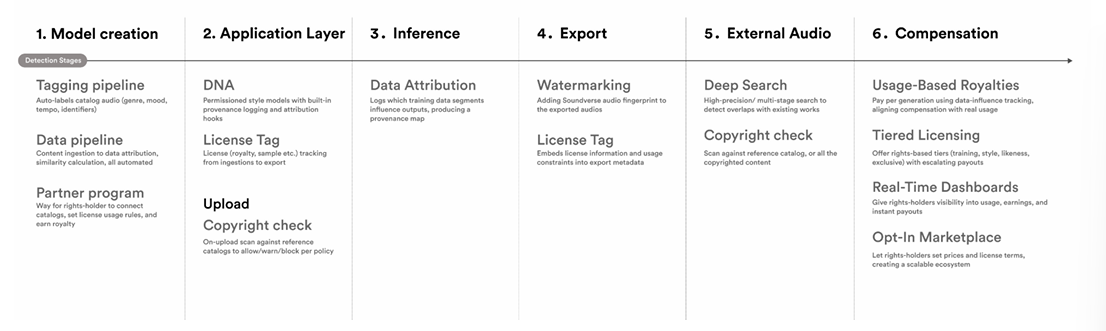
The most pivotal development enabling ethical innovation in 2026 is Soundverse’s Ethical AI Music Framework—a fully transparent, six-stage pipeline aligning AI innovation with artist integrity.
What is the Ethical AI Music Framework?
The Ethical AI Music Framework is an end-to-end infrastructure that replaces opaque generative processes with transparency and traceability. It is specifically engineered to handle consent-based data sourcing, explainable inference, secure watermarking, and recurring compensation.
The Six Core Stages:
- Licensed Data Sourcing – Rather than scraping content from the internet, Soundverse obtains fully licensed datasets, ensuring every creator’s consent.
- Permissioned Models (DNA) – AI models are built from artist-authorized data, preserving sonic identity without infringing on copyright.
- Explainable Inference (Attribution) – The framework links each generated track to its data origins, guaranteeing fair attribution.
- Traceable Export (Watermarking) – Every exported file is embedded with traceable metadata preserving authorship lineage.
- Deep Search (External Scanning) – This feature continuously scans external platforms to monitor unauthorized reuse.
- Recurring Compensation (Partner Program) – Artists contributing audio through the Content Partner Program receive automated royalties whenever their data is utilized.
This ethical transparency creates an immutable trust layer between creators and enterprises. Major labels relying on AI for catalog expansion can now do so within fully compliant frameworks.
Soundverse’s complementary solutions like Soundverse DNA—an artist-trained AI engine—and Soundverse Trace—a trust infrastructure embedding attribution—reinforce this ethical ecosystem. Together, they enable a new blockchain music future anchored in accountability.
Professionals interested in applied creative workflows can explore Generate AI Music with Soundverse Text-to-Music or experiment with feature-based generation using Now Generate Music with Filters Such As Genre, Theme, Instruments or Even Vibe.
The growing importance of ethics and compliance in 2026
In 2026, ethical AI adoption is not a marketing advantage—it’s a compliance requirement. As governments standardize digital rights frameworks, companies engaging with AI music systems must follow consent and attribution guidelines similar to content licensing laws.
Within this environment, frameworks like Soundverse’s stand out as viable, industry-ready solutions capable of mitigating legal risks while fostering open innovation. For artists, this means maintaining ownership of their digital identity; for enterprise users, it means operating with audit-ready transparency.
Join the Next Evolution of Music Creation
Experience the power of AI-driven composition and ownership in the Web3 era. Start generating, minting, and sharing your AI music on decentralized platforms today.
Start Creating with Soundverse
Related Articles
- How AI-Generated Music Is Transforming the Music Industry — Discover how artificial intelligence is reshaping every layer of the modern music landscape.
- AI Music Generator and Human Composers: A Future Together — Explore how human creativity and AI collaboration are forming the foundation for a new music era.
- Soundverse AI: Revolutionizing Music Creation for New-Age Content Creators — Learn how Soundverse’s AI tools empower creators to produce music faster and more freely than ever before.
- What AI Can Generate Songs — Understand the capabilities of AI music systems and how they are redefining composition and ownership.
Here's how to make AI Music with Soundverse
Video Guide

Here’s another long walkthrough of how to use Soundverse AI.
Text Guide
- To know more about AI Magic Tools, check here.
- To know more about Soundverse Assistant, check here.
- To know more about Arrangement Studio, check here.
Soundverse is an AI Assistant that allows content creators and music makers to create original content in a flash using Generative AI. With the help of Soundverse Assistant and AI Magic Tools, our users get an unfair advantage over other creators to create audio and music content quickly, easily and cheaply. Soundverse Assistant is your ultimate music companion. You simply speak to the assistant to get your stuff done. The more you speak to it, the more it starts understanding you and your goals. AI Magic Tools help convert your creative dreams into tangible music and audio. Use AI Magic Tools such as text to music, stem separation, or lyrics generation to realise your content dreams faster. Soundverse is here to take music production to the next level. We're not just a digital audio workstation (DAW) competing with Ableton or Logic, we're building a completely new paradigm of easy and conversational content creation.
TikTok: https://www.tiktok.com/@soundverse.ai
Twitter: https://twitter.com/soundverse_ai
Instagram: https://www.instagram.com/soundverse.ai
LinkedIn: https://www.linkedin.com/company/soundverseai
Youtube: https://www.youtube.com/@SoundverseAI
Facebook: https://www.facebook.com/profile.php?id=100095674445607
Join Soundverse for Free and make Viral AI Music
 We are constantly building more product experiences. Keep checking our Blog to stay updated about them!