The Business Case for Ethical AI Music Tools in 2026
Explore why ethical AI music tools are the foundation for sustainable music business models in 2026.
The Business Case for Ethical AI Music Tools
In 2026, the music industry's digital transformation has entered its most ethically demanding phase yet. As AI-generated music becomes mainstream, entrepreneurs, AI developers, and record labels are grappling with a critical question: how can innovation grow without sacrificing artist integrity? The answer lies in developing and implementing ethical AI music tools that prioritize transparency, consent, and fair compensation.
AI-driven music innovation is not new. Over the past two years, companies have developed systems capable of creating melodies, harmonies, and entire songs based on text prompts. Yet, the rise of generative platforms has also fueled debate about data sourcing, artist rights, and the ethics of AI-driven creativity. In 2026, these discussions are no longer theoretical—they’re shaping real business models across the global music economy.
Why do businesses need ethical AI music tools in 2026?
Music technology startups and established enterprises are increasingly realizing that ethical AI isn’t just a moral stance; it’s a business necessity. The era of unchecked data scraping and black-box algorithms is ending. Countries across Europe and North America have introduced stricter AI auditing policies, requiring proof of dataset legitimacy and consent-based training methods.

Companies using AI music tools must therefore demonstrate compliance or risk reputational and financial penalties. Ethical technology in music ensures long-term brand trust and regulatory resilience. A system designed with AI music ethics in mind minimizes legal exposure while maximizing creative output.
What defines ethical AI music tools?

Ethical AI music tools follow principles that protect rights-holders while enabling innovation. The three core pillars underpinning ethical music generation in 2026 include:
- Transparency: Developers must disclose data sources and model architecture openly. This helps creators understand whether their work contributes to training datasets.
- Consent and Attribution: Artists should be asked for permission and credited when their intellectual property is used.
- Recurring Compensation Models: Revenue-sharing structures that reward rights-holders each time generated content includes or resembles their licensed material.
Implementing these pillars builds sustainable ecosystems. Ethical AI is not a hurdle—it’s a growth driver that attracts investors who prioritize responsible innovation.
How ethical AI transforms music business models
Until 2025, AI music technologies operated mainly under experimental models—low transparency, limited rights management, and one-time licensing fees. However, the current era demands models that balance creativity with integrity.
In 2026, startups are adopting responsible AI in music frameworks to signal compliance and fairness. Investors view companies that integrate ethical standards as lower-risk and future-proof. Label executives also favor systems that ensure proper attribution, as these digital audit trails facilitate royalty collection and distribution.
Ethical AI music tools create measurable value:
- Legal Sustainability: Clear consent pathways reduce exposure to infringement claims.
- Market Differentiation: Transparency becomes a unique selling proposition.
- Revenue Expansion: Recurring compensation structures incentivize rights-holders and build trust with new contributors.
To explore how responsible systems can lead innovation, see Soundverse’s insights on AI music business trends. For a deeper dive, watch our guide on creating Deep House music and tutorial on making music with AI.
What are the risks of ignoring AI music ethics?
Ignoring AI music ethics can lead to serious reputational and regulatory consequences. Platforms that scrape unlicensed data or fail to credit artists risk being excluded from marketplace listings or facing copyright lawsuits. The rapid development of AI generators in 2025 demonstrated that audiences and creators demand accountability.
Musicians and publishers now prefer companies operating under ethical AI frameworks. As data regulation matures, even advanced text-to-music generators must show traceability and explainability. The lack of these elements could severely damage user trust—a costly mistake in today’s competitive market.
Learn how transparent generation methods prevent such risks in Soundverse’s coverage of how AI-generated music is transforming the music industry.
How Soundverse builds the business case for ethical AI music tools
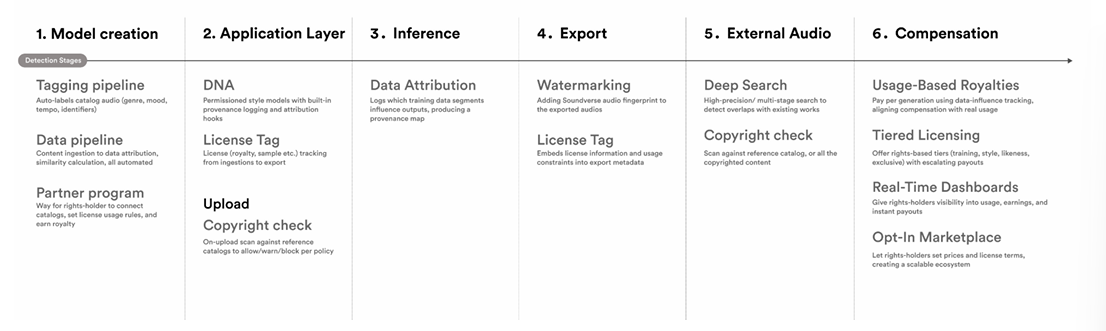
Soundverse leads the global conversation on responsible AI in music with its flagship Ethical AI Music Framework—the infrastructure specifically designed to bridge the gap between innovation and artist integrity.
The Six-Stage Ethical AI Music Framework
Soundverse’s system replaces opaque processes with a transparent, auditable pipeline:
- Licensed Data Sourcing (No Scraping): Soundverse partners directly with rights-holders to obtain legal datasets for training. No unlicensed content enters the workflow.
- Permissioned Models (DNA): Only consent-based, lineage-proven data feeds the model. Artists can opt into training through the Content Partner Program.
- Explainable Inference (Attribution): Each generated output includes metadata identifying influences and contributors, enabling proper credit.
- Traceable Export (Watermarking): Soundverse embeds invisible watermarks in exports, ensuring traceability across streaming and commercial use.
- Deep Search (External Scanning): Automated systems scan global databases to prevent content overlap with protected works.
- Recurring Compensation (Partner Program): Rights-holders earn continued royalties each time their licensed data is referenced during generation.
This six-stage architecture provides clear benefits to enterprise clients:
- Compliance verification: Transparent processes make auditing seamless.
- Attribution automation: Artists automatically receive recognition.
- Revenue continuity: Ethical generation leads to sustainable monetization.
The Ethical AI Music Framework helps companies meet legal obligations while strengthening customer relationships. It transforms responsible AI in music from a theoretical principle into a working product.
Integrated Solutions: Content Partner Program and Soundverse Trace
The Content Partner Program within Soundverse offers an opt-in licensing structure for creators who contribute audio data. Participants earn usage-based royalties whenever their material is referenced by the AI model, a mechanism that revolutionizes how rights-holders participate in digital training ecosystems.
Meanwhile, Soundverse Trace provides the trust layer that validates attribution and rights protection across each stage—from dataset assembly to output delivery. Combined, these tools form a holistic solution for ethical technology in music.
For developers exploring system integration or additional AI capabilities, read about Soundverse’s AI Magic Tools and adaptive model design featured in Soundverse introduces stem separation AI Magic Tool.
What business opportunities emerge through ethical AI models?
Implementing ethical AI music tools unlocks multiple growth channels:
- Partnership Revenue: Rights-holder collaboration increases dataset diversity and commercial reach.
- Regulatory Alignment: Transparency makes it easier to scale globally without compliance barriers.
- Brand Trust: Publicly demonstrating ethical alignment attracts premium clients and artists.
Corporate teams using Soundverse’s framework report higher retention among label partners due to its fair compensation system. With AI music ethics becoming a global expectation, the framework offers companies a competitive advantage in 2026’s dynamic landscape.
Organizations can also strengthen partnerships through programs like Soundverse Affiliate Program, which encourages business collaboration and ethical content monetization.
Start Creating Ethically with AI Music Tools Today
Empower your creativity with advanced AI technology built on ethical standards. Generate, mix, and produce music that respects artistry and originality while accelerating your workflow.
Sign Up Free
Related Articles
- How AI-Generated Music Is Transforming the Music Industry: Discover how ethical AI innovation is reshaping the creative landscape and redefining music creation for modern artists.
- AI Music Generator and Human Composers: A Future Together: Explore how human creativity and AI technology can coexist to build a more sustainable and ethical music future.
- Navigating the World of Royalty-Free and Copyright-Free Music Using Soundverse AI: Learn how creators can produce and use legal, ethical music with Soundverse’s royalty-free AI tools.
- The Role of AI Music in Film and Television: See how ethical AI music tools are revolutionizing soundtrack production across film and TV industries.
Here's how to make AI Music with Soundverse
Video Guide

Here’s another long walkthrough of how to use Soundverse AI.
Text Guide
- To know more about AI Magic Tools, check here.
- To know more about Soundverse Assistant, check here.
- To know more about Arrangement Studio, check here.
Soundverse is an AI Assistant that allows content creators and music makers to create original content in a flash using Generative AI. With the help of Soundverse Assistant and AI Magic Tools, our users get an unfair advantage over other creators to create audio and music content quickly, easily and cheaply. Soundverse Assistant is your ultimate music companion. You simply speak to the assistant to get your stuff done. The more you speak to it, the more it starts understanding you and your goals. AI Magic Tools help convert your creative dreams into tangible music and audio. Use AI Magic Tools such as text to music, stem separation, or lyrics generation to realise your content dreams faster. Soundverse is here to take music production to the next level. We're not just a digital audio workstation (DAW) competing with Ableton or Logic, we're building a completely new paradigm of easy and conversational content creation.
TikTok: https://www.tiktok.com/@soundverse.ai
Twitter: https://twitter.com/soundverse_ai
Instagram: https://www.instagram.com/soundverse.ai
LinkedIn: https://www.linkedin.com/company/soundverseai
Youtube: https://www.youtube.com/@SoundverseAI
Facebook: https://www.facebook.com/profile.php?id=100095674445607
Join Soundverse for Free and make Viral AI Music

We are constantly building more product experiences. Keep checking our Blog to stay updated about them!