Is AI Music Royalty-Free by Default?
Explore AI music royalties, licensing, and copyright in 2026. Learn how Soundverse Trace ensures fair attribution and legal clarity for AI-generated tracks.
Is AI Music Royalty-Free by Default?
Introduction
The rapid evolution of generative technology has reshaped the music industry by introducing new ways of composing, producing, and distributing sound. Since 2024 and 2025 saw the mainstream adoption of AI-assisted composition tools, the focus in 2026 has shifted to ownership and rights: is AI music royalty-free by default? This question goes beyond creative curiosity—it’s a legal and ethical cornerstone for how music creators, rights-holders, and AI developers coexist in this new digital ecosystem.
When we talk about AI music royalties, we're addressing more than just payout models. It’s about whether AI-generated sound outputs fall under existing copyright law, what counts as ownership, and how content creators can fairly license and monetize their work.
What Does “Royalty-Free AI Music” Actually Mean?

The term royalty-free AI music often gets conflated with “copyright-free” music, but they are distinctly different concepts. Royalty-free simply means you pay one time (or none) for a license, and you’re free to use the track multiple times without recurring payments. It doesn’t mean the music has no owner or that it can be used without permission.
In 2026, platforms generating AI soundtracks—whether for YouTube, film, podcasts, or video games—have begun adopting hybrid licensing models: combining royalty-free licensing for non-commercial creators with usage-based royalty systems for commercial monetization. For independent artists and producers, this distinction matters because automated systems increasingly track usage through embedded metadata.
Who Owns AI-Generated Music?
Ownership remains one of the most discussed AI music legal issues. Traditionally, copyright law assigns authorship to a human creator. However, when a neural network generates a melody or mix autonomously, determining who “created” the final product becomes complex.
Legal regulators in Europe, the U.S., and Asia are still defining parameters. As of 2026, most frameworks lean toward attributing authorship to the user who initiated the generation process. The user’s actions—selecting prompts, style parameters, and export configurations—qualify as creative input. But if the underlying datasets include copyrighted work, AI music licensing becomes more intricate.
That’s where systems capable of data attribution and provenance tracking come in. Without clear visibility into what content influenced a generated piece, it’s impossible to determine royalty responsibility.
Why AI Music Isn't Always Royalty-Free by Default
AI models are trained on massive datasets, many containing copyrighted works from labels, publishers, and independent artists. Unless those rights-holders explicitly authorize training use, the resulting AI outputs may carry derivative elements that trigger infringement risks.
In 2026, several lawsuits in creative industries have underscored the need for transparent dataset management. If a generated piece includes recognizable snippets from older copyrighted recordings, it isn’t automatically royalty-free, even if synthesized by an AI. Therefore, the default assumption should be that AI-produced tracks require licensing verification before commercial deployment.
How AI Music Royalties Are Being Tracked in 2026
AI music royalties are now managed through attribution models, often using watermarking or fingerprinting technology. These systems connect generated outputs with training datasets, allowing rights-holders to earn recurring payouts.
Platforms like Soundverse have led the industry in implementing ethical infrastructure. Their Content Partner Program enables creators to contribute audio assets for AI training and receive usage-based royalties whenever those assets influence a generated track.
This has paved the way for more equitable systems compared to earlier AI tools discussed in our analysis of Mubert alternatives. Transparent models ensure musicians and producers are not unfairly excluded from financial returns. For a deeper dive, watch our guide on creating Deep House music or explore how to make music with Soundverse AI.
The Role of Attribution in AI Music Licensing
Attribution is the cornerstone of authentic AI music licensing. Without reliable provenance data, creators have little protection against plagiarism or unauthorized use. In 2025, numerous independent artists faced challenges proving ownership over AI-inspired works uploaded to streaming platforms. In 2026, however, advanced licensing frameworks now integrate real attribution logs and watermarking features throughout the creation process.
Sound attribution allows:
- Dataset transparency – Identifying the source of training data.
- Usage verification – Confirming which creators influenced the output.
- Automated payout routing – Distributing royalties to rights-holders.
This system reduces disputes and helps ensure fair compensation models in an ecosystem increasingly run by generative algorithms.
The Legal Challenges Around AI Music Copyright
Legal professionals and policymakers are still defining boundaries for AI-generated music copyright. In many regions, copyright protection requires evidence of human authorship. If AI autonomously generates a piece without substantial human input, some jurisdictions may classify it as public domain, as reflected in copyright office guidance.
However, most commercial AI systems involve human control through prompts, style choices, or arrangement editing—qualifying the final composition as human-guided, and therefore copyrightable. The difficulty arises when multiple parties share creation ownership: the prompt author, the AI developer, and possibly original dataset contributors.
In these multi-ownership cases, platform-level licensing frameworks become indispensable for managing rights attribution.
Ethical Considerations in AI Music Creation
Beyond legal structure lies an ethical dimension. Should musicians receive royalties when their past work indirectly inspires AI tracks? Should AI models trained on publicly available but copyrighted music compensate those rights-holders? These debates continue to shape AI music regulation in 2026, including initiatives such as the TRAIN Act.
Ethical AI systems, such as those in the Ethical AI Music Framework, adopted by Soundverse, emphasize consent, transparency, and attribution. The framework builds trust between artists and technology developers, demonstrating that innovation doesn’t have to come at the expense of creative integrity.
How Soundverse Trace Solves AI Music Royalty Complexity
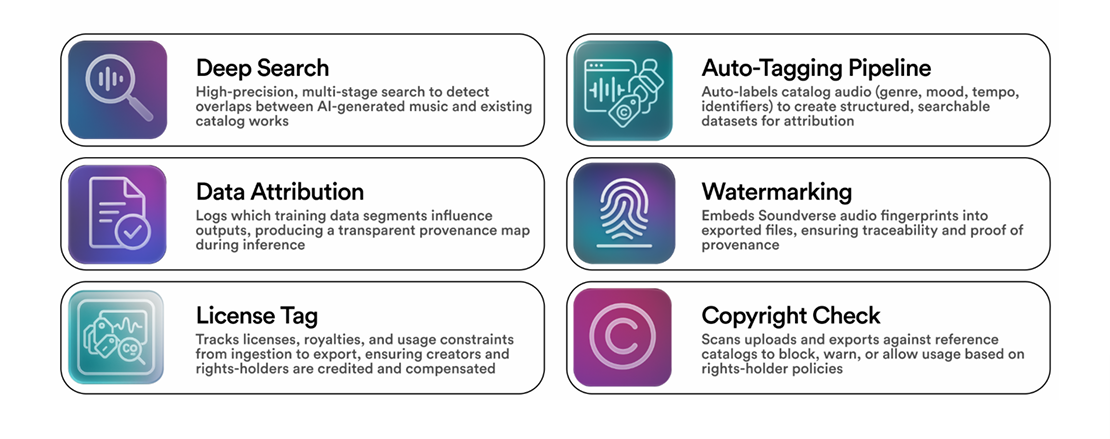
How to make AI Music Licensing Transparent with Soundverse Trace
To navigate this complex frontier, Soundverse introduced Soundverse Trace, a comprehensive trust layer engineered exclusively for AI-generated audio. This system embeds a deep chain of attribution and protection across every stage of music generation.
Key Capabilities of Soundverse Trace:
- Deep Search: High-precision scanning (1:1, 1:N) to detect dataset overlaps and reused patterns.
- Data Attribution: Logs exactly which training data influenced the output.
- Audio Watermarking: Embeds inaudible audio fingerprints within exported tracks.
- License Tagging: Preserves metadata about rights ownership from ingestion to final export.
These features empower creators, producers, and legal teams to verify provenance, prevent infringement, and automate royalty payouts.
With Soundverse Trace, music ownership and AI licensing no longer remain opaque processes. The platform’s ability to trace data lineage ensures rights-holders are properly compensated via its Content Partner Program, while also protecting creators who rely on royalty-free material.
Professionals exploring sound innovation can read more on how AI-generated music is transforming the industry or discover companion technologies such as Soundverse’s Stem Separation Magic Tool, which facilitates deeper audio analysis and remixing.
The Future of AI Music Licensing
By 2026, the conversation around AI music royalties is not about banning technology but integrating responsibility. Transparent attribution frameworks will become a regulatory standard as governments pressure AI providers to prove lawful dataset usage. Blockchain integration and smart contracts could further streamline royalty distribution, ensuring creators receive payment automatically when their work contributes to training outputs.
Soundverse, through its Ethical AI Music Framework, continues to lead this evolution, aligning cutting-edge innovation with artist integrity.
Start Creating Royalty-Free AI Music Today
Generate unique, copyright-free tracks in minutes with Soundverse’s powerful AI tools. Simplify your licensing concerns and focus on producing world-class content.
Related Articles
- Copyright-Free vs. Royalty-Free Music: What Creators Should Know — Understand the key differences between copyright-free and royalty-free tracks to protect your creative work.
- Navigating the World of Royalty-Free and Copyright-Free Music Using Soundverse AI — Learn how Soundverse helps creators easily access royalty-free and copyright-free music for any project.
- How AI-Generated Music Is Transforming the Music Industry — Explore how AI is revolutionizing music creation and what it means for composers, listeners, and rights holders.
- The Role of AI Music in Film and Television — Discover how filmmakers and producers are using AI-generated compositions to shape the soundscapes of modern entertainment.
Here's how to make AI Music with Soundverse
Video Guide

Here’s another long walkthrough of how to use Soundverse AI.
Text Guide
- To know more about AI Magic Tools, check here.
- To know more about Soundverse Assistant, check here.
- To know more about Arrangement Studio, check here.
Soundverse is an AI Assistant that allows content creators and music makers to create original content in a flash using Generative AI. With the help of Soundverse Assistant and AI Magic Tools, our users get an unfair advantage over other creators to create audio and music content quickly, easily and cheaply. Soundverse Assistant is your ultimate music companion. You simply speak to the assistant to get your stuff done. The more you speak to it, the more it starts understanding you and your goals. AI Magic Tools help convert your creative dreams into tangible music and audio. Use AI Magic Tools such as text to music, stem separation, or lyrics generation to realise your content dreams faster. Soundverse is here to take music production to the next level. We're not just a digital audio workstation (DAW) competing with Ableton or Logic, we're building a completely new paradigm of easy and conversational content creation.
TikTok: https://www.tiktok.com/@soundverse.ai Twitter: https://twitter.com/soundverse_ai Instagram: https://www.instagram.com/soundverse.ai LinkedIn: https://www.linkedin.com/company/soundverseai Youtube: https://www.youtube.com/@SoundverseAI Facebook: https://www.facebook.com/profile.php?id=100095674445607
Join Soundverse for Free and make Viral AI Music

We are constantly building more product experiences. Keep checking our Blog to stay updated about them!