Is AI Music Copyrighted? Understanding AI Music Copyright Laws in 2026
Learn about AI music copyright laws, ownership rights, and Soundverse Trace protecting AI-generated music in 2026.
Is AI Music Copyrighted?
Artificial intelligence has revolutionized music creation. In 2026, AI-generated tracks are topping charts, scoring films, and filling playlists worldwide. As musicians and producers embrace tools that create symphonies with a few text prompts, the question has become urgent: Is AI music copyrighted? This article explores the evolving landscape of AI music copyright, ownership issues, and how Soundverse Trace establishes clarity and protection in this complex ecosystem.
What Does ‘AI Music Copyright’ Mean?
AI music copyright refers to the legal protection—or eligibility for protection—of music created by or with artificial intelligence. Copyright law traditionally safeguards original works produced by humans. However, when an AI system composes melodies autonomously, determining who owns the output becomes complicated.
In 2026, global music industries are navigating this uncertainty. Some jurisdictions, such as the U.K. and Japan, have begun recognizing certain rights for AI-assisted works, while others like the U.S. still require human involvement for copyright eligibility. This mirrors how AI music copyright remains legally complex in 2026, with the US Copyright Office requiring human authorship for protection.

Can AI-Generated Music Be Copyrighted?
The simple answer is: not entirely yet. Most nations continue to define copyright authorship around human creativity. If an AI model produces a track without direct human intervention, it often lacks legal protection under traditional copyright frameworks. For instance, the Copyright Office guidance affirms that copyright does not extend to purely AI-generated music that lacks sufficient human control.
However, if a musician guides the AI—by inputting prompts, curating training data, or editing outputs—the human contribution can qualify for copyright in the curated selection and arrangement. This hybrid approach has become common among producers and composers using advanced AI tools.

Who Owns AI-Created Music?
Ownership of AI-created music depends on several factors:
- Human Input – The person or entity who provides creative direction is usually considered the author.
- AI Tool Provider – Some platforms claim partial rights depending on their terms of service.
- Training Data Rights – If an AI system was trained on copyrighted audio, outputs may trigger derivative work concerns under intellectual property law.
The distinction between AI as a tool and AI as an autonomous creator is key. When artists use text-to-music generators or co-compose with AI, they typically hold copyright in the human-directed elements. Where AI independently generates composition, legal recognition is uncertain.
How Do Copyright and Artificial Intelligence Interact?
AI relies on vast datasets—often containing existing copyrighted material—to learn musical styles. This raises questions about whether the trained model’s outputs unfairly exploit copyrighted works they were exposed to. According to the TRAIN Act, copyright holders now gain access to training records used in AI systems to foster transparency.
Courts and legislative bodies across the world are debating how data ingestion and output generation intersect with copyright law. Cases in 2024 and 2025 focused on fair use and data rights, and by 2026 there is growing pressure for transparent AI provenance. Transparency now defines legality. Ethical AI systems disclose training sources and ensure rights attribution to reduce infringement risk.
For a deeper dive into workflow tutorials, watch our guide on creating Deep House music or learn how to make music using Soundverse tools on our official Soundverse YouTube channel.
What Are AI-Generated Music Rights?
AI-generated music rights include attribution, licensing, and royalties associated with tracks produced using machine learning models. They can involve both human creators and contributors of the data used for training.
Modern frameworks increasingly tie rights not just to authorship but to participation. For example, if a label provides stems for AI training under a consent agreement, they can receive ongoing royalties whenever derivative music appears. This concept aligns with models of collective compensation and technological tools designed to track dataset contributions—essential for sustainable AI creativity.
How Is Ownership of AI-Composed Music Determined in 2026?
By 2026, music law and AI technology have established emerging norms:
- Human-Guided Creation: Copyright belongs to the prompt author or producer.
- Fully Autonomous Generation: Currently, no copyright protection unless laws recognize AI as creators in the future.
- Collaborative Systems: Shared ownership between AI developers, dataset contributors, and artists through licensing arrangements such as the Content Partner Program.
Industry groups are lobbying for a distinct category—“machine-generated creative work”—to ensure fair compensation and transparency across the supply chain. As highlighted in Music and AI: 2025’s developments, public opinion strongly supports licensing before using copyrighted materials, showing the demand for regulatory reform.
What Ethical and Legal Challenges Exist?
Key challenges include:
- Attribution ambiguity: Many models fail to record which data influenced each output.
- Infringement tracking: Without detailed provenance, detecting unauthorized reuse becomes difficult.
- Royalty distribution: Musicians whose datasets shaped AI compositions often remain uncompensated.
The solution lies in traceable systems integrating deep search and metadata watermarking—technologies at the core of Soundverse Trace.
How to Make AI Music Copyright Management Simple with Soundverse Trace
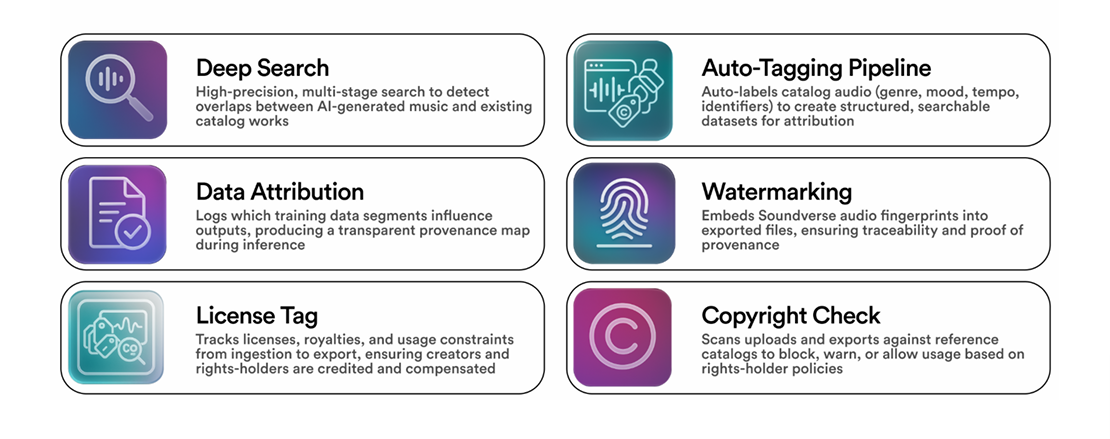
Now that you understand the concept of AI music copyright, here’s how musicians and producers can manage rights effectively using Soundverse Trace.
Soundverse Trace is a comprehensive trust layer for AI music. It embeds attribution, deep search, and rights protection throughout every stage—from dataset creation to final export. As noted in AI Music Safety & Attribution, ethical AI in music is increasingly defined by transparent attribution.
Core Capabilities:
- Deep Search: High-precision scanning (1:1, 1:N) detects overlaps between AI outputs and existing catalogues, helping prevent copyright infringement.
- Data Attribution: Logs which training data points influenced generated tracks, enabling full traceability and ensuring ethical use.
- Audio Watermarking: Adds inaudible yet robust fingerprints to audio, verifying authenticity and ownership.
- License Tagging: Maintains rights metadata from data ingestion through export so royalty tracking and automated payouts can function seamlessly.
Primary Use Cases:
- Preventing violations in AI-generated compositions.
- Tracking catalog usage for royalty payments.
- Verifying AI music provenance for legal compliance.
- Automating takedowns or payouts for rights holders.
Combined with The Ethical AI Music Framework, Soundverse Trace is part of a transparent six-stage pipeline ensuring consent, attribution, and recurring compensation. Rights-holders participating through the Content Partner Program can opt in to licensing agreements that provide usage-based royalties whenever their data influences new AI compositions.
For musicians exploring AI, Soundverse Trace eliminates confusion about ownership and intellectual property of AI compositions, giving confidence to release tracks commercially and safely.
Why Transparent Metadata Matters in AI Music Law
Without traceable metadata, verifying who owns what becomes nearly impossible. Audio watermarks and license tagging technologies provide the evidence required to defend copyright and assign royalties accurately.
In an era when music can be generated at scale, tools like Soundverse Trace represent a pivotal innovation—a system capable of turning automated creation into accountable artistry.
Related Insights for AI Musicians and Legal Experts
To deepen your understanding of how AI reshapes music creation and licensing, explore related topics:
- How AI-Generated Music Is Transforming the Music Industry
- Copyright-Free vs Royalty-Free Music: What Creators Should Know
- AI Music in the USA
- Soundverse Introduces Stem Separation AI Magic Tool
Generate Copyright-Safe AI Music Instantly
Create professional-quality, royalty-free music with Soundverse’s AI tools. Protect your creative work and stay clear of copyright limitations while producing the perfect soundtrack for your project.
Related Articles
- Copyright-Free vs Royalty-Free Music: What Creators Should Know – Learn the key differences between copyright-free and royalty-free music and how it affects creators using AI-generated audio.
- Enhancing YouTube Content with Royalty-Free and Copyright-Free Music Using Soundverse AI – Discover how Soundverse AI empowers YouTube creators to enhance videos with high-quality, copyright-safe tracks.
- Navigating the World of Royalty-Free and Copyright-Free Music Using Soundverse AI – Explore how AI tools simplify licensing and help creators find music that’s free to use in all types of projects.
- The Role of AI Music in Film and Television – See how AI-generated music is revolutionizing soundtrack creation for filmmakers and media producers.
Here's how to make AI Music with Soundverse
Video Guide
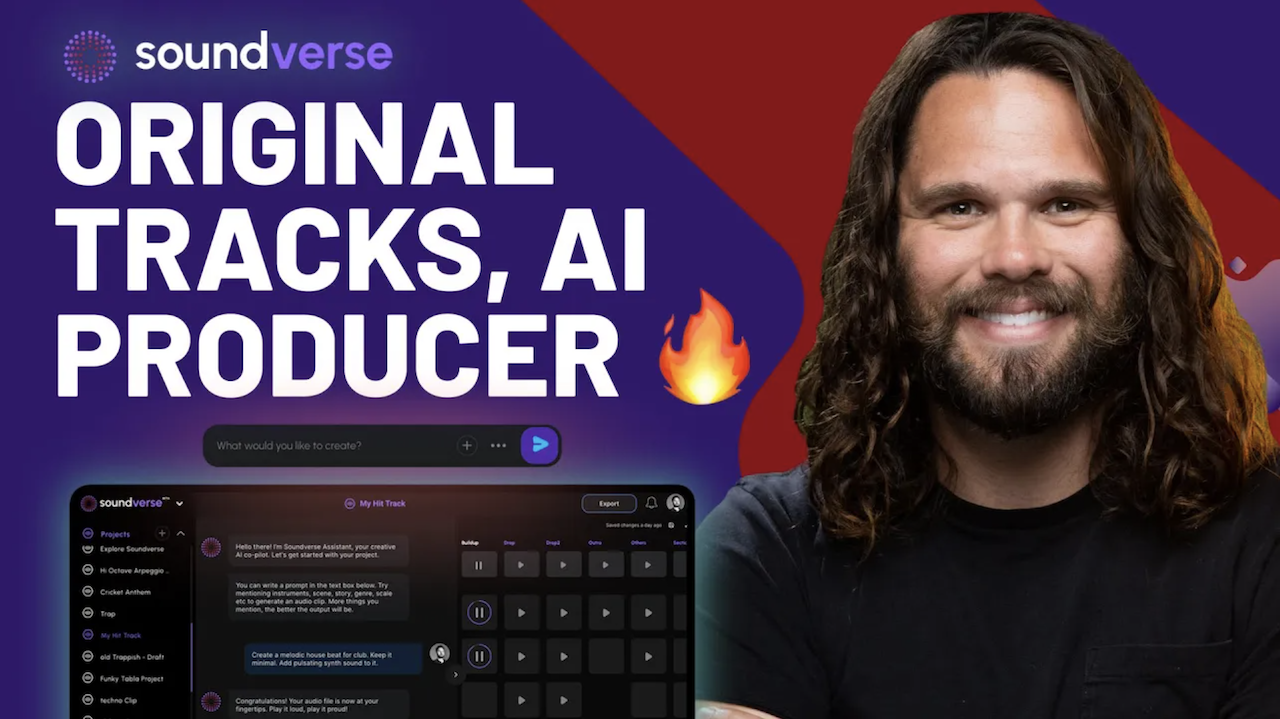
Here’s another long walkthrough of how to use Soundverse AI.
Text Guide
- To know more about AI Magic Tools, check here.
- To know more about Soundverse Assistant, check here.
- To know more about Arrangement Studio, check here.
Soundverse is an AI Assistant that allows content creators and music makers to create original content in a flash using Generative AI. With the help of Soundverse Assistant and AI Magic Tools, our users get an unfair advantage over other creators to create audio and music content quickly, easily and cheaply. Soundverse Assistant is your ultimate music companion. You simply speak to the assistant to get your stuff done. The more you speak to it, the more it starts understanding you and your goals. AI Magic Tools help convert your creative dreams into tangible music and audio. Use AI Magic Tools such as text to music, stem separation, or lyrics generation to realise your content dreams faster. Soundverse is here to take music production to the next level. We're not just a digital audio workstation (DAW) competing with Ableton or Logic, we're building a completely new paradigm of easy and conversational content creation.
TikTok: https://www.tiktok.com/@soundverse.ai
Twitter: https://twitter.com/soundverse_ai
Instagram: https://www.instagram.com/soundverse.ai
LinkedIn: https://www.linkedin.com/company/soundverseai
Youtube: https://www.youtube.com/@SoundverseAI
Facebook: https://www.facebook.com/profile.php?id=100095674445607
Join Soundverse for Free and make Viral AI Music
We are constantly building more product experiences. Keep checking our Blog to stay updated about them!
Image Steps: []