How to Test AI Music for Copyright Safety in 2026
Learn how to test AI music for copyright safety using AI tools like Soundverse Trace.
How to Test AI Music for Copyright Safety
As AI-generated music continues to gain popularity in 2026, musicians, producers, and developers face a growing need to ensure their work respects copyright laws. The merging of artificial intelligence and music creation has transformed how compositions emerge—from simple prompts turning into fully orchestrated works to voice models that emulate famous singers. However, this innovation brings a critical challenge: AI music copyright testing.
Understanding when and how to verify an AI track’s originality is essential to avoiding accidental copyright infringement and maintaining ethical AI music production standards. This guide provides a practical, step-by-step approach for testing AI music copyright safety, exploring modern legal expectations, and showing how Soundverse Trace simplifies this process for creators.
Why should you test AI-generated music for copyright safety in 2026?

In the early days of AI music, copyright infringement risk was an afterthought. But by 2026, legal frameworks in the U.S., EU, and other major markets have matured, requiring creators and developers to verify provenance before distribution or monetization.
AI models now access extensive datasets—samples, stems, and tracks from online platforms—and it's often difficult to track whether every source had proper licensing consent. Thus, AI music copyright testing has become essential for transparency, ethics, and legal compliance.
Here are the major reasons you need to test your AI tracks for copyright safety:
- Avoid legal disputes: Rights-holders can now trace dataset origins with advanced forensic and AI-driven tools. Unverified outputs may result in takedown orders or litigation.
- Protect your brand: As an artist or developer, you want your identity associated with original, ethical work.
- Ensure dataset integrity: Knowing whether training data is consent-based or licensed ensures fair compensation and industry trust.
- Build audience trust: Consumers increasingly favor transparent, ethically generated audio.
- Enable monetization and publishing: Platforms like Spotify, Apple Music, and YouTube require clear rights metadata for AI-generated music uploads.
To explore how AI creation aligns with emerging music business trends, read Music Industry Trends.
How to make AI music copyright testing easy with Soundverse Trace
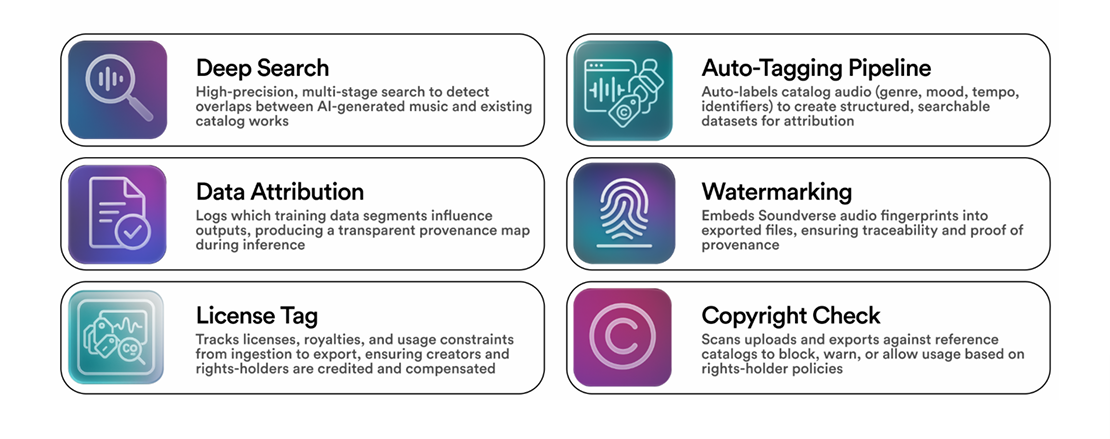
Soundverse Trace is designed as a comprehensive trust layer that brings reliability, transparency, and rights protection to AI-generated music.
What is Soundverse Trace?
Soundverse Trace is a highly specialized system that embeds attribution, deep search, and rights protection mechanisms throughout the lifecycle of AI music. From dataset ingestion to final audio export, it ensures every note and sample in an AI composition can be verified for originality.
Core capabilities of Soundverse Trace
- Deep Search (1:1, 1:N): Performs detailed, high-precision overlap analysis against global audio databases to detect similar melodic, rhythmic, or harmonic patterns.
- Data Attribution: Records training data that influenced the model’s output for traceability and compliance audits.
- Audio Watermarking: Embeds inaudible fingerprints into generated audio for provenance verification.
- License Tagging: Automatically retains rights metadata from the dataset source through distribution.
These features make Soundverse Trace ideal for scenarios requiring certification-level validation before publishing, such as professional releases, sync licensing, and royalty-tracked content creation. For a deeper dive, watch our guide on creating Deep House music or explore the Soundverse tutorial on “How to Make Music”.
To see how Soundverse’s multifeature ecosystem supports ethical output, read Soundverse AI Magic Tools and Soundverse Assistant: Your AI Music Co‑Producer.
Step 1: Prepare your AI-generated music for verification
Before running any copyright detection process, gather all project assets. Export your track stems, metadata, and the final mix. Make sure to save any descriptive information, such as prompts used for generation or instrumentation choices. Having this information ready helps tools like Soundverse Trace evaluate the full creation context, aiding in deep search and data attribution accuracy.
Step 2: Run Deep Search analysis
Once your audio is ready, upload it to Soundverse Trace and trigger the Deep Search function. This feature compares your music across massive datasets, from royalty-free archives to copyright-registered compositions. Matching patterns are scored on similarity metrics, ensuring detailed copyright infringement analysis. Unlike simplistic match-checkers, Deep Search operates at multiple levels—melody, harmony, rhythm, and even spectral properties—providing unmatched reliability for detecting overlaps.
Step 3: Verify data attribution logs
After the deep search completes, Soundverse Trace generates a Data Attribution Report. This report reveals any dataset segments that influenced your AI model’s output. It’s especially useful for developers tracking compliance within large-scale model architectures. If a composition is found to include traces from protected training data, rights holders can be automatically notified, or creators can choose to license the work properly.
Step 4: Embed watermarks and rights metadata
Next, you can activate Audio Watermarking and License Tagging features. Watermarking integrates inaudible identifiers within your AI-generated track, ensuring ownership traceability even after remixing or re-encoding. License Tagging automatically carries metadata regarding authorship, model version, and dataset licenses—all of which are essential for maintaining a transparent rights trail. Watermarked tracks not only protect intellectual property but also strengthen long-term provenance chains—an increasingly critical standard in 2026’s digital music ecosystem.
Step 5: Review and certify for ethical AI music production
After testing and embedding metadata, review your Soundverse Trace report for final validation. Each project receives a trust score indicating how confidently the audio can be certified as original or derivative. By maintaining certification records, you can easily verify AI music rights during collaborations or uploads to streaming services. This practice aligns directly with ethical AI music production principles—transparent training, explicit consent, and fair creator compensation.
Pro Tips for Effective AI Music Copyright Testing
- Use reference-free prompts: Avoid prompt phrases referring to specific copyrighted songs or artists.
- Regularly update your detection dataset: The larger and more current the database, the better your copyright detection AI works.
- Run multiple analyses: Conduct periodic re-tests when updating a project. AI datasets evolve, and so does copyright data.
- Leverage consent-based licensing: Collaborate with rights-holders through programs like Soundverse’s Content Partner Program, where datasets are transparently licensed with recurring royalties.
- Adopt transparency frameworks: Incorporate The Ethical AI Music Framework in your workflow to uphold artist integrity from training to output.
To learn more about frameworks promoting fairness within AI music creation, explore AI Music’s Role in Film and Television and Navigating Royalty-Free and Copyright-Free Music.
Why copyright detection AI matters more in 2026 than ever before
AI-generated content has exploded in scale. With thousands of new models and billions of AI-composed tracks uploaded daily, human enforcement simply can’t keep up. Copyright detection AI systems fill this gap by automating identification processes and delivering evidence‑backed transparency across the music supply chain. Advanced tools don’t just prevent infringement; they help advance fair trade between rights-holders and innovators. By 2026, major record labels are adopting AI trust layers to protect catalogs and reward dataset contributors, proving that digital ethicization can coexist with creativity.
Test and Protect Your AI Music Creations Today
Ensure your AI-generated tracks are free from copyright risks. Soundverse lets you create, test, and share music confidently with tools designed for compliance and creativity.
Related Articles
- Navigating the World of Royalty-Free and Copyright-Free Music Using Soundverse AI: Learn how to identify and use legally safe music with Soundverse’s copyright-free and royalty-free options.
- Copyright-Free vs. Royalty-Free Music: What Creators Should Know: Understand the crucial differences between copyright-free and royalty-free music to stay compliant when creating with AI tools.
- Enhancing YouTube Content with Royalty-Free and Copyright-Free Music Using Soundverse AI: Discover how to make your YouTube videos stand out using safe, hassle-free AI-generated music from Soundverse.
- AI Music in the USA: Explore how AI-generated music is reshaping copyright laws and creative freedom across the United States.
Here's how to make AI Music with Soundverse
Video Guide

Here’s another long walkthrough of how to use Soundverse AI.
Text Guide
- To know more about AI Magic Tools, check here.
- To know more about Soundverse Assistant, check here.
- To know more about Arrangement Studio, check here.
Soundverse is an AI Assistant that allows content creators and music makers to create original content in a flash using Generative AI. With the help of Soundverse Assistant and AI Magic Tools, our users get an unfair advantage over other creators to create audio and music content quickly, easily and cheaply. Soundverse Assistant is your ultimate music companion. You simply speak to the assistant to get your stuff done. The more you speak to it, the more it starts understanding you and your goals. AI Magic Tools help convert your creative dreams into tangible music and audio. Use AI Magic Tools such as text to music, stem separation, or lyrics generation to realise your content dreams faster. Soundverse is here to take music production to the next level. We're not just a digital audio workstation (DAW) competing with Ableton or Logic, we're building a completely new paradigm of easy and conversational content creation.
TikTok: https://www.tiktok.com/@soundverse.ai
Twitter: https://twitter.com/soundverse_ai
Instagram: https://www.instagram.com/soundverse.ai
LinkedIn: https://www.linkedin.com/company/soundverseai
YouTube: https://www.youtube.com/@SoundverseAI
Facebook: https://www.facebook.com/profile.php?id=100095674445607
Join Soundverse for Free and make Viral AI Music

We are constantly building more product experiences. Keep checking our Blog to stay updated about them!