How Ethical AI Music Platforms Handle Artist Opt-Outs in 2026
Discover how ethical AI music platforms protect artists through opt-out policies and responsible data practices in 2026.
How Ethical AI Music Platforms Handle Artist Opt-Outs
In 2026, the music industry's intersection with artificial intelligence is defined not just by technological innovation but by ethical responsibility. As AI-generated compositions flood streaming platforms, the conversation around artist consent, data licensing, and creative ownership has reached a critical peak. Ethical AI music platforms are setting new standards on how to handle artist opt-outs, ensuring that technology enhances creativity—never exploits it.
Why Are Artist Opt-Out Policies Crucial in 2026?
AI models in music rely on large volumes of data, often sourced from existing recordings. In past years (2024 and 2025), unlicensed scraping and ambiguous datasets led to significant backlash from artists whose works were used without explicit consent. By 2026, the regulatory landscape and public sentiment demand systems that allow artists to actively opt out of AI training sets and to verify that their music isn't being repurposed without permission.

Artist opt-out policies serve multiple ethical and operational purposes:
- Respecting Creative Ownership in AI: Artists deserve control over how their intellectual property interacts with algorithmic creativity.
- Maintaining Trust Between Creators and Developers: Transparency strengthens the collaboration between human composers and AI engineers.
- Preventing Legal Conflicts and Reputational Damage: Consensual data usage reduces lawsuits and supports talent retention.
- Encouraging Sustainable Innovation: Ethical AI frameworks foster models that learn responsibly rather than extractively.
What Does Ethical AI Mean for Music Creation?
Ethical AI music platforms place principles such as transparency, attribution, and fair compensation at the core of their infrastructure. Unlike opaque systems that use unverified or pirated data, ethical solutions implement traceability and rights management at every stage of AI-generated music production.

The ethical standard in 2026 emphasizes three foundational elements:
- Consent: AI training must only use licensed or authorized content.
- Attribution: Every creative input should be traceable to its source.
- Compensation: Rights holders should benefit from ongoing usage, not just one-time data contributions.
Platforms like Soundverse—and alternatives explored in resources such as Mubert alternatives—exemplify this shift. The goal is not to replace human creativity but to amplify it ethically. For a deeper creative dive, watch our guide on how to make music with Soundverse or explore the Explore Tab overview.
How Do Artist Opt-Out Mechanisms Work?
Opt-out mechanisms are essential parts of ethical AI governance. These systems empower artists to register their works, track usage, and withdraw consent for data training if desired. The best AI music ethics protocols balance ease of use and data accuracy.
The process typically includes:
- Registration: Artists create verified profiles within the AI music platform's rights management database.
- Catalog Management: Uploaded songs are linked to metadata—unique identifiers, timestamps, and licensing information.
- Training Review: Platforms periodically disclose which datasets are being used for model updates, allowing creators to see whether their works are included.
- Opt-Out Execution: Artists can deactivate specific tracks or entire catalogs, triggering the system to remove associated data from future model iterations.
- Audit Trails: Verification logs confirm the removal and provide transparency, ensuring no hidden data continues to influence AI outputs.
Such opt-out processes, supported by traceable technologies like Soundverse Trace, reinforce ethical compliance from dataset creation to export. Additional insights on AI’s responsible use can be found in AI-generated music ethics. For genre-specific inspiration, check out the tutorial on Deep House production.
What Challenges Do Ethical AI Music Platforms Face?
Despite progress, enforcing artist opt-out across decentralized AI models still poses challenges:
- Fragmented Rights Databases: Not all artists register their data with centralized platforms, making identification complex.
- Legacy Models: Older AI models lack transparency and may still contain unauthorized data from pre-2025 datasets.
- Cross-Platform Collaboration: Data flows between multiple AI developers can make audit consistency difficult.
- Balancing Innovation and Restriction: Overly strict opt-out rules might slow generative music advances.
In response, ethical platforms collaborate with digital rights advocates and labels to standardize data protocols. The emphasis is shifting toward responsible AI in music that integrates creativity with verifiable integrity.
How to Make Artist Opt-Outs Work with Soundverse’s Ethical AI Music Framework
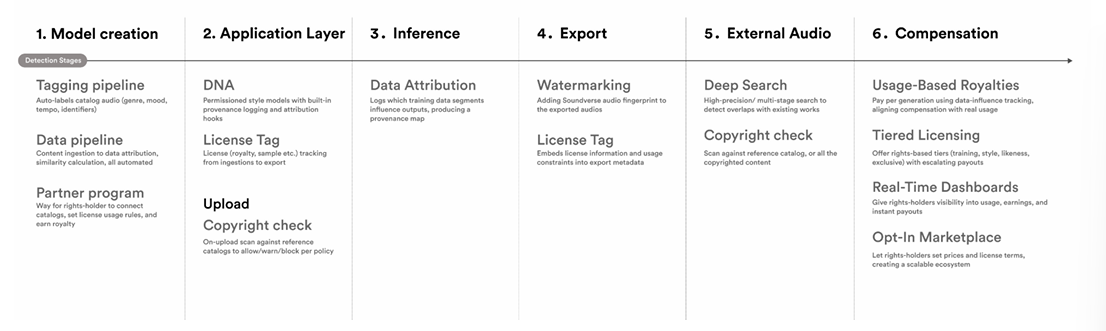
Soundverse addresses these challenges through its Ethical AI Music Framework, designed as an end-to-end infrastructure bridging innovation and artist integrity. Unlike traditional black-box systems, it introduces transparency at every stage.
Stage 1: Licensed Data Sourcing (No Scraping) ensures every dataset originates from explicit rights-holder agreements or public domain libraries.
Stage 2: Permissioned Models (DNA) binds model training data to consent tags, linking every component to an authorized creator.
Stage 3: Explainable Inference (Attribution) records how AI decisions draw inspiration from licensed sources and generates visible attributions.
Stage 4: Traceable Export (Watermarking) embeds invisible identifiers into all generated tracks, allowing rights owners to detect derivative works externally.
Stage 5: Deep Search (External Scanning) continuously scans external platforms for content overlaps, reinforcing ethical protections even after export.
Stage 6: Recurring Compensation (Partner Program) connects rights usage with recurring royalties, ensuring continual value-sharing for participating artists.
Combined with the Content Partner Program, Soundverse empowers creators to contribute data ethically and still maintain control over whether their tracks are included. Rights holders can opt out conveniently, securing their creative autonomy while benefiting from transparent attribution. This model has resonated strongly among artists exploring new forms of collaboration such as Soundverse Affiliate Program.
What Are the Broader Implications for Music Rights Management?
In 2026, ethical AI frameworks influence music rights management across production, distribution, and monetization. As streaming services and AI startups integrate transparent technologies, music rights tracking becomes automated yet accountable.
Key implications include:
- Enhanced Rights Visibility: Labels can instantly verify whether AI-generated tracks involve licensed samples.
- Global Compliance: Unified frameworks meet international data consent standards.
- Sustainable Revenue Streams: Recurring compensation models align AI music generation with fair income for creators.
- Artist Empowerment: Opt-out tooling returns agency to those whose art fuels generative systems.
Adopting such standards complements creative initiatives highlighted in related resources like Soundverse AI Magic Tools and Stem Separation AI Magic Tool, both of which prioritize ethical creation.
Join the Movement for Ethical AI Music
Empower your creativity with Soundverse—an AI music platform designed with artists’ rights and creative transparency in mind. Start generating responsibly sourced music today.
Create Ethically with Soundverse
Related Articles
- How AI-Generated Music Is Transforming the Music Industry — Explore how AI-driven composition tools are reshaping production, creativity, and revenue models across the global music industry.
- AI Music Generator and Human Composers: A Future Together — Discover how human creativity and AI composition tools can collaborate to open new frontiers in modern music creation.
- Navigating the World of Royalty-Free and Copyright-Free Music Using Soundverse AI — Learn how content creators can legally and ethically source music using AI tools that respect artists’ rights and licensing rules.
- The Role of AI Music in Film and Television — Uncover how ethical AI-generated music enhances narratives and simplifies soundtrack creation for film and TV projects.
Here's how to make AI Music with Soundverse
Video Guide

Here’s another long walkthrough of how to use Soundverse AI.
Text Guide
- To know more about AI Magic Tools, check here.
- To know more about Soundverse Assistant, check here.
- To know more about Arrangement Studio, check here.
Soundverse is an AI Assistant that allows content creators and music makers to create original content in a flash using Generative AI.
With the help of Soundverse Assistant and AI Magic Tools, our users get an unfair advantage over other creators to create audio and music content quickly, easily and cheaply.
Soundverse Assistant is your ultimate music companion. You simply speak to the assistant to get your stuff done. The more you speak to it, the more it starts understanding you and your goals.
AI Magic Tools help convert your creative dreams into tangible music and audio. Use AI Magic Tools such as text to music, stem separation, or lyrics generation to realise your content dreams faster.
Soundverse is here to take music production to the next level. We're not just a digital audio workstation (DAW) competing with Ableton or Logic, we're building a completely new paradigm of easy and conversational content creation.
TikTok: https://www.tiktok.com/@soundverse.ai
Twitter: https://twitter.com/soundverse_ai
Instagram: https://www.instagram.com/soundverse.ai
LinkedIn: https://www.linkedin.com/company/soundverseai
Youtube: https://www.youtube.com/@SoundverseAI
Facebook: https://www.facebook.com/profile.php?id=100095674445607
Join Soundverse for Free and make Viral AI Music

We are constantly building more product experiences. Keep checking our Blog to stay updated about them!