How Ethical AI Music Platforms Create Competitive Moats in 2026
Discover how ethical AI music platforms build lasting competitive advantages through transparency & artist-first frameworks.
How Ethical AI Music Platforms Create Competitive Moats
In 2026, the global AI music industry has matured beyond experimental tools and novelty apps. The conversation has shifted decisively toward transparency, artist trust, and the ethical foundations that define sustainable success. Music tech entrepreneurs, AI product developers, and ethics researchers all recognize that the next great competitive advantage in AI music won't be faster generation speeds or trend-based sound libraries—it will be integrity. Ethical AI music platforms stand at the heart of this evolution, shaping how creative technologies sustain fairness between artists, technologists, and users.
Why Ethical AI Music Platforms Dominate the Conversation in 2026
By 2026, the AI music landscape has faced significant scrutiny. Past controversies in 2024 and 2025, including disputes over unlicensed training data and unclear copyright boundaries, pushed lawmakers and creators to demand transparency. Startups that ignored these concerns struggled to attract talent and enterprise partnerships. Ethical AI music platforms distinguish themselves precisely by addressing these sensitivities. Their models not only generate high-quality tracks but also embed artist rights, licensing clarity, and compensation mechanisms directly into their operations. This shift from efficiency to ethical accountability has redefined competitive advantage in AI.

What Defines an Ethical AI Music Platform?
An ethical AI music platform applies best practices of responsible artificial intelligence to the music creation lifecycle—from dataset formation to distribution. Instead of scraping unlicensed music, these platforms use permissioned models trained only on licensed catalogs. Their outputs include automatic attribution to contributing artists and watermarking for traceable exports. Ethical AI music frameworks embrace transparency, explaining how the AI arrives at creative outputs and enabling audit trails to verify compliance. These platforms are not just tools but ecosystems that balance innovation with artist-centric values.
The emergence of these systems has encouraged innovators to reimagine AI music business models. In contrast to traditional generators that rely on public datasets and one-off licensing, modern ethical AI approaches make recurring compensation possible. They turn creators into stakeholders rather than data points, aligning the incentives of everyone in the chain—content contributors, users, and enterprise clients.

How Does Ethical Artificial Intelligence Create a Competitive Advantage in AI Music?
Competitive advantage in AI is shifting toward trust-based infrastructure. Ethical artificial intelligence ensures companies can scale responsibly and maintain partnerships with artists, record labels, and regulatory bodies. By providing legal clarity, ethical AI systems significantly reduce the risk of copyright violations—a costly obstacle for startups entering commercial contracts.
Moreover, ethical AI platforms attract enterprise-level clients who demand compliance-ready solutions. When a music label or streaming service needs AI-generated compositions, choosing a transparent platform enables them to avoid IP conflicts and reputational risks. Thus, ethics is not only an obligation—it’s a strategic moat.
In academic circles, this emerging competitive moat is connected to three primary dynamics:
- Data Legitimacy: Licensed data means no infringement issues during training, creating a secure foundation.
- Transparent Attribution: Users and artists can trace AI outputs, strengthening transparency.
- Long-Term Artist Relationships: Recurring compensation builds loyalty, turning artists into long-term data partners.
What Business Models Are Emerging Around Ethical AI Music?
Several new monetization structures are taking root in 2026. Platforms now offer Content Partner Programs—cooperative initiatives that reward artists for contributing audio samples and styles. Royalty systems based on usage and attribution ensure income continuity. Startups following ethical AI principles find it easier to access label catalogs and sanctioned sound libraries because their frameworks protect contributor rights.
In parallel, AI music ethics have become a corporate governance issue. Venture investors prioritize startups that align with transparent, consent-driven data sourcing. Those trying to expand in new territories—like generative music licensing in Europe and Asia—must demonstrate compliance readiness. Ethical AI processing, therefore, has become a gateway to global scalability.
For readers interested in broader trends shaping music creation this year, see AI Music Industry Insights and Music Industry Trends.
How to Make Ethical AI Music with Soundverse The Ethical AI Music Framework
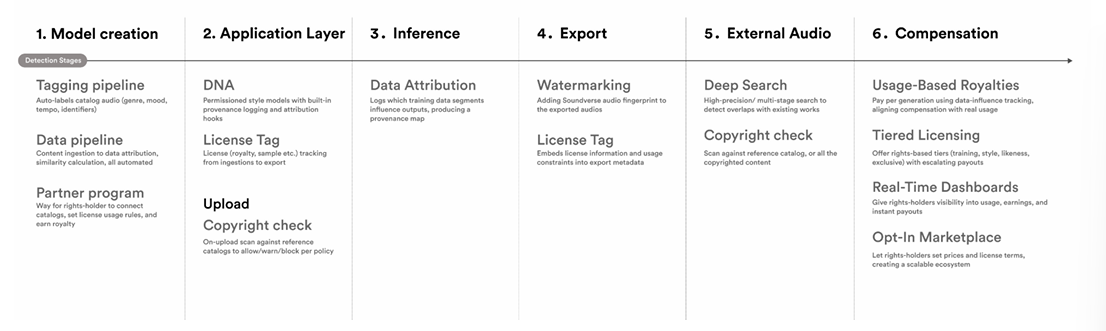
The strongest example of a competitive moat built on AI ethics is Soundverse’s Ethical AI Music Framework. This infrastructure connects innovation with artist integrity through a transparent, six-stage pipeline that replaces opaque black-box modeling with explainability and fairness.
The Six Stages of the Ethical AI Music Framework
- Licensed Data Sourcing – All datasets are contractually licensed. The system prohibits scraping and ensures consent-driven data gathering.
- Permissioned Models (DNA) – Each model is built with approved data contributors, often utilizing Soundverse DNA, an artist-trained engine that captures unique sonic identities ethically.
- Explainable Inference (Attribution) – Every generated result includes clear attribution mapping, showing which contributors influenced the production stage.
- Traceable Export (Watermarking) – Output files carry embedded identifiers for transparent track verification.
- Deep Search (External Scanning) – The AI monitors external ecosystems to detect unauthorized derivative use and uphold content integrity.
- Recurring Compensation (Partner Program) – Contributors receive recurring royalties whenever their data or stylistic identity informs an output.
For a deeper dive, watch our guide on creating Deep House music or explore the How to Make Music tutorial.
This framework does more than secure compliance—it builds commercial resilience. Users, artists, and enterprises benefit from transparent relationships, which in turn attract institutional clients seeking verified AI music sources.
For entrepreneurs exploring platform differentiation, ethical frameworks like Soundverse’s represent the most defensible innovation layer in modern AI music. When trust becomes quantifiable, competitiveness becomes sustainable.
How Soundverse Tools Enhance Ethical AI Workflows
Soundverse extends its ethical philosophy through supporting tools:
- Soundverse Trace embeds attribution and rights protection throughout the music creation pipeline. It ensures traceability and authentic ownership metadata.
- Content Partner Program empowers artists, allowing them to join the licensing pool and receive royalties tied to AI-generated track usage.
- Soundverse DNA lets users generate original music via ethically trained models, solving the persistent problem of unauthorized stylistic imitation.
To see how Soundverse technology enhances creative freedom for content creators, explore Soundverse AI Magic Tools and Genre-Specific AI Composition Guides. For a quick walkthrough of our creation process, explore the Explore Tab tutorial.
Why Ethical Infrastructure Now Defines Startup Valuation
For AI music startups in 2026, investor conversations revolve around accountability metrics. Ethical compliance signals readiness for enterprise partnerships, while black-box architectures trigger risk assessment flags. Platforms that can demonstrate transparent provenance and recurring value distribution are commanding higher valuations.
In particular, startups applying the Soundverse Ethical AI Music Framework gain credibility by proving that artist rights and user innovation can coexist profitably. The result is not just ethical optimization—it’s a recurring revenue ecosystem.
Looking Forward: The 2026 Outlook
By late 2026, the AI music industry is expected to consolidate around verified, transparent ecosystems. Artists are integrating directly into AI pipelines, and regulators increasingly mandate clear attribution and consent protocols. Ethical AI music platforms stand poised to dominate this new compliance-first landscape.
For creators and business leaders, this shift is also an invitation. Implementing ethical infrastructure unlocks not only artistry but strategic trust. As more industries—film, advertising, gaming—seek reliable AI music sources, those who embrace transparent frameworks will hold the most resilient moats.
To delve deeper into responsible innovation across AI music and content creation, explore related articles such as Best Suno Alternative: Soundverse, Generating Music With Text-to-Music AI, and Affiliate Opportunities for Creators.
Start Creating Ethical AI Music Today
Join Soundverse and experience the most transparent, creator-friendly AI music platform built on ethical principles. Create original tracks, generate stems, and explore limitless creative possibilities—all without sacrificing artistic integrity.
Sign Up Free
Related Articles
- How AI-Generated Music Is Transforming the Music Industry: Discover how artificial intelligence is reshaping the way music is created, distributed, and consumed across genres.
- Soundverse: Revolutionizing Music Creation for New Age Content Creators: Explore how Soundverse empowers creators with tools designed to make AI music production intuitive, ethical, and accessible.
- Navigating the World of Royalty-Free and Copyright-Free Music Using Soundverse AI: Learn how Soundverse ensures music creators have access to ethically generated, royalty-free content for all projects.
- AI Music Generator and Human Composers: A Future Together: Explore the collaborative potential between human creativity and AI in building a more sustainable music ecosystem.
Here's how to make AI Music with Soundverse
Video Guide

Here’s another long walkthrough of how to use Soundverse AI.
Text Guide
- To know more about AI Magic Tools, check here.
- To know more about Soundverse Assistant, check here.
- To know more about Arrangement Studio, check here.
Soundverse is an AI Assistant that allows content creators and music makers to create original content in a flash using Generative AI.
With the help of Soundverse Assistant and AI Magic Tools, our users get an unfair advantage over other creators to create audio and music content quickly, easily and cheaply.
Soundverse Assistant is your ultimate music companion. You simply speak to the assistant to get your stuff done. The more you speak to it, the more it starts understanding you and your goals.
AI Magic Tools help convert your creative dreams into tangible music and audio. Use AI Magic Tools such as text to music, stem separation, or lyrics generation to realise your content dreams faster.
Soundverse is here to take music production to the next level. We're not just a digital audio workstation (DAW) competing with Ableton or Logic, we're building a completely new paradigm of easy and conversational content creation.
TikTok: https://www.tiktok.com/@soundverse.ai
Twitter: https://twitter.com/soundverse_ai
Instagram: https://www.instagram.com/soundverse.ai
LinkedIn: https://www.linkedin.com/company/soundverseai
Youtube: https://www.youtube.com/@SoundverseAI
Facebook: https://www.facebook.com/profile.php?id=100095674445607
Join Soundverse for Free and make Viral AI Music

We are constantly building more product experiences. Keep checking our Blog to stay updated about them!