How AI Music Platforms Detect and Prevent Copyright Conflicts
Learn how AI music platforms detect and prevent copyright conflicts in 2026 using Soundverse Trace.
How AI Music Platforms Detect and Prevent Copyright Conflicts
In 2026, as artificial intelligence continues reshaping the music industry, one of its most pressing challenges remains intellectual property protection. AI models can now produce symphonies, jingles, and pop tracks from text prompts, but with this advancement comes increased scrutiny. Stakeholders across music tech, law, and creative sectors are asking an essential question: how do AI music platforms detect and prevent copyright conflicts?
Soundverse has emerged as a leader in this space, developing advanced solutions that ensure transparency, ethical compliance, and rights integrity in the era of AI-generated soundscapes. This blog explores how AI music copyright detection functions, why it's vital to the industry's sustainability, and the role Soundverse Trace plays in redefining trust within digital music ecosystems.
Why Is AI Music Copyright Detection Crucial in 2026?
AI models learn from enormous datasets of existing sound recordings, compositions, and performances. When these datasets include copyrighted material, the risk of unintentional infringements grows dramatically. As generative platforms become more accessible, the volume of new audio content produced daily by creators multiplies. Without proper safeguards, rights violations could proliferate, threatening the viability of AI music creation.

For professionals who work with AI platforms, copyright detection performs multiple roles:
- Legal Compliance: It secures adherence to copyright and data protection laws across jurisdictions.
- Creative Accountability: It ensures AI-generated outputs are traceable to their original inspirations.
- Economic Fairness: It helps rights-holders receive the royalties due to them when their work contributes to AI models.
The emphasis on these principles has intensified since 2024, when several landmark litigation cases highlighted weaknesses in both training data transparency and output tracking across popular generative audio tools. By 2026, compliance managers and music label executives universally acknowledge that robust AI music copyright detection systems are necessary, not optional.
How Do AI Music Platforms Detect Copyright Conflicts?
AI music platforms combine machine listening, data attribution, and metadata analysis to identify copyright overlaps. Detection generally occurs in two stages:

1. Dataset Verification Before Training
Platforms start by scanning inbound datasets using deep learning algorithms to establish whether each track, instrumental stem, or vocal snippet is original, licensed, or under copyright protection. The process often integrates licensed repositories from programs such as Soundverse’s Content Partner Program, which rewards contributors with royalties based on usage.
2. Post-Generation Copyright Comparison
Once users generate music, AI systems analyze outputs against massive reference libraries via 1:1 and 1:N similarity scans. This comparison checks for melodic, harmonic, rhythmic, and timbral likenesses to known tracks. When a match meets predefined thresholds, the system flags potential infringements and records them within an internal audit trail.
Modern AI platforms also assist legal teams by producing structured reports that document similarity scores and training data provenance. These insights streamline legal reviews and enable faster takedowns or payouts when rights conflicts emerge. For more practical techniques, watch our Soundverse Tutorial Series on how to make music with AI.
What Techniques Enable Accurate AI Music Copyright Detection?
Pattern Recognition and Feature Extraction
Cutting-edge detection systems examine audio signals at minute detail. Through spectral analysis, key signatures, and harmonic fingerprints, they compare the essence of sound rather than surface characteristics. This technique prevents manipulation-based evasion, such as pitch-shifting or time-stretching copyrighted works.
Data Attribution Layers
Tracking which datasets influenced generated results is fundamental for industry accountability. Attribution frameworks log model references, embedding metadata indicating the sources that contributed to final compositions. This enables full traceability—an essential element for royalty distribution in AI-assisted production.
Audio Watermarking and Rights Metadata
Many ethical platforms now implement inaudible watermarks, embedding unique digital identifiers into each generated piece. These identifiers persist throughout the production and dissemination chain, ensuring ownership clarity even if content changes formats or distribution methods.
When music passes through streaming channels or social platforms, watermark decoding verifies authenticity and source, allowing detection systems to distinguish between legitimately produced AI tracks and copied derivatives.
How Does Copyright Conflict Prevention Work?
Prevention doesn’t stop at reactive detection—it involves building protective measures throughout every creative stage. In modern AI pipelines, preventive frameworks include:
- Transparent Data Licensing: Training models only on approved datasets and opt-in contributions from licensed musicians.
- Attribution Auditing: Automatically logging which sources contributed to generated material.
- Automated Risk Alerts: Generative engines flag outputs that closely emulate copyrighted structures before export.
- Continuous Rights Tracking: Embedding persistent metadata within each generated file, following it through editing, remixing, and distribution.
By integrating both detection and prevention, platforms preserve credibility and foster ethical innovation—a philosophy championed by Soundverse through its Ethical AI Music Framework.
How AI Music Copyright Detection Supports Intellectual Property in 2026
Music copyright protection in the AI era isn’t simply a defensive mechanism—it empowers new economic models. Through verified provenance, creators can share training data confidently, knowing that royalties are automatically distributed when outputs derive from their work.
For AI developers, transparent copyright protection fosters trust with users and partners. For digital content producers, it ensures compliance when enhancing YouTube content with royalty-free music using Soundverse AI. Such traceability creates a secure creative ecosystem where artists and algorithms coexist harmoniously.
How Soundverse Trace Prevents Copyright Conflicts
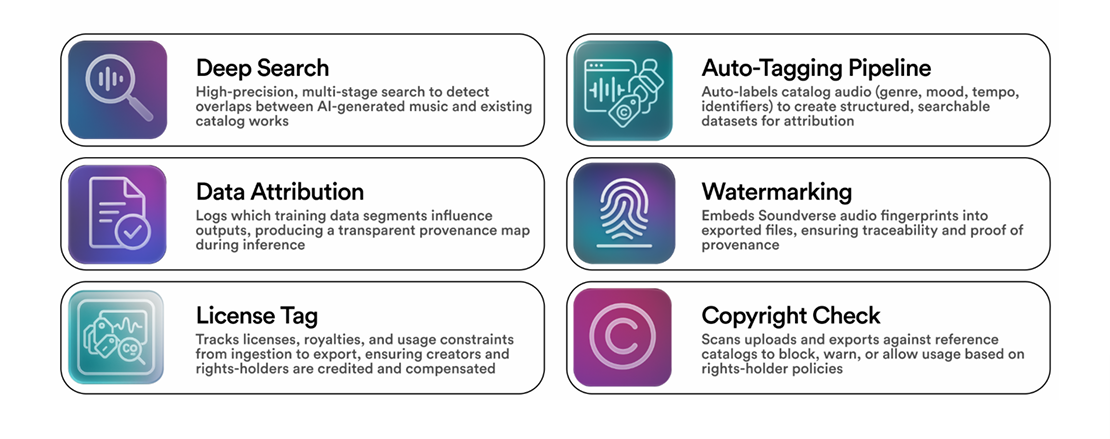
Soundverse Trace introduces a robust trust layer for AI music, merging attribution, deep search, and rights protection across an entire creative lifecycle—from dataset creation to final export. This system forms the backbone of Soundverse’s approach to AI music copyright detection.
Core Capabilities of Soundverse Trace
- Deep Search: Executes highly precise 1:1 and 1:N scans to detect overlaps between generated outputs and known copyrighted works, as detailed in How to Avoid Copyright Claims With AI Music in 2026 - Soundverse AI.
- Data Attribution: Logs which training data influences outputs, ensuring transparency for rights auditing.
- Audio Watermarking: Embeds durable, inaudible fingerprints that persist across file transformations.
- License Tagging: Preserves rights metadata from ingestion to export, maintaining provenance integrity.
Primary Use Cases
Soundverse Trace directly supports compliance professionals, creators, and developers seeking:
- Prevention of copyright infringement in AI outputs.
- Catalog usage tracking for royalties.
- Provenance verification for AI-generated audio.
- Automated takedown or payout workflows for rights-holders.
Integrating Soundverse Trace with Broader Initiatives
Together with the Ethical AI Music Framework and the Content Partner Program, Soundverse Trace completes a transparent ecosystem where attribution, consent, and compensation work in unison. The synergy promotes sustainable development across the AI music economy in 2026 and beyond.
For creators exploring generative music and remix technologies, tools like Soundverse Arrangement Studio and sound generation features described in Generate AI Music with Soundverse Text-to-Music all benefit from Trace’s underlying compliance guardrails. For more examples of production styles, check out our tutorial on creating Deep House music.
The Future of AI Music Copyright Protection in 2026
Looking ahead, AI copyright detection technologies are expected to become standardized components of digital audio workflows. As cross-industry collaborations expand, we can expect:
- Universal Attribution Registries: Shared databases documenting AI data usage across platforms.
- Blockchain-Based Rights Exchange: Transparent smart contracts managing royalty distribution.
- Automated International Compliance Auditing: Unified systems aligning global copyright standards for generative content.
Soundverse stands at the forefront of these developments, bridging the technical and legal worlds. By creating trust infrastructures like Soundverse Trace, the company ensures that innovation doesn’t undermine artistic rights but rather strengthens them.
Start Creating Copyright-Safe Music with AI Today
Harness Soundverse’s advanced AI to generate original, royalty-free tracks with built-in copyright protection. Stay creative and compliant while producing music that’s truly yours.
Related Articles
- Enhancing YouTube Content with Royalty-Free and Copyright-Free Music Using Soundverse AI: Learn how creators use Soundverse to find copyright-safe tracks that keep their YouTube videos monetized and protected.
- Copyright-Free vs Royalty-Free Music: What Creators Should Know: Discover the crucial differences between copyright-free and royalty-free music, and how AI platforms simplify compliance.
- Navigating the World of Royalty-Free and Copyright-Free Music Using Soundverse AI: Explore how Soundverse helps artists and brands navigate licensing challenges through smart AI-generated music options.
- How AI-Generated Music Is Transforming the Music Industry: Dive into how AI is reshaping music composition, copyright protection, and the overall creative process.
Here's how to make AI Music with Soundverse
Video Guide

Here’s another long walkthrough of how to use Soundverse AI.
Text Guide
- To know more about AI Magic Tools, check here.
- To know more about Soundverse Assistant, check here.
- To know more about Arrangement Studio, check here.
Soundverse is an AI Assistant that allows content creators and music makers to create original content in a flash using Generative AI.
With the help of Soundverse Assistant and AI Magic Tools, our users get an unfair advantage over other creators to create audio and music content quickly, easily and cheaply.
Soundverse Assistant is your ultimate music companion. You simply speak to the assistant to get your stuff done. The more you speak to it, the more it starts understanding you and your goals.
AI Magic Tools help convert your creative dreams into tangible music and audio. Use AI Magic Tools such as text to music, stem separation, or lyrics generation to realise your content dreams faster.
Soundverse is here to take music production to the next level. We're not just a digital audio workstation (DAW) competing with Ableton or Logic, we're building a completely new paradigm of easy and conversational content creation.
TikTok: https://www.tiktok.com/@soundverse.ai
Twitter: https://twitter.com/soundverse_ai
Instagram: https://www.instagram.com/soundverse.ai
LinkedIn: https://www.linkedin.com/company/soundverseai
Youtube: https://www.youtube.com/@SoundverseAI
Facebook: https://www.facebook.com/profile.php?id=100095674445607
Join Soundverse for Free and make Viral AI Music

We are constantly building more product experiences. Keep checking our Blog to stay updated about them!
Image Steps: []