How to Credit AI Music Properly: A 2026 Guide to Ethical AI Music Attribution
Learn how to credit AI music properly in 2026 with ethical AI music attribution, ownership, and clear crediting guidelines.
How to Credit AI Music Properly
In 2026, AI-generated music has become a cornerstone of content creation, film scoring, streaming, and independent production. As artificial intelligence tools like Soundverse make it possible for anyone to compose complex soundscapes in minutes, understanding AI music attribution has never been more critical. Musicians, producers, and creators must give appropriate AI music credits, uphold ethical labeling standards, and comply with evolving copyright frameworks. This guide explains exactly how to do that and why attribution matters for the future of the music industry.
Why Does AI Music Attribution Matter in 2026?
AI music attribution is the process of recognizing both the human and machine contributions behind a musical work. As AI systems grow more sophisticated, their generated outputs can be near-indistinguishable from human compositions. However, the commercial release of uncredited AI works can lead to audience confusion, ethical concerns, and even legal disputes over ownership.
Proper attribution serves several purposes:
- Transparency for listeners. Fans deserve to know how much of a song was human-made versus AI-assisted, helping build trust between artist and audience.
- Legal compliance. Many regions now require creators to disclose AI-generated content in professional releases.
- Fair compensation. Attribution helps ensure that rights-holders, including data contributors, receive royalties when their material influences AI outputs.
- Industry standards. Labeling practices set the benchmark for how the music community responsibly integrates AI technology.
Crediting AI music is not just about ethics—it protects your work’s legitimacy in a fast-evolving digital ecosystem.

How Has AI Music Attribution Evolved Since 2024?
From 2024 to 2025, the conversation around AI-generated content intensified. Early AI tools produced vast amounts of untraceable outputs, raising concerns about unauthorized dataset usage. Without a unified music crediting guideline, many releases lacked transparency.
By 2026, however, industry frameworks—like the Ethical AI Music Framework—began formalizing how AI music labeling and crediting should function. As a result, most major streaming platforms now encourage or even require metadata tags that identify AI involvement. This aligns with the broader movement toward sustainable and ethical AI artistry (AI Music Safety & Attribution: Building Trust in 2026's Creative AI).
For comparison, you can also explore how these standards shaped generative workflows in other areas such as AI-generated music in film and television and music industry trends.

What Should Be Included in AI Music Credits?
When crediting AI-generated songs, clarity is key. A well-structured AI music credit line usually includes:
- Human Creator: The name of the artist, producer, or composer who directed the creation.
- AI System or Tool: The name of the platform or model (e.g., “Created using Soundverse AI” or “Generated in part with Soundverse”).
- Date of Creation: Timestamped metadata for version tracking.
- Contribution Details: A brief statement on how the AI contributed—did it generate melodies, harmonies, lyrics, or full stems?
- Attribution Metadata: Any embedded rights or fingerprint information for provenance tracking.
This level of detail honors the partnership between human creativity and AI assistance while safeguarding both ownership and trust.
How to Make AI Music Attribution More Ethical with Soundverse Trace
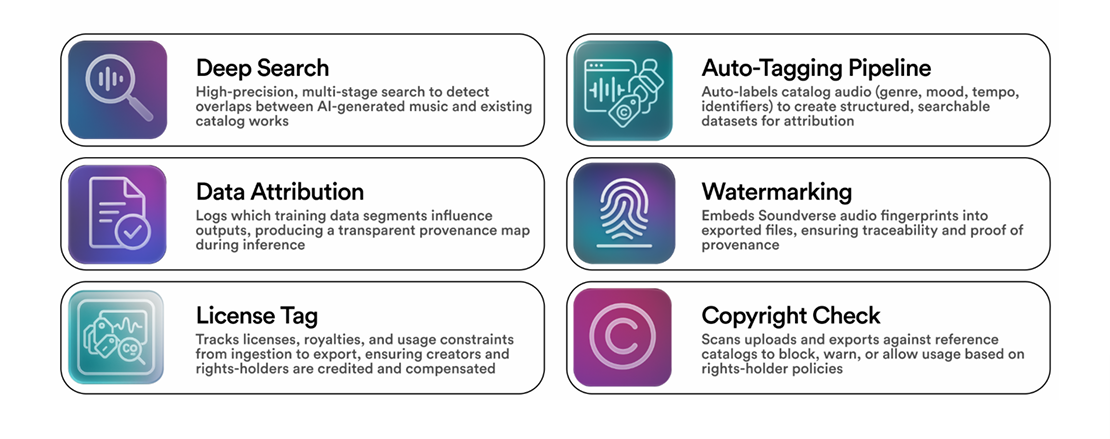
To support creators in this growing space, Soundverse has developed Soundverse Trace, a comprehensive trust layer for AI music attribution and provenance tracking.
What Is Soundverse Trace?
Soundverse Trace is a next-generation system that embeds attribution, deep search, and rights protection across the full AI music lifecycle—from training dataset formation to final export. It ensures your compositions are transparently credited and protected against misuse.
Core Capabilities:
- Deep Search: Conducts precise scans to detect overlaps and match references, supporting both one-to-one and one-to-many verification.
- Data Attribution: Logs which elements of a dataset influenced the AI output, maintaining a transparent record for compliance.
- Audio Watermarking: Adds inaudible yet robust fingerprints to your music for tracking.
- License Tagging: Preserves embedded rights metadata throughout upload, generation, and export.
Primary Use Cases:
- Prevents copyright infringement in AI outputs.
- Tracks catalog usage for royalty payouts.
- Verifies the provenance of AI-generated work.
- Automates takedowns or payments for rights-holders.
Soundverse Trace empowers producers to maintain artistic control while ensuring transparent and ethical AI artist attribution.
For a deeper understanding of Soundverse’s ethical AI infrastructure, see also the Soundverse AI Magic Tools overview and its AI music generation comparison with Mubert.
For a deeper dive, watch our guide on creating Deep House music or the tutorial on how to make music with Soundverse.
Step-by-Step: How to Credit AI Music Properly
Step 1: Identify the AI Tool Used in Creation
Before finalizing your track, document all AI tools and systems involved in the music-generating process. For example, if you used Soundverse to compose backing vocals or generate melodic stems, record that tool’s name for your metadata.
Step 2: Record Human and AI Contributions Separately
List each creative element—lyrics, composition, arrangement, and performance—and identify whether it was manually or algorithmically generated. This structure invites clarity in collaboration and publishing.
Step 3: Include Attribution in File Metadata
When exporting your final track, embed the AI tool name, version, and dataset reference in the metadata. Platforms like Soundverse automate this process by attaching license-tagged watermarks directly to the file.
Step 4: Display Credits Publicly
When releasing music to platforms such as Spotify or YouTube, include a visible credit line, for example:
“Composed by [Artist Name], generated in part using Soundverse AI (2026).”
Visible disclosure not only meets transparency guidelines but positions your work within the ethical creator community.
Step 5: Register and Protect Your Work
Finally, verify your track’s provenance through systems like Soundverse Trace. Its audio watermarking ensures traceability across digital distribution channels, protecting your intellectual property.
What Are the Legal and Ethical Implications of AI-Generated Song Ownership?
Ownership of AI-generated music continues to evolve. Current frameworks in 2026 distinguish between:
- Human-Authored Works: Fully owned by the human creator.
- AI-Assisted Works: Joint authorship models, where human and AI contributions coexist.
- Fully AI-Generated Works: Ownership often defaults to the user operating the AI platform, provided clear attribution and licensing terms are followed (AI Music Copyright 2026: Complete Legal Guide for Creators, AI Music Creation 2026: Hybrid Workflows for Composers).
With attribution logged using systems like Soundverse Trace, disputes over AI training data sources or derivative influence are drastically reduced. This creates an auditable record for royalties and licensing purposes.
Pro Tips for Ethical AI Music Labeling
- Be transparent early. Mention AI participation in your social posts or release announcements.
- Follow consistent terminology. Use clear tags such as “AI-assisted” rather than vague terms like “co-generated.”
- Respect dataset origins. Ensure your chosen platform, like Soundverse, abides by consent-based data use through its Content Partner Program.
- Educate collaborators. Align all team members on attribution policies to avoid conflicting credits.
- Stay current. Read ongoing updates such as AI-generated music transformation trends to keep compliance strategies fresh.
Start Creating and Crediting AI Music the Right Way
Master AI music attribution while generating professional tracks with Soundverse. Create, license, and share original compositions that respect creators and innovation alike.
Related Articles
- How AI-Generated Music is Transforming the Music Industry — Discover how AI-generated music is reshaping production, collaboration, and creative possibilities for artists worldwide.
- Copyright-Free vs Royalty-Free Music: What Creators Should Know — Learn the key differences between copyright-free and royalty-free music and how they affect licensing and attribution.
- Navigating the World of Royalty-Free and Copyright-Free Music Using Soundverse AI — Explore how Soundverse AI simplifies finding and using royalty-free tracks for ethical music creation.
- The Role of AI Music in Film and Television — Understand how AI music is revolutionizing soundtrack creation, making attribution more efficient for filmmakers and producers.
Here's how to make AI Music with Soundverse
Video Guide

Here’s another long walkthrough of how to use Soundverse AI.
Text Guide
- To know more about AI Magic Tools, check here.
- To know more about Soundverse Assistant, check here.
- To know more about Arrangement Studio, check here.
Soundverse is an AI Assistant that allows content creators and music makers to create original content in a flash using Generative AI.
With the help of Soundverse Assistant and AI Magic Tools, our users get an unfair advantage over other creators to create audio and music content quickly, easily and cheaply.
Soundverse Assistant is your ultimate music companion. You simply speak to the assistant to get your stuff done. The more you speak to it, the more it starts understanding you and your goals.
AI Magic Tools help convert your creative dreams into tangible music and audio. Use AI Magic Tools such as text to music, stem separation, or lyrics generation to realise your content dreams faster.
Soundverse is here to take music production to the next level. We're not just a digital audio workstation (DAW) competing with Ableton or Logic, we're building a completely new paradigm of easy and conversational content creation.
TikTok: https://www.tiktok.com/@soundverse.ai
Twitter: https://twitter.com/soundverse_ai
Instagram: https://www.instagram.com/soundverse.ai
LinkedIn: https://www.linkedin.com/company/soundverseai
Youtube: https://www.youtube.com/@SoundverseAI
Facebook: https://www.facebook.com/profile.php?id=100095674445607
Join Soundverse for Free and make Viral AI Music

We are constantly building more product experiences. Keep checking our Blog to stay updated about them!