How AI Music Platforms Build Trust Through Disclosure in 2026
Explore how AI music platforms build trust with transparency, ethics, and disclosure practices in 2026.
How AI Music Platforms Build Trust Through Disclosure
Introduction
As the music industry continues to evolve in 2026, a critical conversation dominates discussions among music professionals, AI developers, and label executives: trust. The rise of AI-generated songs has inspired incredible innovation, yet it also brings new responsibilities. Listeners, artists, and studios now demand not just creativity from AI systems, but also transparency, fairness, and accountability. In this context, AI music platforms are under intense scrutiny to show exactly how they create, manage, and disclose AI-generated works.
To build lasting credibility, these platforms are embracing new ethical frameworks that prioritize openness over opacity. This article explores how disclosure practices in AI-generated music strengthen trust between creators, listeners, and technology providers—and how initiatives like Soundverse’s Ethical AI Music Framework are setting the standard.
Why is transparency critical for AI music platforms in 2026?
Transparency has become a non-negotiable element of technological trust. By 2026, the public and industry stakeholders are more informed about how AI operates. Hidden data sources and black-box models have given way to a clear demand: show us how the music is made.

Users no longer passively consume AI-generated songs—they want to know whether artists consented to their data being used for training, how royalties are distributed, and whether AI creations adhere to ethical boundaries. Without transparency, even technically advanced AI music platforms risk eroding industry trust.
Several trends have amplified this demand:
- Expansion of AI Regulation: New music AI regulations across the US and EU mandate disclosure for AI-generated content, as seen in Spotify Strengthens AI Protections for Artists.
- Artist Advocacy: High-profile artists advocate for transparent data usage, especially regarding voice and style replication.
- Platform Accountability: Companies that proactively disclose their AI processes gain competitive credibility.
In short, transparency in AI music is no longer a branding choice—it’s a compliance and ethical requirement that protects both creators and the technology providers themselves.
How do disclosure practices improve trust in the AI music ecosystem?

AI disclosure goes beyond labeling a song as “AI-generated.” True disclosure involves clarity about every stage of the content generation pipeline—from training data and model permissions to how attribution and compensation are managed.
Here’s how these practices build trust across stakeholders:
- For Artists: They can see exactly where and how their work might contribute to AI datasets, reducing fears of exploitation.
- For Listeners: Disclosure ensures they can identify AI-assisted or AI-created tracks, preventing deceptive releases.
- For Record Labels: Transparent systems simplify audit trails and ensure fair royalties.
Platforms that use disclosure as a cornerstone of operation effectively communicate that they have nothing to hide. This honesty positions them as industry allies rather than disruptive invaders—a crucial distinction in 2026’s competitive AI music market.
For a practical example of this in action, watch our guide on creating Deep House music to explore how Soundverse demonstrates traceable workflows within its creative suite.
What does ethical AI in music really mean today?
Ethical AI in music extends far beyond compliance. It involves proactive responsibility to respect creative ownership while leveraging the scalability of machine learning. Ethical platforms prioritize consent, collaboration, and traceability at every level of the creative process.
Modern ethical AI platforms therefore:
- Use licensed training data instead of scraped content.
- Implement permission-based machine models where rights-holders control their participation.
- Maintain attribution systems that identify how datasets contribute to outputs.
- Offer recurring compensation programs for dataset contributors.
This approach ensures both innovation and integrity can coexist—a message that resonates strongly across industry conferences and panels in 2026.
How disclosure practices differ among AI music platforms
Not all AI music platforms adhere to the same ethical and disclosure standards. While some prioritize convenience and speed, others invest heavily in explainability and licensing validation.
For instance, platforms like Mubert and Udio focus on generative models that produce royalty-free tracks. However, newer systems inspired by frameworks such as Soundverse’s Ethical AI Music Framework emphasize data traceability and creator compensation.
This differentiation marks the line between “functional” automation and “trustworthy” AI artistry. Platforms that align with transparent pipelines attract partnerships with major music companies, while less transparent systems risk restriction or outright bans by regulatory authorities.
For readers exploring alternative AI tools, articles such as Best Udio Alternative: Soundverse AI and Mubert Alternatives: Soundverse outline where ethical disclosure gives Soundverse a competitive advantage.
How to make trust foundational with Soundverse The Ethical AI Music Framework
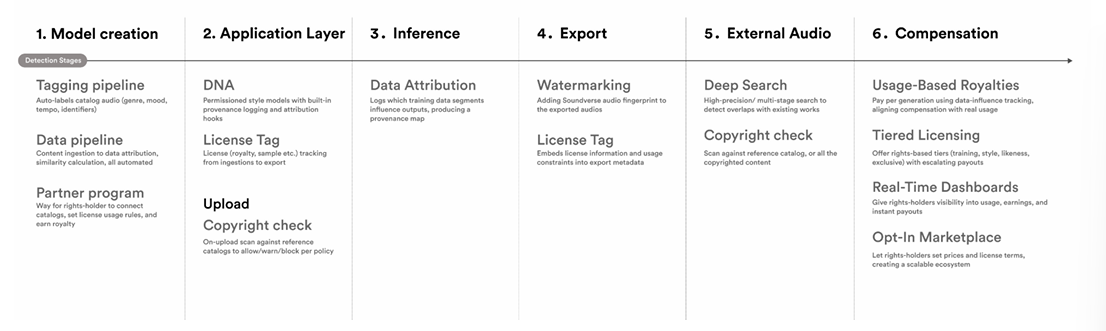
Soundverse stands at the forefront of ethical AI in music with its Ethical AI Music Framework, a comprehensive, six-stage system that redefines what transparency means in 2026. Rather than functioning as a black-box generator, Soundverse provides traceable insight into every decision and data source.
Stage 1: Licensed Data Sourcing
Soundverse only uses licensed data, ensuring no scraped content is part of its training sets. Every track and dataset carries an auditable origin.
Stage 2: Permissioned Models (DNA)
Instead of generic models, Soundverse uses permissioned models. Rights-holders can decide whether to contribute data, ensuring creative DNA integrity.
Stage 3: Explainable Inference (Attribution)
Every output is fully traceable. This explainable inference identifies contributing data segments, allowing transparent credits and audit logs.
Stage 4: Traceable Export (Watermarking)
Each piece of generated music receives a watermarked identity, enabling future verification for usage rights and authenticity.
Stage 5: Deep Search (External Scanning)
Through its Soundverse Trace integration, the system performs external scans to map overlap detection with existing audio content, ensuring originality.
Stage 6: Recurring Compensation (Partner Program)
The Content Partner Program rewards data contributors through recurring usage-based royalties, closing the feedback loop for fair AI monetization.
This structured process not only complies with international requirements but also builds tangible trust with artists and partners by demonstrating how their creative input fuels innovation ethically.
Learn how Soundverse applies similar principles across advanced tools like the AI Magic Tool and projects described in AI Music Generator and Human Composers: A Future Together.
For more applied instruction, check out our tutorial on how to make music to see ethical transparency embedded directly in workflow design.
How do ethical frameworks reshape the business of AI-generated songs?
Beyond technical transparency, ethical frameworks reshape the entire business logic of AI-generated music. Artists gain new revenue streams through data licensing rather than fearing displacement. Labels leverage transparency to validate AI contributions within catalog management systems. And listeners get confidence that their favorite AI-assisted compositions align with creative fairness.
For investors and tech developers, such frameworks reduce legal and reputational risks, enabling AI adoption at enterprise scale. Companies that embrace these models early are already seeing stronger B2B partnerships and public approval.
What does the future of music industry trust look like?
By late 2026, the music industry’s trajectory is clear: openness equals sustainability. The platforms that invite inspection, provide documentation, and align with human creative rights will form the backbone of a new standard for hybrid artistry. Ethical AI in music will not be a special feature—it will be the baseline expectation.
From film scoring to game soundtracks, AI-assisted creativity will continue expanding. But only transparent systems, empowered by explainability and disclosure, will earn long-term legitimacy. The journey toward trust begins with clear frameworks like Soundverse’s Ethical AI Music Framework.
Start Creating with Transparent AI Music Tools
Experience the next generation of ethical AI-powered music creation. Build your sound with tools that prioritize creativity, originality, and full disclosure.
Related Articles
- How AI-Generated Music Is Transforming the Music Industry — Explore how AI music platforms are changing how artists produce, distribute, and collaborate across genres.
- AI Music Generator and Human Composers: A Future Together — Discover how human creativity and AI tools can coexist to shape the future of music composition.
- The Role of AI Music in Film and Television — Learn how AI-generated compositions are enhancing soundtracks and creative workflows in film and TV.
- Navigating the World of Royalty-Free and Copyright-Free Music Using Soundverse AI — Understand how AI simplifies licensing for creators through royalty-free and copyright-safe music generation.
Here's how to make AI Music with Soundverse
Video Guide

Here’s another long walkthrough of how to use Soundverse AI.
Text Guide
- To know more about AI Magic Tools, check here.
- To know more about Soundverse Assistant, check here.
- To know more about Arrangement Studio, check here.
Soundverse is an AI Assistant that allows content creators and music makers to create original content in a flash using Generative AI. With the help of Soundverse Assistant and AI Magic Tools, our users get an unfair advantage over other creators to create audio and music content quickly, easily and cheaply. Soundverse Assistant is your ultimate music companion. You simply speak to the assistant to get your stuff done. The more you speak to it, the more it starts understanding you and your goals. AI Magic Tools help convert your creative dreams into tangible music and audio. Use AI Magic Tools such as text to music, stem separation, or lyrics generation to realise your content dreams faster. Soundverse is here to take music production to the next level. We're not just a digital audio workstation (DAW) competing with Ableton or Logic, we're building a completely new paradigm of easy and conversational content creation.
TikTok: https://www.tiktok.com/@soundverse.ai
Twitter: https://twitter.com/soundverse_ai
Instagram: https://www.instagram.com/soundverse.ai
LinkedIn: https://www.linkedin.com/company/soundverseai
Youtube: https://www.youtube.com/@SoundverseAI
Facebook: https://www.facebook.com/profile.php?id=100095674445607
Join Soundverse for Free and make Viral AI Music

We are constantly building more product experiences. Keep checking our Blog to stay updated about them!