How AI Music Is Evaluated for Quality in 2026
Learn how AI music quality evaluation works and how Soundverse Trace ensures reliability in 2026.
How AI Music Is Evaluated for Quality
Understanding how AI music is evaluated for quality has become one of the most discussed topics among audio engineers and AI researchers in 2026. As generative models begin to shape more of today’s music landscape, the challenge isn’t only producing music—it’s measuring whether that output is truly high-quality, balanced, and ethically valid. This process, known as AI music quality evaluation, lies at the intersection of machine learning, psychoacoustics, and aesthetic judgment.
What does AI music quality evaluation mean?
At its core, AI music quality evaluation refers to assessing how well AI-generated music aligns with traditional standards of audio production, composition aesthetics, and emotional expressiveness. Unlike simple algorithmic scoring systems used a few years ago, today’s evaluation frameworks in 2026 combine AI music testing, machine learning audio metrics, and human-in-the-loop verification.

When AI began producing full-length compositions in 2024 and 2025, the main metrics were spectral clarity, loudness uniformity, and structural coherence. However, as AI systems produced more dynamic and stylistically varied music, new forms of evaluation were required—ones that could interpret creativity, originality, and cultural relevance.
What metrics determine the quality of AI-generated music in 2026?
AI engineers today rely on several advanced indicators.
- Spectral Balance Analysis: Measures the distribution of frequencies and ensures tonal consistency.
- Rhythmic Accuracy: Uses timing variance algorithms to test whether beats and transitions feel natural.
- Dynamic Range Evaluation: Checks compression ratios and perceived loudness levels.
- Melodic Originality Index: Derived from large music datasets, this index quantifies how much a generated melody diverges from known compositions.
- Emotion Mapping Models: Machine learning systems compare the affective patterns of generated tracks to human-composed music, evaluating if emotional intentions are preserved.
- Human Feedback Loops: Professionals still play a pivotal role, using AI-assisted dashboards to rate tracks beyond mathematical metrics—judging aspects like mood fit, instrument realism, and arrangement fluidity.
Each of these plays into broader AI music testing workflows used by label producers, music platforms, and academic research teams. Developers continuously refine these models to align algorithmic performance with perceived musical beauty.
How do machine learning audio metrics evolve in AI music testing?
Between 2024 and 2026, the field of machine learning audio metrics transitioned from static rule-based thresholds to adaptive learning architectures. These models can interpret multi-modal inputs—waveform data, harmonic analysis, and even lyric sentiment—to deliver nuanced evaluations.
For example, convolutional and recurrent neural networks can now detect audio coherence and predict genre authenticity. Ensemble models combine acoustic patterns with compositional grammar recognition, leading to more reliable AI-generated music assessment. As a result, evaluation isn’t restricted to technical fidelity; it expands to creative integrity.
One breakthrough trend throughout 2025 and into 2026 has been the application of transformer-based models trained on tens of millions of tracks, as seen in studies such as AI Music Quality Analysis 2026 and AI Music Analysis 2026. These systems recognize both classical form and experimental structures, generating a reference database used to benchmark new AI tracks.
For those exploring how these broader trends influence production, Soundverse has covered related domains such as music industry trends and how AI-generated music is transforming the music industry. Together, these advancements mark a shift towards standardized evaluative ecosystems for music. For a deeper dive, watch our Soundverse Tutorial - How to Make Music or explore techniques in our Deep House Music tutorial.
What challenges exist in AI-generated music assessment?
Despite technical sophistication, certain challenges remain.
- Subjectivity of Taste: Music perception varies by listener demographics, making universal scoring difficult.
- Bias in Training Data: Datasets favor particular genres or production styles, skewing evaluation.
- Copyright Verification: Generated tracks may unintentionally overlap with existing compositions.
- Ethical Representations: Determining whether the AI respects consent and attribution for data sources.
These concerns have driven demand for transparent evaluation pipelines that pair accuracy with accountability. Audio engineers frequently combine music quality algorithms with provenance technologies to verify that output matches ethical standards. Studies such as The 2026 State of AI Music and AI & Music Tech In 2026 further highlight these compliance challenges.
Why is provenance critical in AI music quality evaluation?
Evaluating quality isn’t just about audio fidelity—it’s about origin. Provenance systems confirm where training data came from and outline its influence on each generated waveform. Without clear lineage records, even a technically perfect track can risk infringement or misattribution.
Soundverse introduced one of the most advanced provenance-based frameworks specifically for this need.
How to make AI music quality evaluation reliable with Soundverse Trace
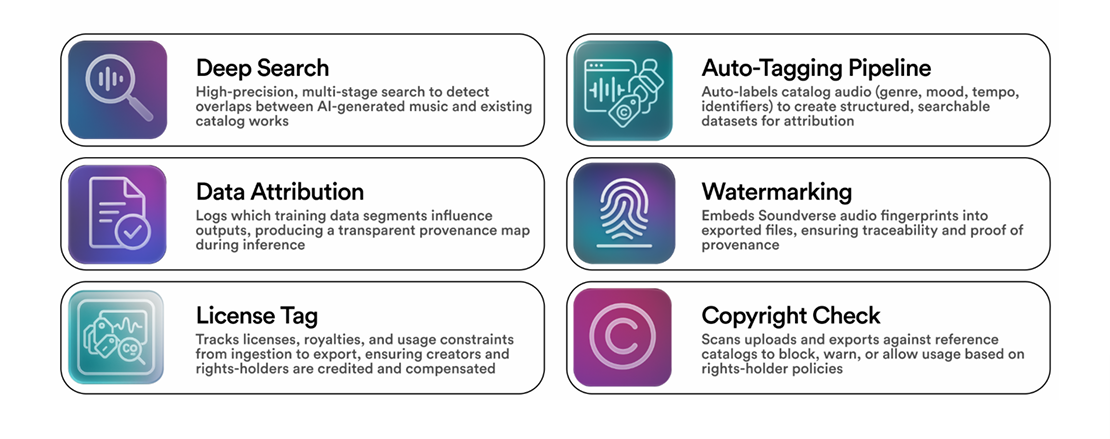
Soundverse Trace acts as a comprehensive trust layer designed for AI-driven audio ecosystems. It embeds attribution, deep search, and rights protection across the full music lifecycle—from initial dataset creation to final export.
Core Capabilities
- Deep Search: Performs high-precision scanning (1:1 and 1:N comparisons) to detect overlaps or reuse.
- Data Attribution: Logs which training data influenced output composition layers.
- Audio Watermarking: Embeds inaudible digital fingerprints into each generated file for traceability.
- License Tagging: Preserves rights metadata consistently from ingestion through export.
These features allow Soundverse Trace to address three critical evaluation components:
- Identify originality and prevent hidden dataset recycling.
- Verify authenticity through watermark data checks.
- Enforce ethical compliance by tracking license metadata.
By combining these capabilities, Soundverse Trace closes the loop between creative output and statistical validation. For AI researchers, this provides an empirical layer that integrates seamlessly with existing AI music testing platforms.
Additionally, when paired with The Ethical AI Music Framework, users gain full transparency across a six-stage pipeline—ensuring consent, attribution, and recurring compensation for contributors. For producers employing section-based evaluation workflows, the Section Analysis tool automatically detects and labels song parts (Intro, Chorus, Bridge, etc.), offering a structural roadmap before final scoring.
For those experimenting with composition and AI feedback, related articles such as generate AI music with Soundverse text-to-music and Soundverse AI Magic tools create content quickly with AI provide detailed creative insights.
How are music quality algorithms shaping industry standards in 2026?
Industry benchmarks increasingly depend on algorithmic testing frameworks validated by organizations and independent labs. The main shift has been towards explainability—evaluations that can show how scores were derived instead of just posting numerical results.
Producers use algorithmic dashboards to track:
- Harmonic continuity scores
- Mix coherence levels
- Instrumental timbre accuracy
- Impact potential based on genre-specific listening models
Through hybrid evaluation—AI metrics plus watermark-based provenance checks—platforms ensure their outputs meet both artistic and legal expectations. Publications like Best AI Tools for Music Producers (2026 Guide) and AI Music Mixing Quality discuss how these algorithmic benchmarks shape new production realities.
What does the future hold for AI music quality assessment?
By mid-2026, evaluative AI tools are increasingly integrated into standard production workflows. Engineers expect next-generation systems to merge sonic profiling with listener sentiment mapping—providing predictive analytics on track likability before release. Ethical evaluation will remain a major focus as international standards continue evolving around AI-generated content verification.
For creators and developers, Soundverse Trace stands as an essential trust layer bridging creativity, accountability, and reproducibility. It turns quality evaluation from a subjective art into an auditable science.
Experience High-Quality AI Music Creation Today
Generate music that meets professional quality standards using Soundverse’s advanced AI music tools. Explore endless creative possibilities and assess your results with intelligent sound quality evaluation features.
Start Creating with Soundverse
- How AI-Generated Music Is Transforming the Music Industry — Discover how artificial intelligence is redefining music production, distribution, and creativity in the global industry.
- AI Music Generator and Human Composers: A Future Together — Learn how AI and human musicians can collaborate to craft powerful soundscapes that blend innovation and emotion.
- The Benefits of Composing with AI Music Generator — See how using AI tools for composition can boost creativity, enhance sound quality, and save production time.
- The Role of AI Music in Film and Television — Explore how AI-generated compositions are shaping soundtracks and background music for screen productions.
Here's how to make AI Music with Soundverse
Video Guide

Here’s another long walkthrough of how to use Soundverse AI.
Text Guide
- To know more about AI Magic Tools, check here.
- To know more about Soundverse Assistant, check here.
- To know more about Arrangement Studio, check here.
Soundverse is an AI Assistant that allows content creators and music makers to create original content in a flash using Generative AI. With the help of Soundverse Assistant and AI Magic Tools, our users get an unfair advantage over other creators to create audio and music content quickly, easily and cheaply. Soundverse Assistant is your ultimate music companion. You simply speak to the assistant to get your stuff done. The more you speak to it, the more it starts understanding you and your goals. AI Magic Tools help convert your creative dreams into tangible music and audio. Use AI Magic Tools such as text to music, stem separation, or lyrics generation to realise your content dreams faster. Soundverse is here to take music production to the next level. We're not just a digital audio workstation (DAW) competing with Ableton or Logic, we're building a completely new paradigm of easy and conversational content creation.
TikTok: https://www.tiktok.com/@soundverse.ai
Twitter: https://twitter.com/soundverse_ai
Instagram: https://www.instagram.com/soundverse.ai
LinkedIn: https://www.linkedin.com/company/soundverseai
Youtube: https://www.youtube.com/@SoundverseAI
Facebook: https://www.facebook.com/profile.php?id=100095674445607
Join Soundverse for Free and make Viral AI Music
 We are constantly building more product experiences. Keep checking our Blog to stay updated about them!