How AI Handles Polyrhythms & Complex Rhythms in 2026
Discover how AI handles complex polyrhythms and enhances rhythmic accuracy in music production.
How AI Handles Polyrhythms & Complex Rhythms
Introduction
Artificial intelligence has already proven its creative strength across composition, mixing, and sound design. But in 2026, one of the most fascinating frontiers for music AI lies in rhythmic comprehension — particularly polyrhythms and complex timing patterns. The way AI music rhythm analysis deciphers and reproduces intricate rhythmic interplay has redefined how digital systems interpret groove, feel, and syncopation.
For musicians and producers, rhythm is not merely a technical grid; it’s an emotional language. Understanding the subtleties of timing variations and overlapping meters forms the backbone of musical human expression. For technologists designing intelligent music tools, modeling such temporal richness requires combining machine learning music algorithms, signal analysis, and human rhythmic perception models.
In this article, we dive into how AI systems handle complex and polyrhythmic structures, what defines rhythmic accuracy in 2026, and how developers, producers, and researchers are applying AI to decode the deep mathematics and feel of rhythm.
What are Polyrhythms and Why Are They Challenging for AI?
Polyrhythms occur when multiple distinct rhythms, often based on conflicting time signatures or divisions, are played simultaneously. A classic example is a 3-against-2 rhythm — where one instrument repeats a three-beat cycle while another repeats a two-beat cycle, creating a shifting rhythmic feel.

For human musicians, mastering such interplay involves internal sensing of pulse layers. For AI, however, the challenge is computational. AI must map overlapping cycle lengths, detect micro-timing nuances, and reconcile multiple time references within a unified beat grid.
Early rhythm analysis systems (around 2024–2025) struggled because they relied heavily on rigid beat detection models. By 2026, new learning architectures now integrate AI beat detection, onset analysis, and probabilistic timing inference. These methods allow algorithms to adapt to rhythmic ambiguity and groove fluctuations more naturally.
How Does AI Music Rhythm Analysis Work in 2026?
Modern AI rhythm systems employ hybrid approaches combining signal processing and neural models. Here’s how they generally operate:

- Onset Detection and Signal Decomposition: AI first identifies transient peaks in the waveform — percussive events, note attacks, or rhythmic accents. Advanced onset detectors in 2026 use transformer-based encoders capable of distinguishing subtle dynamic levels and overlapping rhythmic events.
- Time-Frequency Mapping: The system converts time-based audio into frequency-domain matrices, such as constant-Q transforms or Mel spectrograms. By learning how frequency energy fluctuates over time, AI can quantify rhythmic periodicities even in dense arrangements.
- Pattern Recognition Networks: Using large audio datasets, model architectures capture rhythmic idioms across genres — jazz swing, Afro-Cuban patterns, progressive metal polyrhythms, or modern electronic syncopations.
- Hierarchical Tempo Tracking: Instead of a single tempo estimate, new models maintain multiple nested tempo tracks. This allows simultaneous representation of different rhythmic layers (e.g., 3:2:5 relationships).
- Groove and Timing Precision Models: Beyond identifying beats, AI systems now measure microtiming offsets — subtle variations that define groove. This enhances timing precision and produces rhythm interpretations that sound organic, not robotic.
For a deeper dive, watch our guide on creating Deep House music and the Soundverse Tutorial: How to Make Music.
Why Rhythmic Accuracy Matters for Music Producers and AI Researchers
For music producers, rhythmic precision dictates whether a generated track feels mechanical or alive. For AI designers, improving rhythmic accuracy is fundamental to realistic composition. The better AI recognizes temporal relationships, the more nuanced its generated music becomes.
In 2026, studios increasingly rely on AI rhythm analysis for:
- Beat Alignment: Syncing recorded tracks to metronomic grids without losing expressive timing.
- Style Emulation: Modeling legendary drummers’ timing fingerprints.
- Generative Composition: Creating new rhythmic textures and hybrid grooves for genres like post-jazz, neo-fusion, or AI-driven electronic music.
See reference research in Polyrhythm Analysis Using the composite Tool showing computational mapping of rhythmic interplay.
What Machine Learning Methods Power Complex Rhythm AI?
Machine learning models for complex rhythm AI have evolved substantially. Three major frameworks dominate current research and production systems:
1. Probabilistic Beat Tracking Networks
These networks analyze multiple possible beat interpretations simultaneously. By applying Bayesian inference, they estimate the most probable temporal structure given uncertain cues — essential for irregular time signatures or polyrhythms.
2. Graph-Based Temporal Models
Using graph neural networks (GNNs), these models treat rhythmic structures as nodes and edges representing temporal relationships. This helps in recognizing interdependent rhythmic cycles — a prerequisite for advanced polyrhythmic tracking.
3. Multi-Agent Systems
AI agents represent individual instruments or rhythmic streams. Their interactions are modeled in real-time to simulate ensemble-level timing feedback, producing naturally interlocking rhythms rather than rigid quantization.
Research like Strategic Analysis: Key AI-Driven Transformations in 2026 highlights how multi-agent systems reshape collaboration in AI music design.
How AI Beat Detection Influences Groove in Generated Music
AI beat detection has matured into one of the most reliable components of music AI pipelines. The improvements made between 2025 and 2026 focus on adaptability — the ability to follow flexible beats, tempo drifts, and expressive performances.
Current models use context-aware detectors that analyze dynamic amplitude envelopes and rhythmic probabilities simultaneously. For AI-generated compositions, this translates into highly expressive grooves even without human input.
Some producers pair rhythm analysis tools with AI melody or harmony models to produce cohesive generative compositions. This trend mirrors the rise of integrated creative AIs discussed in How AI-generated music is transforming the music industry.
Learn more about industry-wide adoption trends in the AI Music Analysis 2026: Descriptive AI, Auto-Tagging & Benchmark overview.
Real-world Applications of AI Rhythm Analysis
In 2026, the integration of rhythm-focused AI modules appears in various music technology contexts:
- DAW plugins for tempo stability correction.
- Game soundtracks that adapt dynamically to player motion.
- AI drumming systems that accompany live performers with synchronized timing.
- Music education platforms assessing rhythmic tightness for learners.
Advanced developers even use rhythm AI to train other models — enabling AI music co-producers (see Soundverse Assistant) that can understand user-intended grooves.
For more creative practical examples, explore the Soundverse Tutorial - "Explore" Tab.
How to Make AI Music with Complex Rhythms Using Soundverse AI Music Generator
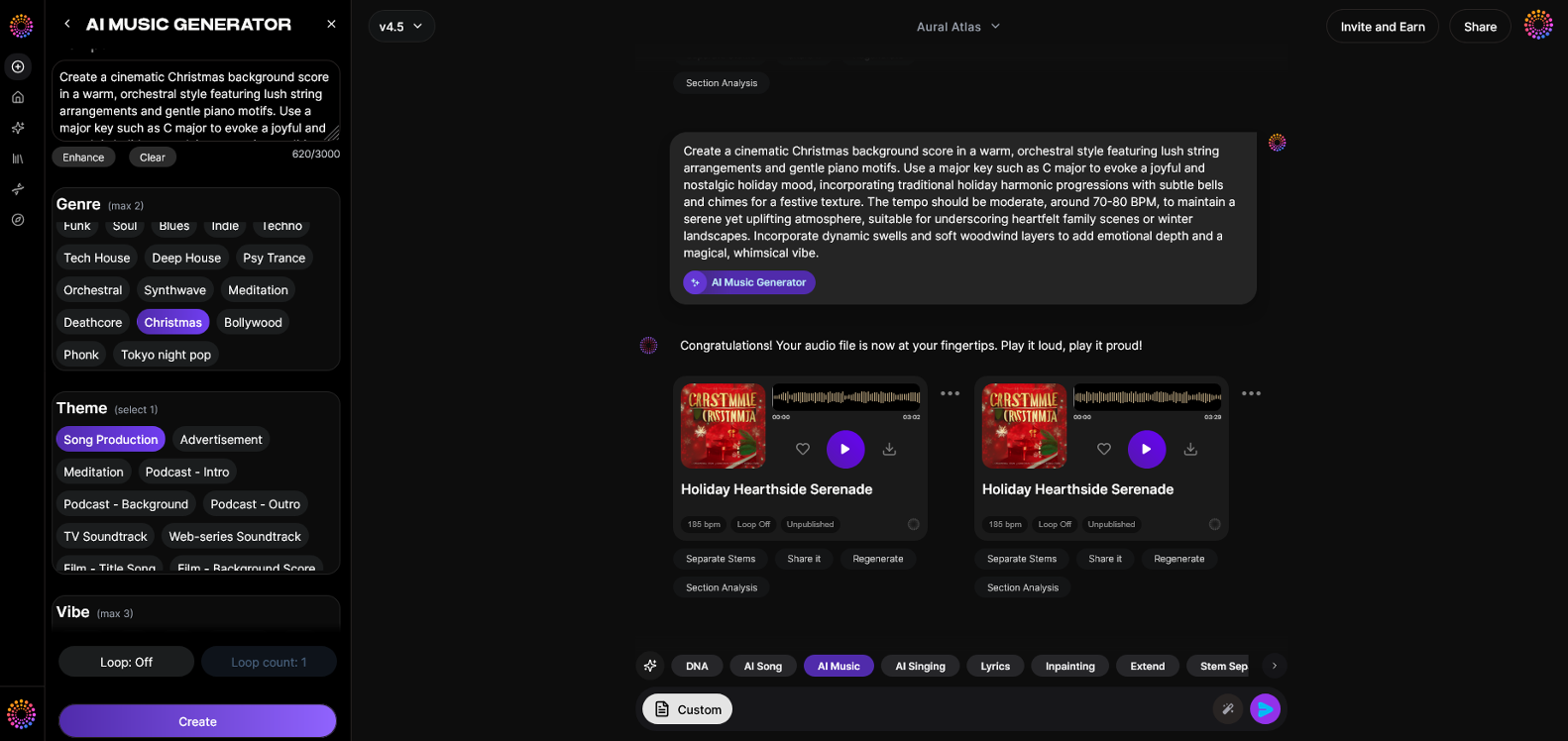
Soundverse’s AI Music Generator stands at the intersection of composition and rhythm intelligence. This feature allows users to create fully produced instrumental music from text prompts, perfectly suited for genres that depend on intricate grooves — whether that’s layered percussion, evolving loops, or beat-driven ambient.
Core Capabilities
- Text-to-Music Conversion: Generate entire arrangements simply by describing the musical idea in words.
- Loop Mode: Create endlessly seamless rhythmic loops ideal for background, games, or meditation.
- Detailed Control: Specify genre, mood, instrumentation, and tempo for total rhythmic customization.
- Multiple Model Options (V4, V5): Choose between versions optimized for either cinematic dynamics or rhythmic precision.
Primary Use Cases
Soundverse’s AI Music Generator is designed for producing:
- Game soundtracks with adaptive rhythm layers
- Video background tracks needing steady timbral consistency
- Meditation loops with flowing, repeating pulse patterns
- Advertising music requiring emotional yet precise rhythmic pacing
You can explore more creative directions in Generate AI Music with Soundverse Text-to-Music and Now Generate Music with Filters such as Genre, Theme, Instruments, or Even Vibe.
Beyond Rhythm: Integrating Soundverse’s Ecosystem
For creators seeking total workflow unity, Soundverse integrates its rhythm generator with complementary features:
- Voice to Instrument: Transform percussive vocalizations or beatboxing into realistic drum sounds.
- Melody to Song Generator: Expand rhythm foundations with complete melodic structures.
- Inpainting: Fix imperfect rhythmic sections while preserving the rest of the track — no re-recording needed.
These tools streamline complex editing tasks, ensuring that timing corrections, groove regeneration, or loop extensions maintain musical continuity.
Interested producers can learn more about these capabilities in Soundverse AI Magic Tools.
Unlock Your Rhythm with Soundverse AI
Generate, analyze, and perfect complex rhythms using advanced AI tools designed for musicians and producers. Experience how Soundverse transforms creative ideas into seamless compositions.
Start Creating with AI
Related Articles
- Soundverse Introduces Stem Separation AI Magic Tool — Discover how Soundverse’s new stem separation feature enhances music editing and remixing workflows with AI precision.
- AI Music Generator and Human Composers: A Future Together — Explore the evolving collaboration between AI systems and human creativity in shaping the future of music production.
- How an AI Music Generator Inspires Creative Fusion — Learn how AI tools blend diverse musical influences to create unique and genre-defying compositions.
- The Role of AI Music in Film and Television — Find out how AI-driven music generation is revolutionizing soundtrack creation across multimedia industries.
Here's how to make AI Music with Soundverse
Video Guide
 Here’s another long walkthrough of how to use Soundverse AI.
Text Guide
- To know more about AI Magic Tools, check here.
- To know more about Soundverse Assistant, check here.
- To know more about Arrangement Studio, check here.
Soundverse is an AI Assistant that allows content creators and music makers to create original content in a flash using Generative AI. With the help of Soundverse Assistant and AI Magic Tools, our users get an unfair advantage over other creators to create audio and music content quickly, easily and cheaply. Soundverse Assistant is your ultimate music companion. You simply speak to the assistant to get your stuff done. The more you speak to it, the more it starts understanding you and your goals. AI Magic Tools help convert your creative dreams into tangible music and audio. Use AI Magic Tools such as text to music, stem separation, or lyrics generation to realise your content dreams faster. Soundverse is here to take music production to the next level. We're not just a digital audio workstation (DAW) competing with Ableton or Logic, we're building a completely new paradigm of easy and conversational content creation.
TikTok: https://www.tiktok.com/@soundverse.ai
Twitter: https://twitter.com/soundverse_ai
Instagram: https://www.instagram.com/soundverse.ai
LinkedIn: https://www.linkedin.com/company/soundverseai
Youtube: https://www.youtube.com/@SoundverseAI
Facebook: https://www.facebook.com/profile.php?id=100095674445607
Join Soundverse for Free and make Viral AI Music
 We are constantly building more product experiences. Keep checking our Blog to stay updated about them!