Grammy Rules Explained: Human Creativity vs AI Assistance
Understand Grammy rules 2024 AI music, human authorship, and ethics of AI in awards.
Grammy Rules Explained: Human Creativity vs AI Assistance
In 2026, the intersection between creativity and technology in the music industry has become more pronounced than ever. Artificial intelligence has shifted from an experimental tool to a co-creator in mainstream production. But as AI-generated music surges, one critical question dominates conversations among musicians and producers: What do the Grammy rules say about AI-assisted music?
This article dives deep into the Recording Academy's Grammy rules around human creativity and AI authorship, explains what counts as eligible work, and explores how frameworks like Soundverse’s Ethical AI Music Framework ensure artists stay compliant while embracing innovation.
What are the Grammy rules 2024 AI music regulations all about?
The Recording Academy clarified its position on AI and human contribution back in 2024, a year that became a turning point in music ethics. The new Grammy rules 2024 AI music guidelines stated that while AI can assist in song creation, only human creators can be recognized nominees and award recipients. This means that Grammys still celebrate human authorship even if artificial intelligence played a supporting role.
Under these rules, an AI model cannot be credited as a songwriter or producer. However, if a human uses AI tools in the creation process—say, for generating instrumental layers or refining melodic structures—the artist remains eligible, provided they’ve made a substantial creative contribution.
By 2026, these rules continue to guide eligibility, sparking wider debates about where human inspiration ends and computational output begins.

Why did the Grammys make these changes to address AI in music awards?
The Grammy committee adapted these rules to preserve the spirit of artistic authorship. As generative AI models became widespread in 2024 and 2025, the industry faced mounting ethical questions about originality. The academy’s concern was ensuring that awards recognize genuine human effort and concept ownership—not the outputs of anonymized machines. The Recording Academy updated its stance on AI-generated music, allowing songs that use AI as a tool to compete in the awards.
The new policy also acknowledged AI’s role as a creative amplifier. Just as digital audio workstations revolutionized recording in the 2000s, AI tools offered new possibilities for crafting melodies, lyrics, and arrangements. But without clear ethical guidelines, these tools could easily blur lines around copyright and moral rights.
This move reinforced transparency, accountability, and fairness across the global music community.

What defines human authorship in songs under Grammy eligibility guidelines?
The key is substantial human authorship. For a song or composition to qualify for a Grammy, a human creator must:
- Contribute original creative input, such as writing lyrics, composing melodies, or arranging instrumentals.
- Control the creative process, guiding how AI tools are used, edited, or interpreted.
- Perform or produce elements manually, ensuring artistic direction remains uniquely human.
AI can support by generating ideas or sounds, but it cannot be the originator of artistic intent. In other words, the spark must come from human imagination. Even performances with AI-created backing may remain eligible.
This ensures that even as AI refines music generation, recognition remains rooted in creativity rather than computation—a principle detailed in many analyses of AI music in the USA.
How are the new Grammy rules shaping music industry ethics in 2026?
Two years after the 2024 update, the impact is clear. Artists now disclose when AI assists their projects, transparency is becoming part of ethical best practices, and industry conversations around attribution have intensified.
Ethical AI use is no longer just a compliance requirement—it’s a brand necessity. Producers, songwriters, and record labels now integrate ethical audits into their workflows to ensure credit distribution aligns with both legal standards and fan expectations.
This shift aligns with wider discussions across the industry about ethical authorship and moral rights, also explored in how AI-generated music is transforming the music industry. For a deeper dive, watch our guide on creating Deep House music and the tutorial on how to make music with Soundverse.
How does AI assistance factor into creative recognition?
The Grammys recognize the artistry of using AI, not the output generated by it. This nuance creates a vital space for innovation: musicians can use AI tools as instruments or collaborators without diminishing their authorship.
Creative recognition depends on these distinctions:
- AI-assisted creation: Human guides AI to produce textures or genres similar to those in Soundverse’s AI-generating processes. Eligible.
- AI-generated autonomously: AI creates music without human input or governance. Not eligible.
The outcome encourages experimentation but demands transparency in production credits.
How to make ethically compliant AI music in light of Grammy rules 2024 AI music policies
Following these Grammy rules requires more than disclosure; it requires ethical infrastructure. Musicians must rely on tools that ensure data licensing, consent, and traceable outputs.
This is not only about legality but about maintaining the integrity of human artistry in a hybrid creative ecosystem—an issue parallel to topics like copyright-free and royalty-free music ethics.
How to make Grammy-compliant AI-assisted music with Soundverse The Ethical AI Music Framework
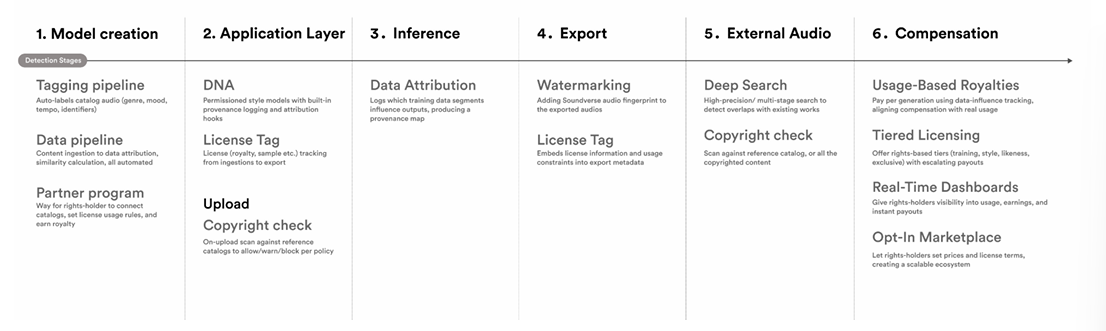
Soundverse's Ethical AI Music Framework serves as one of the most forward-thinking infrastructures aligning perfectly with the Grammy’s approach to human-centered creation in 2026.
Overview
The framework replaces opaque model behavior with an end-to-end ethical pipeline that guarantees consent, attribution, and recurring compensation. It bridges innovation with integrity—exactly what creators need when blending artificial intelligence with human emotion.
Six Core Stages of Ethical Creation
- Licensed Data Sourcing (No Scraping) – All data used to train AI music models is obtained with explicit permission, ensuring no illegitimate dataset usage.
- Permissioned Models (DNA) – Soundverse DNA enables artists to train AI on their personal sonic identity. This approach ensures that generated music reflects authentic artistry while maintaining compliance.
- Explainable Inference (Attribution) – Each AI output includes metadata about creative origins, helping artists prove authorship.
- Traceable Export (Watermarking) – Watermarking technology transparently embeds identity information into audio renders.
- Deep Search (External Scanning) – The system checks that generated material doesn’t duplicate copyrighted works, protecting originality.
- Recurring Compensation (Partner Program) – Contributors receive ongoing royalties whenever their licensed data is used, reinforcing fair value distribution.
Together these features allow creators to honor Grammy eligibility guidelines by ensuring full transparency in AI collaboration.
Related Soundverse Tools
- Soundverse Trace – This trust layer verifies rights ownership and usage paths, supporting compliance audits.
- Content Partner Program – Enables rights-holders to earn continuous usage-based royalties.
- Soundverse DNA – Allows artists to fine-tune AI creation in ethically permissible ways, ensuring human creators retain creative authorship.
Creators exploring Soundverse’s AI Magic Tools can integrate these features to maintain transparency across their production workflows.
What does the future hold for AI and Grammy recognition beyond 2026?
As we look ahead, the Recording Academy’s principles will likely evolve alongside AI’s role in music innovation. With AI increasingly shaping arrangement, mastering, and even performance simulation, new debates could emerge: How much machine input is too much? Could there be new award categories recognizing human–AI collaboration?
By maintaining ethical frameworks like Soundverse’s, the industry ensures it is ready for these questions—placing human creativity at the forefront even as tools grow increasingly intelligent.
Create Award-Worthy Tracks with Soundverse AI
Unlock your creative potential with advanced AI music tools designed for artists, producers, and content creators. Generate unique compositions, mix stems, and bring your musical ideas to life effortlessly.
Start Creating Music Free
Related Articles
- How AI-Generated Music Is Transforming the Music Industry — Discover how artificial intelligence is redefining production workflows and opening new creative possibilities for musicians worldwide.
- AI Music Generator and Human Composers: A Future Together — Learn how technology and human artistry can collaborate to produce innovative and emotionally resonant music.
- Navigating the World of Royalty-Free and Copyright-Free Music Using Soundverse AI — Understand the benefits of using AI-generated royalty-free tracks for your creative projects and online content.
- The Role of AI Music in Film and Television — Explore how directors and producers are leveraging AI-driven compositions to enhance storytelling and cinematic impact.
Here's how to make AI Music with Soundverse
Video Guide

Here’s another long walkthrough of how to use Soundverse AI.
Text Guide
- To know more about AI Magic Tools, check here.
- To know more about Soundverse Assistant, check here.
- To know more about Arrangement Studio, check here.
Soundverse is an AI Assistant that allows content creators and music makers to create original content in a flash using Generative AI. With the help of Soundverse Assistant and AI Magic Tools, our users get an unfair advantage over other creators to create audio and music content quickly, easily and cheaply. Soundverse Assistant is your ultimate music companion. You simply speak to the assistant to get your stuff done. The more you speak to it, the more it starts understanding you and your goals. AI Magic Tools help convert your creative dreams into tangible music and audio. Use AI Magic Tools such as text to music, stem separation, or lyrics generation to realise your content dreams faster. Soundverse is here to take music production to the next level. We're not just a digital audio workstation (DAW) competing with Ableton or Logic, we're building a completely new paradigm of easy and conversational content creation.
TikTok: https://www.tiktok.com/@soundverse.ai
Twitter: https://twitter.com/soundverse_ai
Instagram: https://www.instagram.com/soundverse.ai
LinkedIn: https://www.linkedin.com/company/soundverseai
Youtube: https://www.youtube.com/@SoundverseAI
Facebook: https://www.facebook.com/profile.php?id=100095674445607
Join Soundverse for Free and make Viral AI Music

We are constantly building more product experiences. Keep checking our Blog to stay updated about them!