Can AI Music Be Trademarked? Understanding AI Music Trademark Laws in 2026
Learn if AI music can be trademarked in 2026 and explore Soundverse's Ethical AI Music Framework for compliant music branding.
Can AI Music Be Trademarked?
In the era of artificial intelligence redefining creativity, the question of intellectual property rights in music has taken center stage. By 2026, AI-generated compositions have become commonplace across industries — from marketing jingles to full-length albums. Yet, a pressing question persists: Can AI music be trademarked? Understanding where music trademark law intersects with machine-generated creativity is essential for artists, producers, and tech entrepreneurs navigating this evolving digital landscape.
What Does Trademarking Music Actually Mean?
Trademark law protects identifiers used to distinguish one company’s products or services from another. In the context of music, trademarks are not applied to the actual melody or composition — that falls under copyright — but to brand elements like band names, logos, slogan phrases, and sometimes signature sounds. So when we talk about “AI music trademark,” we are referring to protecting the brand identity of musical output created with artificial intelligence.
Musicians and producers increasingly want to secure their AI-driven brands as unique symbols that represent their creative style. For example, an AI artist collective that generates music under a distinct brand name may seek trademark protection to prevent misuse or imitation of that identity.
Can AI Music Be Trademarked in 2026?
The short answer: Yes, but indirectly. The music composition itself (the AI-generated song) cannot be trademarked, since trademark law protects identifiers — not creative expressions. However, elements associated with AI music, such as the project name, logo, or sonic watermark, can be trademarked.
In 2026, global intellectual property regulators largely maintain that only human authors can hold direct copyright or trademark ownership. But AI-assisted creations can belong to the human or enterprise who directed, trained, or commissioned the AI’s output. This means the person or organization using the AI tool — rather than the AI itself — can register trademarks related to how the music is branded.
How Does AI-Generated Music Affect Intellectual Property Rights?
AI-generated compositions blur traditional ownership boundaries. Users often wonder: who owns a song when an algorithm writes it? According to emerging AI copyright guidelines, the party that configures the AI’s input data, provides creative direction, or selects final outputs typically acquires ownership. In trademark matters, the same rule applies — the identifiable human or brand behind the AI system is recognized as the rights-holder.
For instance, an AI music producer defining prompts to create a signature track can establish the sound as part of their brand identity. If the generated intro features a unique motif recognizable as belonging to that artist's brand, they can potentially trademark that motif under “sound mark” protection.
What Are the Major AI Copyright Issues in Music Law?
Artificial intelligence in music law is a multidimensional topic. By 2026, several recurring themes dominate legal discussions surrounding music intellectual property, echoing findings from AI Music Copyright 2026: Complete Legal Guide for Creators and The 2026 State of AI Music - Major Differences and Legal Peace:
- Authorship Ambiguity: Determining whether the AI or the human is the true ‘author’. International conventions still rely on human responsibility.
- Data Licensing: Ensuring the training datasets used to generate music are legally sourced and not scraped without permission.
- Attribution and Compensation: Protecting original creators whose work contributed to model training.
- Brand Confusion: Preventing AI brands from imitating trademarked sound logos or musical identities.
- Cross-Border Protection: Addressing variation in AI copyright enforcement across countries.
These topics intersect with trademark law when AI music mimics or dilutes an existing brand’s audio identity. Thus, companies and artists producing AI sound outputs must prioritize transparent model use and identifiable authorship chains.
Why Trademarking Matters for AI Musicians in 2026
Music branding and trademarks are vital for establishing recognition and commercial ownership. As AI musicians — both virtual and human–AI hybrids — rise to fame, they need to secure their brand name, logo, and sonic fingerprint just like any traditional artist.
A trademark provides three layers of protection:
- Legal Exclusivity: Prevents others from selling or publishing music under a confusingly similar name.
- Brand Trust: Reinforces authenticity in a world of AI clones and generative remixes.
- Monetization: Enables licensing opportunities and partnerships under a protected brand identity.
In other words, while you can’t trademark an AI-composed melody itself, you can trademark the identifiers that frame your brand around that music.
What About AI Voice Models and Signature Sounds?
There’s growing usage of AI singers and voice replicas. A common question is whether distinctive AI-generated voices can be trademarked. The answer depends on uniqueness and commercial use. If an AI-generated voice becomes a brand’s defining sound (like a recognizable voice pattern used in ads), trademarking it as a sound mark may be possible.
However, live filters or real-time voice swaps are not trademarkable as a sound mark because they change dynamically; trademark protection applies only to consistent, identifiable signatures. Soundverse emphasizes consent and traceability to ensure rightful ownership of any AI voice model used.
How AI Music Trademark Laws Have Evolved Since 2024
Between 2024 and 2025, legislative bodies started drafting preliminary AI authorship policies, leading to significant updates summarized in AI Music and the Law in 2026: What Creators Can and Cannot Do:
- Human Oversight Required: The AI system itself cannot hold marks, but the entity directing output can.
- Transparency Mandate: Origin disclosure requirements apply to commercial AI tracks.
- Sound Mark Registration Expansion: Trademark offices now accept digital sonic fingerprints, including registered AI watermarks.
These changes have empowered creators using enterprise-grade AI frameworks to align production with compliant data and ownership transparency.
How to Make AI Music Trademark-Compliant with Soundverse's Ethical Framework
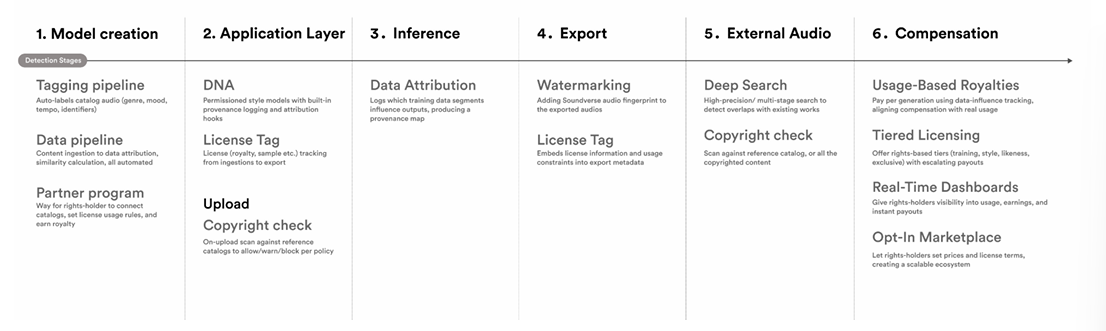
The most practical way to ensure your AI music trademark and branding efforts remain legally sound is by adopting transparent production systems like Soundverse’s Ethical AI Music Framework.
How to make AI music trademark compliant with Soundverse The Ethical AI Music Framework
Soundverse has developed the Ethical AI Music Framework, a comprehensive infrastructure bridging innovation and artist integrity. Instead of functioning as a black box, it follows a transparent six-stage pipeline to ensure consent, attribution, and recurring compensation.
- Stage 1: Licensed Data Sourcing – No scraping or unauthorized sampling. Every dataset used for model training is legally acquired.
- Stage 2: Permissioned Models (DNA) – AI models retain ‘creative DNA’ mapping, confirming the lineage of training data.
- Stage 3: Explainable Inference (Attribution) – Every generated output can trace its musical influences and contributors.
- Stage 4: Traceable Export (Watermarking) – Each track embeds legal watermarks linking the composition back to its rightful source.
- Stage 5: Deep Search (External Scanning) – Post-export scanning ensures generated tracks don’t unintentionally mimic trademarked content.
- Stage 6: Recurring Compensation (Partner Program) – Rights-holders receive recurring royalties whenever their licensed data helps generate new works.
For a deeper dive into creative methods, watch our guide on creating Deep House music and how to make music with Soundverse tools.
This framework directly tackles AI copyright issues and provides a reliable foundation for enterprises aiming to launch trademarked AI music brands. Creators participating in Soundverse’s Content Partner Program gain royalty streams and certification that their AI compositions originate from ethically trained data models — strengthening their legal position when filing trademarks or brand registrations.
How Soundverse Trace Strengthens Music Intellectual Property
Soundverse Trace expands on trademark protection by integrating watermarking and attribution across the full creative cycle. It gives legal professionals and artists verifiable proof of source integrity, making it easier to demonstrate originality in trademark disputes.
By combining Soundverse Trace with the overarching Ethical AI Music Framework, producers can confidently build AI-powered music brands that meet data, ownership, and trademark compliance requirements.
Practical Examples of Trademark Application in AI Music
Consider these examples:
- A music producer creates an AI-generated jazz collection using Soundverse. They trademark the brand name “NeuroJazz Collective” and protect its logo and audio watermark.
- A game studio using Soundverse AI Magic Tools generates thematic ambient soundtracks. They trademark the recurring chime motif as their sound signature.
- A YouTube creator using Soundverse Text-to-Music trademark their AI brand intro so competitors can’t imitate the same sound identity.
Each scenario illustrates how trademark law applies to identifiers around music, rather than the music itself. For creators exploring broader applications of AI sound in entertainment, refer to AI Music in the USA and AI Music Generator and Human Composers: A Future Together — both discussing evolving IP norms.
Protect and Create Your AI Music with Soundverse
Start generating, customizing, and managing your original AI tracks with advanced tools designed for creators. Take control of your sound and understand how ownership works in the age of AI music.
Related Articles
- How AI-Generated Music Is Transforming the Music Industry: Discover how artificial intelligence is reshaping composition, creativity, and rights management across the music world.
- Navigating the World of Royalty-Free and Copyright-Free Music Using Soundverse AI: Learn how to legally leverage AI-generated tracks for commercial projects with royalty-free and copyright-free music tools.
- The Role of AI Music in Film and Television: Explore how filmmakers and showrunners are integrating AI-generated scores and soundscapes into their productions.
- Copyright-Free vs. Royalty-Free Music: What Creators Should Know: Understand the key differences between copyright-free and royalty-free tracks to make smarter content choices.
Here's how to make AI Music with Soundverse
Video Guide

Here’s another long walkthrough of how to use Soundverse AI.
Text Guide
- To know more about AI Magic Tools, check here.
- To know more about Soundverse Assistant, check here.
- To know more about Arrangement Studio, check here.
Soundverse is an AI Assistant that allows content creators and music makers to create original content in a flash using Generative AI. With the help of Soundverse Assistant and AI Magic Tools, our users get an unfair advantage over other creators to create audio and music content quickly, easily and cheaply. Soundverse Assistant is your ultimate music companion. You simply speak to the assistant to get your stuff done. The more you speak to it, the more it starts understanding you and your goals. AI Magic Tools help convert your creative dreams into tangible music and audio. Use AI Magic Tools such as text to music, stem separation, or lyrics generation to realise your content dreams faster. Soundverse is here to take music production to the next level. We're not just a digital audio workstation (DAW) competing with Ableton or Logic, we're building a completely new paradigm of easy and conversational content creation.
TikTok: https://www.tiktok.com/@soundverse.ai
Twitter: https://twitter.com/soundverse_ai
Instagram: https://www.instagram.com/soundverse.ai
LinkedIn: https://www.linkedin.com/company/soundverseai
Youtube: https://www.youtube.com/@SoundverseAI
Facebook: https://www.facebook.com/profile.php?id=100095674445607
Join Soundverse for Free and make Viral AI Music

We are constantly building more product experiences. Keep checking our Blog to stay updated about them!