Can AI Music Be Copyrighted in the US?
Understand AI music copyright law and how US rules shape ownership of AI-generated tracks in 2026.
Can AI Music Be Copyrighted in the US?
Artificial intelligence has revolutionized how music is created, distributed, and consumed. From composing complex orchestral arrangements to producing catchy pop instrumentals, AI models now stand shoulder-to-shoulder with human creators. Yet one central question continues to dominate conversations in 2026: Can AI music be copyrighted in the US? This question sits at the intersection of technology, art, and law — and its answer could determine how artists, developers, and rights holders collaborate in the digital age.
What does US copyright law say about AI music in 2026?
As of 2026, the US Copyright Office (USCO) continues to clarify how US copyright law for AI applies to creative works produced with or by artificial intelligence. The foundation of US copyright law remains unchanged: only human authors can hold copyright. This core principle means that music created entirely by a machine, without human involvement, cannot be copyrighted.
This was reaffirmed in past cases like Thaler v. Perlmutter (2023–2024), where the court ruled that non-human entities — including AI systems — cannot be recognized as authors under US law. The principle behind this is simple: copyright protection exists to reward human creativity and effort.
That said, there’s growing nuance. If an artist provides creative input at crucial stages — such as choosing prompts, editing generated audio, or composing part of the structure — that contribution might qualify as a human-authored work assisted by AI. In such circumstances, a portion of the creation could be protected under copyright.
Can AI-generated music be registered for copyright protection?
In the US, you can only register a composition or sound recording with the Copyright Office if a human made significant creative contributions. The Office requires applicants to disclose the use of AI tools and specify the degree of human decision-making involved.
For instance, if a musician uses an AI model to generate melodies but then arranges, edits, and performs the output, the final recording might qualify as a derivative work involving human originality. However, purely machine-made outputs remain public domain. Therefore, understanding how much human input your process involves is essential to determine whether you can legally claim ownership. According to the U.S. Copyright Office’s 2025 announcement, AI-generated works can only be copyrighted when they embody “meaningful human authorship.”
Why is AI music copyright complicated?
The issue lies in authorship attribution. Traditional copyright law assumes a human creator, but AI-generated outputs are derived from probabilistic models trained on massive datasets. When these datasets contain copyrighted music, questions emerge about whether the AI’s output constitutes transformative use or infringement — as discussed in the U.S. Copyright Office’s analysis of AI policy and law.
Additionally, music produced by AI systems may embed stylistic elements, chord progressions, or timbres learned from existing copyrighted material. When not properly licensed, this can create risks for both musicians and companies using AI technologies.
This complexity isn’t unique to music — similar challenges exist for visual art, literature, and digital design. However, music poses additional issues because of its deep commercial ecosystem — royalties, performances, sync licenses, and streaming rights all hinge on ownership clarity. For a practical understanding of crafting with AI, see our tutorial on how to make music from the Soundverse Tutorial Series.
How does human involvement affect AI music copyright eligibility?
Human involvement acts as the deciding factor for ownership rights. The more human creativity influences the output, the stronger the case for protection. The US Copyright Office provides guidance that AI-assisted works can qualify for copyright only to the extent of human contribution.
Common scenarios include:
- AI as a creative assistant: When composers use AI as a brainstorming partner — for instance, generating chord ideas or rhythm patterns — their selection and curation can justify authorship.
- AI as an instrument: If a musician intentionally guides the AI through iterative prompts, feedback, and refinements, the AI becomes a tool, not a co-author.
- AI as a solo composer: When AI autonomously generates entire tracks without human oversight, no copyright can be claimed under current law.
Each scenario requires proper documentation to establish provenance and authorship attribution.
What are the ethical and commercial implications of AI music ownership?
Without proper legal protection, purely machine-made music remains vulnerable to unrestricted use. This opens both opportunities and ethical dilemmas:
- Artists risk having their unique sound replicated by AI without compensation.
- Developers risk lawsuits if their training data used unlicensed works.
- Labels and producers require compliance tools to track attribution and ensure fair payment.
By 2026, many creators now rely on frameworks like Soundverse’s Ethical AI Music Framework to ensure legal clarity while balancing innovation and artist respect.
How to make copyright-compliant AI music with Soundverse The Ethical AI Music Framework
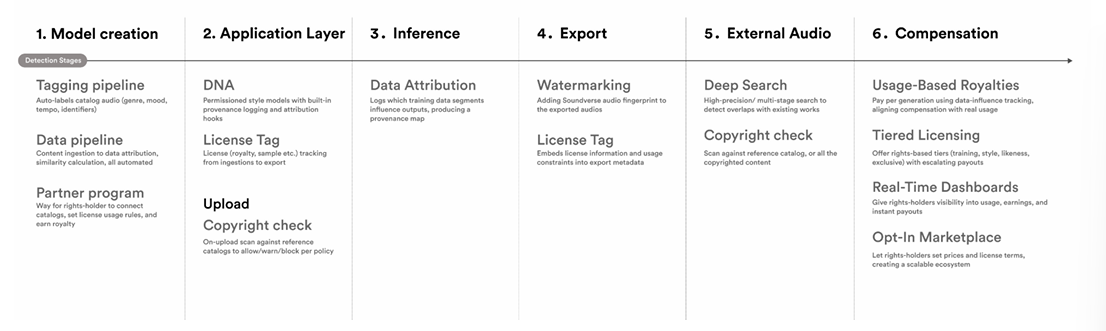
The Ethical AI Music Framework is Soundverse’s comprehensive solution to manage attribution and ownership throughout the AI music lifecycle. It establishes a transparent six-stage pipeline that ensures consent, traceability, and sustainability — bridging the gap between innovation and artist integrity.
Stage 1: Licensed Data Sourcing
Soundverse sources audio and metadata exclusively from licensed, consent-based datasets. No scraping or unauthorized data usage occurs, ensuring compliance from the ground up.
Stage 2: Permissioned Models (DNA)
Each model is permissioned, meaning every data contributor is aware of how their content is used. This creates a chain of trust and accountability across the workflow.
Stage 3: Explainable Inference (Attribution)
Every generated track includes data-layer attribution that explains which influences informed its output, enabling transparent authorship claims.
Stage 4: Traceable Export (Watermarking)
All AI-generated compositions include invisible watermarks that embed ownership and licensing information. This protects artists and users from reuse disputes.
Stage 5: Deep Search (External Scanning)
Soundverse scans global music repositories to verify originality before release, ensuring compliance with international copyright frameworks.
Stage 6: Recurring Compensation (Partner Program)
Rights-holders who contribute training data earn recurring royalties through Soundverse’s Content Partner Program. This establishes a sustainable artist economy around AI creation.
By embedding ethics and transparency into every phase, Soundverse empowers both AI developers and musicians to navigate complex copyright landscapes confidently. For a hands-on overview of AI production workflow, watch our Deep House music tutorial.
What does the future of AI and intellectual property look like in 2026?
In 2026, the US music industry is adopting hybrid legal and technological frameworks. The AI and intellectual property debate now focuses less on whether AI can be an author, and more on how to distribute credit and compensation fairly.
Industry analysts expect AI copyright reform to expand toward shared authorship models, where human-AI co-creations receive partial protection. Several music collectives and policy groups are lobbying for clearer distinctions between AI assistance and autonomous generation.
Meanwhile, platforms like Soundverse are leading practical initiatives. By implementing traceability, attribution, and royalty-sharing systems, they demonstrate how technology can uphold artistic integrity while driving innovation. The 2025 U.S. Copyright Office report on AI and copyrightability reinforces this direction.
Why creators and legal professionals should care now
For musicians, understanding copyright protection for machine-made art isn’t optional anymore. AI has become central to composing, producing, and scoring commercial content. Whether you generate ambient soundscapes or complex symphonies, documenting your creative involvement is essential to protect your rights.
For legal professionals, clarifying authorship boundaries ensures clients can confidently register AI-assisted works. And for developers, ethical data sourcing and transparent attribution guard against compliance risks.
To explore how AI changes music creation itself, see How AI-Generated Music Is Transforming the Music Industry or discover AI Music in the USA. If you’re comparing platforms, check Mubert Alternatives: Soundverse and explore Soundverse’s AI Magic Tools for creative expansion.
Start Creating Original AI Music Today
Experience the freedom to generate and customize music instantly with Soundverse’s advanced AI tools. Protect your creativity and explore a new world of copyright-safe soundscapes built for modern creators.
Try Soundverse for Free
Related Articles
- AI Music in the USA — Explore how artificial intelligence is influencing the American music landscape and what it means for creators and copyright law.
- Copyright-Free vs Royalty-Free Music: What Creators Should Know — Understand the key differences between copyright-free and royalty-free tracks to make smarter licensing decisions for your content.
- Navigating the World of Royalty-Free and Copyright-Free Music Using Soundverse AI — Learn how Soundverse helps you find and generate music that’s safe to use without legal complications.
- The Role of AI Music in Film and Television — Discover how AI-generated music is transforming soundtrack creation for movies, series, and commercials.
Here's how to make AI Music with Soundverse
Video Guide

Here’s another long walkthrough of how to use Soundverse AI.
Text Guide
- To know more about AI Magic Tools, check here.
- To know more about Soundverse Assistant, check here.
- To know more about Arrangement Studio, check here.
Soundverse is an AI Assistant that allows content creators and music makers to create original content in a flash using Generative AI. With the help of Soundverse Assistant and AI Magic Tools, our users get an unfair advantage over other creators to create audio and music content quickly, easily and cheaply. Soundverse Assistant is your ultimate music companion. You simply speak to the assistant to get your stuff done. The more you speak to it, the more it starts understanding you and your goals. AI Magic Tools help convert your creative dreams into tangible music and audio. Use AI Magic Tools such as text to music, stem separation, or lyrics generation to realise your content dreams faster. Soundverse is here to take music production to the next level. We're not just a digital audio workstation (DAW) competing with Ableton or Logic, we're building a completely new paradigm of easy and conversational content creation.
TikTok: https://www.tiktok.com/@soundverse.ai
Twitter: https://twitter.com/soundverse_ai
Instagram: https://www.instagram.com/soundverse.ai
LinkedIn: https://www.linkedin.com/company/soundverseai
Youtube: https://www.youtube.com/@SoundverseAI
Facebook: https://www.facebook.com/profile.php?id=100095674445607
Join Soundverse for Free and make Viral AI Music

We are constantly building more product experiences. Keep checking our Blog to stay updated about them!
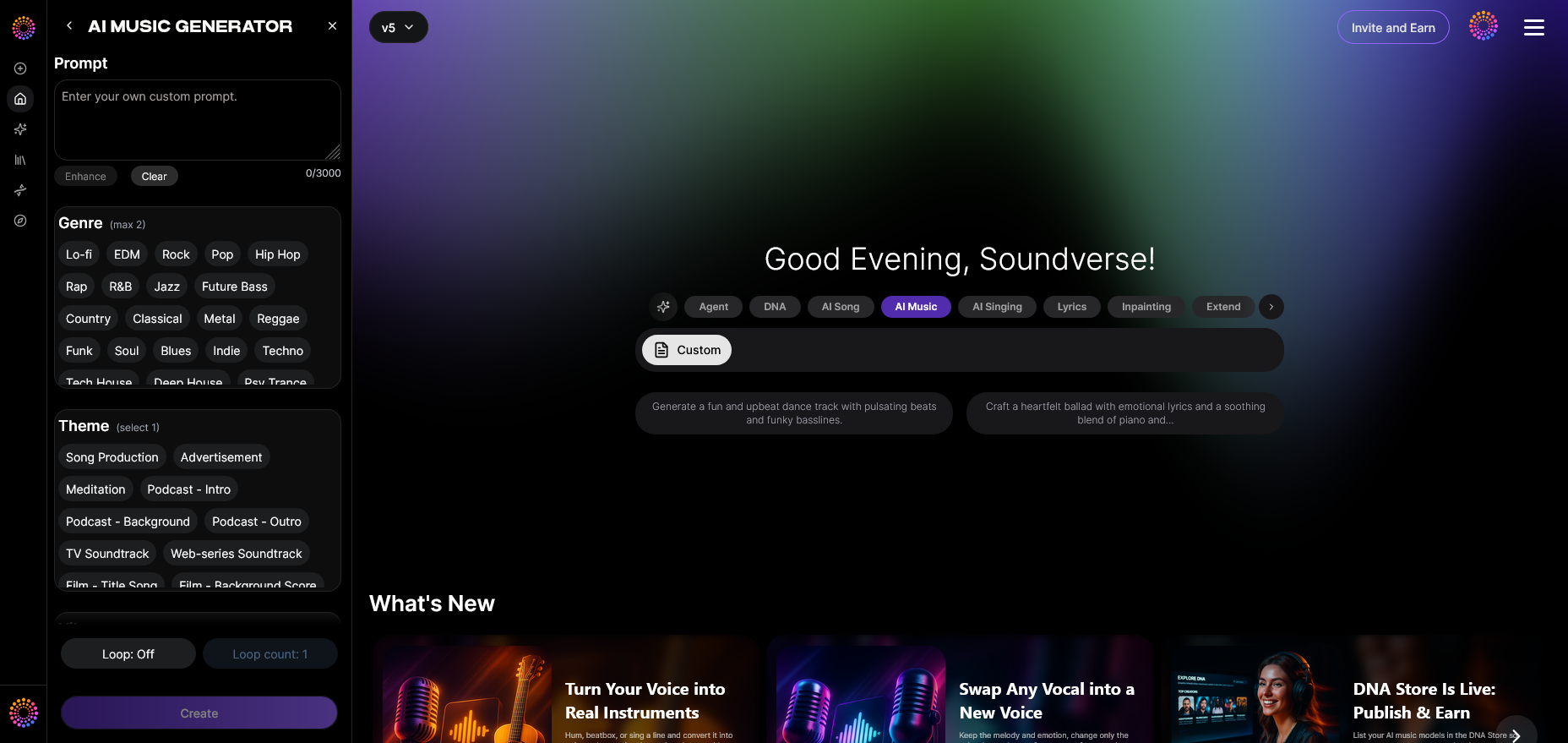
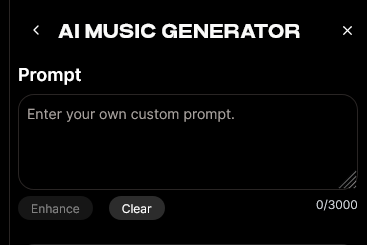
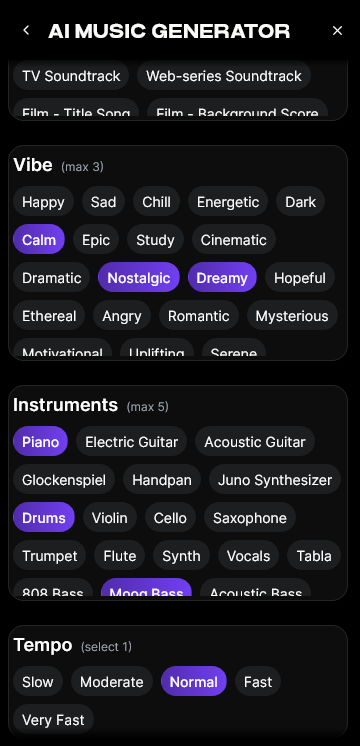
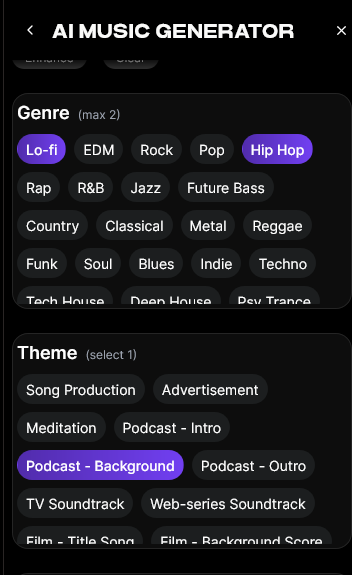
Image Steps: [ { "feature_name": "AI Music Generator", "step_number": 1, "step_title": "Feature Overview", "image_link": "https://soundversestrapi.blob.core.windows.net/strapi-uploads/assets/uploads/AI_Music_Overview_e50e4af5e0/AI_Music_Overview_e50e4af5e0.png" }, { "feature_name": "AI Music Generator", "step_number": 2, "step_title": "Description Input", "image_link": "https://soundversestrapi.blob.core.windows.net/strapi-uploads/assets/uploads/AI_Music_Generator_2_Description_Input_Enter_text_description_of_desired_music_124ddcf48f/AI_Music_Generator_2_Description_Input_Enter_text_description_of_desired_music_124ddcf48f.png" }, { "feature_name": "AI Music Generator", "step_number": 3, "step_title": "Style & Duration", "image_link": "https://soundversestrapi.blob.core.windows.net/strapi-uploads/assets/uploads/AI_Music_Generator_3_Style_and_Duration_Select_music_style_and_track_duration_760301870f/AI_Music_Generator_3_Style_and_Duration_Select_music_style_and_track_duration_760301870f.png" }, { "feature_name": "AI Music Generator", "step_number": 4, "step_title": "Generation", "image_link": "https://soundversestrapi.blob.core.windows.net/strapi-uploads/assets/uploads/AI_Music_Generator_4_Generation_Generate_instrumental_music_based_on_description_f99b07e99c/AI_Music_Generator_4_Generation_Generate_instrumental_music_based_on_description_f99b07e99c.png" }, { "feature_name": "AI Music Generator", "step_number": 5, "step_title": "Export Options", "image_link": "https://soundversestrapi.blob.core.windows.net/strapi-uploads/assets/uploads/AI_Music_Export_fc964d07c3/AI_Music_Export_fc964d07c3.png" } ]