AI Music Quality Issues: Common Problems & Solutions
Explore top AI music quality issues in 2026 and learn how Soundverse Trace improves production accuracy.
AI Music Quality Issues: Common Problems & Solutions
Artificial intelligence has revolutionized music creation, composition, and sound design. However, despite remarkable progress between 2024 and 2025, by 2026 many professionals still encounter persistent AI music quality issues. These include artifacts, audio generation errors, unrealistic sound synthesis, and inconsistencies in machine learning output. Music producers, sound engineers, and AI developers are all exploring strategies to enhance the fidelity of AI-generated tracks and overcome the technical limitations affecting creativity and usability.
Why does AI music still struggle with quality in 2026?
Although AI now plays a dominant role in producing tracks for streaming, advertisements, and games, the complexity of musical structure poses a challenge for computational models. AI music quality suffers when neural architectures fail to interpret emotional nuance, timing variations, or harmonic intent. Most machine learning models rely on large datasets compiled from licensed or public-domain music. If these datasets contain imperfections or lack diversity, resulting compositions exhibit predictable sound patterns, phase distortions, and digital noise. This lack of diversity is one reason highlighted in Music’s AI Problem – UC Press Journals.

Common causes of poor AI music quality
- Audio generation errors – These often appear when network layers misinterpret amplitude envelopes or phase relationships. It results in distorted outputs, random clicks, or phase cancellation.
- Sound synthesis problems – AI systems occasionally produce unrealistic or metallic timbres. Synthetic samples may sound unnatural, especially when trying to emulate human voices or analog instruments.
- AI music production flaws – Quantization artifacts, timing drifts, or compression overshoot can make tracks sound mechanical. These issues are evident in older generation libraries initially trained before 2025.
- Machine learning audio issues – A mismatch between training and inference data leads to unstable outputs. When the model has not been fine-tuned for different genres, it yields uneven dynamic ranges.
- AI songwriting challenges – Compositional logic in AI systems often struggles with progression consistency. Melodies may loop awkwardly or lose coherence beyond short sequences.
Each problem above reduces the perceived professionalism of AI-generated music and directly impacts adoption in high-budget productions.
What are current industry efforts to improve AI music quality?
By 2026, industry trends shifted toward ethical and transparent data handling. Platforms such as Soundverse have influenced global practices with traceable music generation frameworks. Producers no longer view quality purely as a technical measure—it also involves provenance, rights, and trust. The iMusician report noted that artists seek control and filtering of low-effort AI outputs, further emphasizing this movement.

- Model optimization – Developers refine architectures using specialized audio transformers capable of resolving spectral detail.
- Dataset curation – Major AI labs now prioritize licensed and verified audio sources. The risk of generating derivative or infringing material is minimized.
- Post-processing workflows – Hybrid mastering that combines AI equalization and human-sensitive compressors has become an essential step to recover realism.
- Ethical AI frameworks – Platforms adopt transparent pipelines similar to the Soundverse Ethical AI Music Framework to ensure attribution and consent.
For readers exploring cutting-edge AI music trends, refer to Music Industry Trends for context on how generative systems shape production workflows. According to the MIDiA Research report, AI music will continue its exponential growth through 2026.
What solutions exist to mitigate AI noise and distortion?
Noise and distortion stem from low sampling precision and under-trained spectral models. Developers now use convolutional layers dedicated to frequency-band balancing. In addition, post-generation restoration filters can repair transients. However, without integrated traceability, it remains difficult to identify which dataset introduced noise.
AI musicians and engineers thus rely increasingly on metadata to track the influence of training sets. The most notable advancement in 2026 addressing this issue is the Soundverse Trace feature.
How Soundverse Trace solves major AI music quality issues
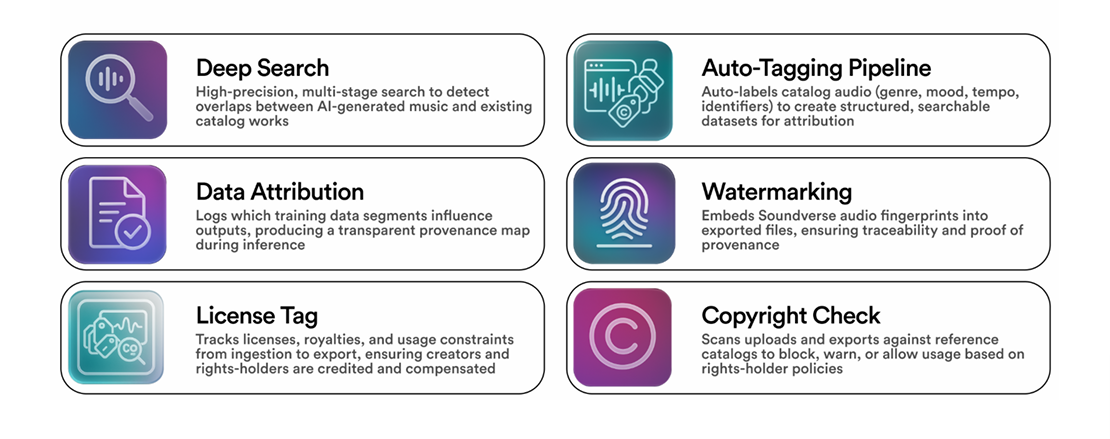
Soundverse Trace is a comprehensive trust layer designed for AI music workflows. Instead of simply evaluating the sonic output, it embeds transparency, rights protection, and fine-grained technical verification from dataset creation through final export. This system ensures that every generated sound possesses verifiable provenance and quality accountability. The concept complements findings from a Deezer and Ipsos study, where 97% of listeners could not distinguish AI-generated from human-made music—highlighting an urgent need for transparent provenance systems.
Key capabilities include:
- Deep Search (1:1 and 1:N scanning): Enables precise identification of overlaps between generated and existing tracks, preventing plagiarism or unwanted influence.
- Data Attribution: Records exactly which dataset samples affected a specific output. Engineers and producers can audit sound lineage and eliminate sources associated with low-quality samples.
- Audio Watermarking: Embeds inaudible fingerprints ensuring that ownership and authenticity remain intact even post-export.
- License Tagging: Retains rights and licensing metadata automatically, allowing producers and artists to track usage or automate royalties.
Thanks to these innovations, Soundverse Trace not only resolves ethical matters but also improves technical reliability. When poor dataset signals are detected, users can trace and remove them, effectively enhancing AI music quality long term.
For creators experimenting with genre-oriented AI output, check Generate AI Music with Soundverse Text-to-Music to understand compatible pipelines and further refine sonic accuracy. For a deeper dive into platform usage, watch our Soundverse Tutorial Series - 9. How to Make Music and Soundverse Tutorial Series - 10. Make Deep House Music.
Integration with related tools
Soundverse Trace complements other tools like Soundverse DNA, which generates original, style-consistent tracks trained on licensed catalogs, and the Ethical AI Music Framework, which provides the underlying consent and transparency across production stages. Together, these technologies form an ecosystem ensuring that AI music creation is high-quality, secure, and legally sound.
If you are producing hybrid content or multi-track sessions, you can also explore Soundverse Stem Separation AI Magic Tool, which helps with cleaning and refining isolated sound stems—another critical step toward improving AI-created mixes.
How should producers and engineers adapt to 2026 AI music standards?
Music professionals must embrace a quality-first mindset integrating traceability and validation tools into their workflow. By adapting to the transparent frameworks now commonplace in 2026, teams can prevent technical degradation and legal risk.
Practical recommendations:
- Evaluate dataset sources: Always verify licensing and diversity of inputs.
- Use traceability layers: Adopt platforms like Soundverse Trace to identify origin paths for generated sounds.
- Apply adaptive mastering: Combine AI dynamics processors with human-engineered EQ decisions to retain warmth.
- Audit metadata and rights tags: Keep consistent tracking of copyright information across project files.
For creators looking for stylistic guidance, explore genre tutorials such as How to Create EDM with Soundverse AI or How to Create Jazz Music with Soundverse AI to refine quality in specific production workflows.
What does the future of AI music quality look like beyond 2026?
As AI architectures move toward multimodal models capable of understanding emotion and context, music generation will grow more sophisticated. By 2027, we can expect fully traceable soundscapes replicated with emotional authenticity and copyright security built in. The emergence of trust layers like Soundverse Trace signals a maturation of music AI—where quality, legality, and creativity coexist naturally.
Enhance Your AI Music Quality Today
Discover how Soundverse’s intelligent AI music tools can help you produce cleaner, balanced, and studio-quality sound in minutes. Elevate your creative workflow and fix common audio issues instantly.
Related Articles
- How AI-Generated Music Is Transforming the Music Industry – Explore how artificial intelligence is reshaping music production, creativity, and accessibility for artists worldwide.
- Soundverse Introduces Stem Separation AI Magic Tool – Learn how Soundverse’s AI stem separation can help creators isolate instruments and vocals for perfect mixing and mastering.
- The Benefits of Composing with AI Music Generator – Understand why AI compositional tools are revolutionizing songwriting, improving output, and saving hours of production time.
- What Are Song Stems and Why Do You Need Them – Get to know how song stems enhance flexibility in editing, mixing, and elevating overall AI music quality.
Here's how to make AI Music with Soundverse
Video Guide
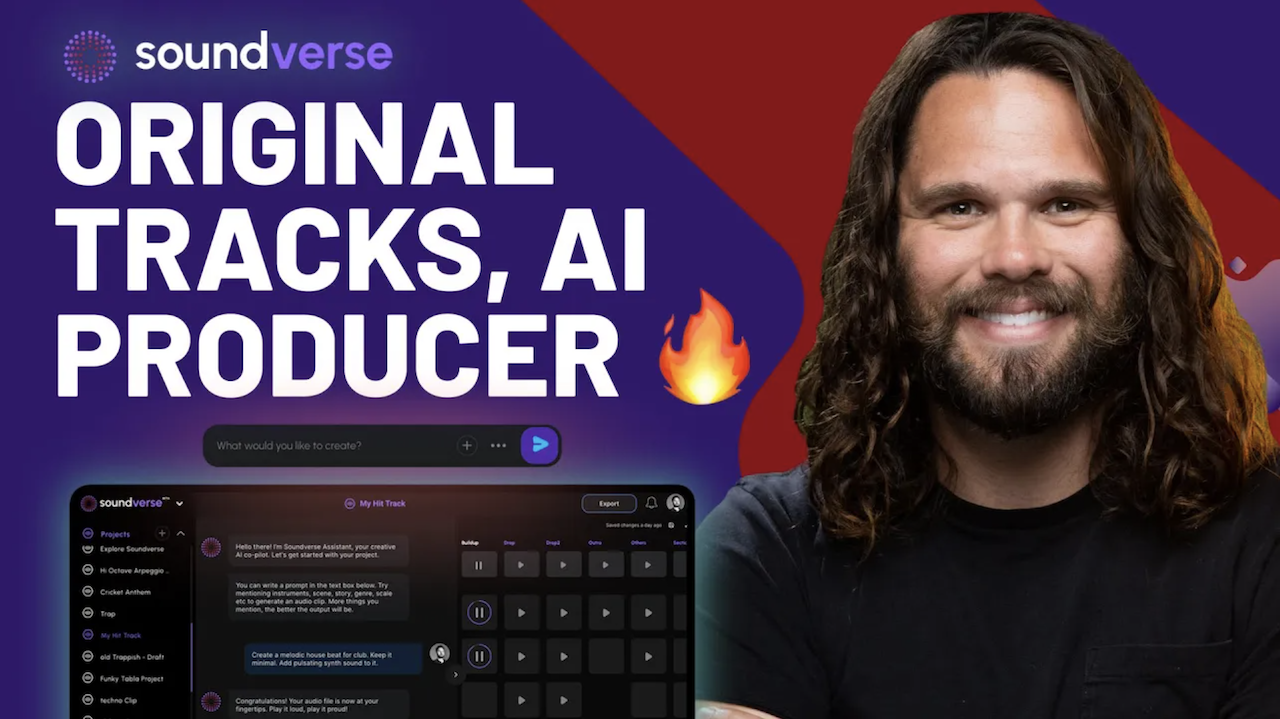
Here’s another long walkthrough of how to use Soundverse AI.
Text Guide
- To know more about AI Magic Tools, check here.
- To know more about Soundverse Assistant, check here.
- To know more about Arrangement Studio, check here.
Soundverse is an AI Assistant that allows content creators and music makers to create original content in a flash using Generative AI.
With the help of Soundverse Assistant and AI Magic Tools, our users get an unfair advantage over other creators to create audio and music content quickly, easily and cheaply.
Soundverse Assistant is your ultimate music companion. You simply speak to the assistant to get your stuff done. The more you speak to it, the more it starts understanding you and your goals.
AI Magic Tools help convert your creative dreams into tangible music and audio. Use AI Magic Tools such as text to music, stem separation, or lyrics generation to realise your content dreams faster.
Soundverse is here to take music production to the next level. We're not just a digital audio workstation (DAW) competing with Ableton or Logic, we're building a completely new paradigm of easy and conversational content creation.
TikTok: https://www.tiktok.com/@soundverse.ai
Twitter: https://twitter.com/soundverse_ai
Instagram: https://www.instagram.com/soundverse.ai
LinkedIn: https://www.linkedin.com/company/soundverseai
Youtube: https://www.youtube.com/@SoundverseAI
Facebook: https://www.facebook.com/profile.php?id=100095674445607
Join Soundverse for Free and make Viral AI Music

We are constantly building more product experiences. Keep checking our Blog to stay updated about them!
Image Steps: []