Billboard vs Grammy: Key Differences Every Artist Should Know
Understand the key differences between Billboard Music Awards and Grammy Awards in 2026.
Billboard vs Grammy: Key Differences Every Artist Should Know
In 2026, the global music landscape is more competitive and data-driven than ever. Artists are no longer judged solely on radio spins or physical record sales; instead, metrics like streaming performance, fan engagement, and creative innovation play an equally significant role. Among all recognitions in the industry, two names stand tall — Billboard Music Awards and Grammy Awards. Both symbolize artistic success, but they measure it very differently. This guide dives deep into the Billboard vs Grammy debate to clarify what each award represents, how winners are chosen, and why both matter for artists aiming for long-term music industry recognition.
What is the main difference between Billboard and Grammy Awards?

The simplest way to define the distinction is this: Billboard rewards results, while the Grammys reward artistry.
- Billboard Music Awards are data-based. They evaluate artists using streaming analytics, digital downloads, radio airplay, and social engagement over a specific time period. Winning here reflects how commercially successful your music has been.
- Grammy Awards, on the other hand, are peer-based. They are granted by the Recording Academy, where music producers, engineers, composers, and fellow artists vote. Winning a Grammy acts as a recognition of excellence in creative expression and technical mastery rather than just sales.
How are Billboard winners determined?

Billboard uses quantifiable data collected through platforms like Spotify, Apple Music, YouTube, and even TikTok. Their methodology includes:
- Chart Performance: This is the strongest factor. Artists who dominate the Billboard Hot 100 and Billboard 200 throughout the eligibility window have a significant edge.
- Streaming Data: Total and unique streams are counted across platforms.
- Radio Airplay: Based on listener impressions and station reports.
- Sales Metrics: Physical and digital purchases, reflecting fan investment.
- Fan Engagement: Social media buzz, hashtag activity, and direct audience reaction score add weight in categories involving popularity.
Because the Billboard Music Awards purely mirror popularity and reach, they are often viewed as the fans’ verdict on the artist’s influence during the year. Fans can even participate in online voting on the Billboard website, which adds another interactive dimension to the process.
How are Grammy winners decided?
The Grammy Awards operate differently. The Recording Academy—made up of thousands of industry professionals—runs a multi-stage nomination and voting process. The Grammy Awards criteria include:
- Artistic excellence, technical proficiency, and overall contribution to the music field.
- Recorded releases during a defined eligibility year.
- Peer voting within relevant genre categories (Pop, Rock, Country, Jazz, etc.).
This structure means commercial success does not guarantee a Grammy. A critically acclaimed but modest-selling album can still win based on musicianship. The Grammys emphasize craft, creativity, and lasting impact over charts. Similar guidelines are used by other award bodies, such as the ACM Awards voting policy, underscoring the industry’s peer-review approach.
For a deeper dive into improving artistry that aligns with Grammy-level standards, watch our Soundverse Tutorial Series - How to Make Music.
Which award carries more industry prestige in 2026?
As of 2026, both awards hold immense prestige, but for different reasons:
- Billboard Music Awards: Considered the most accurate snapshot of public demand and consumption patterns. Victory here proves market dominance.
- Grammy Awards: Remain the artistic gold standard. Winning a Grammy still positions an artist as a respected creative force, often boosting their career longevity and reputation among industry peers.
That said, younger artists in 2026 increasingly see Billboard success as validation from listeners, especially in the social streaming era, while seasoned musicians continue to chase Grammy recognition for its legacy value.
What do these awards mean for artist career development?
An artist’s journey often benefits from both sides of this equation:
- Winning Billboard Awards attracts brand collaborations, touring opportunities, and investment from labels due to visible commercial traction.
- Winning Grammy Awards secures long-term credibility, international recognition, and peer respect, solidifying the artist’s contribution to music as an art form.
Many iconic artists leverage both — Billboard for immediate scale and Grammys for cultural permanence. In an era defined by algorithms and AI-led distribution, this combination of analytics and artistry remains key to building sustainable music careers.
Has technology changed how these awards operate?
Absolutely. Between 2024 and 2026, both organizations recalibrated their eligibility models to adapt to the streaming-first ecosystem. For instance:
- Billboard integrates TikTok virality and short-form video metrics into its data model.
- The Grammys introduced clearer guidelines for AI-assisted music production and defined consent-driven representations for AI-generated elements.
The conversation about AI music ethics, data provenance, and rightful attribution has become central to both award systems’ decision-making. As seen in multiple industry trend analyses, the focus is now on transparent data usage and creative authenticity.
What about international influence and inclusivity?
By 2026, both awards expanded their global reach.
- Billboard integrated regional charts for Asia, Africa, and Latin America, reflecting international streaming traffic.
- The Recording Academy extended voting membership to include more global professionals, acknowledging the worldwide music exchange.
This transformation ensures both awards now represent the truly globalized music scene of the digital decade.
How do emerging artists in 2026 view Billboard vs Grammy?
For emerging musicians using AI tools or online production workflows, Billboard might initially seem more accessible because data-driven growth can be achieved via viral marketing. However, in terms of sustainable artistic career paths, understanding Grammy standards helps shape artistic direction and production quality.
Artists using ethical AI music generation technologies, such as those outlined in the Soundverse AI Magic Tools, can balance innovation with integrity — a concept which both Billboard and Grammy evaluators increasingly value. For example, learning through our Deep House Music tutorial demonstrates how artists can blend technical skill with audience appeal.
How to make sense of the Billboard vs Grammy comparison as a modern artist
In short:
- Billboard = Popular reach, sales, and metrics.
- Grammys = Skill, originality, and artistry.
The smartest artists align their creative and commercial strategies. They track streaming analytics with precision while preserving the emotional, authentic core of their work that Grammy voters appreciate. Tools empowering ethical creation, like Soundverse Arrangement Studio, help musicians achieve that professional-quality consistency.
How to make ethical award-winning music with Soundverse The Ethical AI Music Framework
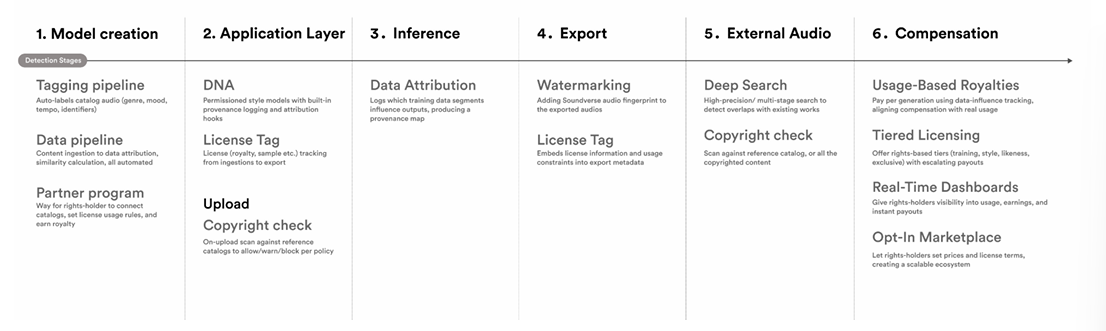
Soundverse’s Ethical AI Music Framework fits perfectly into this discussion about recognition and integrity in modern music creation. In 2026, AI is omnipresent, but questions around data transparency and rightful ownership still challenge producers. Soundverse bridges that gap by embedding ethical infrastructure throughout the creative process.
What the framework does
The Ethical AI Music Framework ensures that AI-generated or AI-assisted compositions are legally compliant, fair, and transparent. It is an end-to-end infrastructure composed of six distinct, traceable stages:
- Stage 1: Licensed Data Sourcing – Only legal and permissioned sound data are used, avoiding scraping or copyright infringement.
- Stage 2: Permissioned Models (DNA) – Every AI model is trained with full consent from rights-holders.
- Stage 3: Explainable Inference (Attribution) – Generated outputs are audit-ready, with clear traceability to original data sources.
- Stage 4: Traceable Export (Watermarking) – Each exported track carries a digital watermark for ownership verification.
- Stage 5: Deep Search (External Scanning) – Tracks can be scanned across the web to detect unauthorized usage.
- Stage 6: Recurring Compensation (Partner Program) – Rights-holders participating in the Content Partner Program receive continuous royalties as AI-generated works evolve.
Why this matters for awards
Both Grammys and Billboards increasingly require transparency in how music is produced. AI-driven tracks must include clear authorship records. Soundverse’s transparent workflow turns compliance from a challenge into a built-in feature, letting artists prove authorship and integrity without manual effort.
The framework connects naturally with Soundverse Trace, a trust layer that embeds attribution and rights protection — vital for songs competing in major award circuits.
For producers and composers preparing to release AI-assisted pieces, this ethical layer ensures eligibility and authenticity, giving them a legitimate path to recognition from both Billboard metrics and Grammy standards.
Create Your Own Award-Worthy Music with Soundverse AI
Experience professional-level music creation in minutes. Harness AI tools to generate, refine, and share unique tracks perfect for streaming, video, or performance.
- How AI-Generated Music Is Transforming the Music Industry — Explore how artificial intelligence is redefining creativity and production in today’s music world.
- AI Music Generator and Human Composers: A Future Together — Discover how AI collaboration empowers artists while preserving human emotion in music composition.
- The Role of AI Music in Film and Television — Learn how AI-driven soundtracks are enhancing storytelling across visual media.
- Music Industry Trends — Stay ahead with insights into evolving music business models and emerging digital platforms.
Here's how to make AI Music with Soundverse
Video Guide

Here’s another long walkthrough of how to use Soundverse AI.
Text Guide
- To know more about AI Magic Tools, check here.
- To know more about Soundverse Assistant, check here.
- To know more about Arrangement Studio, check here.
Soundverse is an AI Assistant that allows content creators and music makers to create original content in a flash using Generative AI.
With the help of Soundverse Assistant and AI Magic Tools, our users get an unfair advantage over other creators to create audio and music content quickly, easily and cheaply.
Soundverse Assistant is your ultimate music companion. You simply speak to the assistant to get your stuff done. The more you speak to it, the more it starts understanding you and your goals.
AI Magic Tools help convert your creative dreams into tangible music and audio. Use AI Magic Tools such as text to music, stem separation, or lyrics generation to realise your content dreams faster.
Soundverse is here to take music production to the next level. We're not just a digital audio workstation (DAW) competing with Ableton or Logic, we're building a completely new paradigm of easy and conversational content creation.
TikTok: https://www.tiktok.com/@soundverse.ai
Twitter: https://twitter.com/soundverse_ai
Instagram: https://www.instagram.com/soundverse.ai
LinkedIn: https://www.linkedin.com/company/soundverseai
Youtube: https://www.youtube.com/@SoundverseAI
Facebook: https://www.facebook.com/profile.php?id=100095674445607
Join Soundverse for Free and make Viral AI Music

We are constantly building more product experiences. Keep checking our Blog to stay updated about them!