AI Music vs Royalty-Free Libraries: Which Is Better for Creators in 2026?
Compare AI music and royalty-free libraries in 2026 to find the best option for creators.
AI Music vs Royalty-Free Libraries: Which Is Better for Creators?
In 2026, the debate between AI music and royalty-free libraries continues to shape how creators produce audio content. As technology advances, content creators, marketers, and musicians all seek cost-effective, flexible, and legally safe solutions for background audio and music licensing. The central question remains: is AI-generated music superior to traditional royalty-free stock music libraries, or do both hold unique advantages?
What is AI Music and Why Is It Transforming Content Creation in 2026?
AI music refers to audio compositions created or assisted by artificial intelligence systems. These systems use machine learning algorithms trained on massive datasets of musical genres, styles, and patterns to generate new compositions. Since 2024 and 2025 paved the way for widespread experimentation, 2026 has become the year AI music truly matured across industries—from YouTube creators to advertising agencies.
AI-generated music enables creators to instantly produce original compositions suited to their project themes, length, and emotional tone. Platforms like Soundverse have pioneered text-to-music and genre-based creation tools, allowing anyone to generate custom tracks within minutes. Instead of browsing through hundreds of pre-made songs, creators can command the AI to compose precisely what they envision.

For deeper exploration of how AI music evolved, see How AI-Generated Music Is Transforming the Music Industry and AI Music Generator and Human Composers: A Future Together. For a deeper dive, watch our guide on how to make music or the tutorial on creating Deep House music.
How Have Royalty-Free Libraries Supported Creators Over the Years?
Royalty-free libraries have long served as the backbone of digital content production. They provide pre-licensed tracks that creators can use without paying ongoing royalties. These collections—offered by companies like Epidemic Sound, Artlist, and PremiumBeat—simplify music licensing by providing clear usage rights under one-time fees or subscriptions.

However, while convenient, royalty-free libraries often come with creative limitations. Tracks may sound overused or fail to perfectly match a project's tone. Content creators in 2026 want personalized music that enhances brand identity, video storytelling, or user experience. Stock music is predictable, and as AI tools become smarter, the demand for made-to-order soundscapes has risen.
For traditionalists who still prefer curated catalogs, these libraries remain vital—but compared with AI music, their scalability and adaptability appear dated. For a closer comparison between royalty-free and AI options, read Royalty‑Free Music in 2026: AI Tools vs Classic Music Libraries.
What Are the Key Differences Between AI Music and Royalty-Free Libraries?
1. Creative Control
AI music offers on-demand customization. Creators can define genre, mood, tempo, instruments, and even lyrical emotions. By contrast, royalty-free libraries provide existing tracks. If a creator needs something specific—say, an “ambient future-tech background” for a product demo—AI generation delivers immediate results whereas libraries may require hours of searching.
2. Licensing and Ownership
Royalty-free licensing grants limited usage rights but does not transfer full ownership. AI-generated music, particularly when produced through platforms with transparent datasets, can offer unique ownership paths. Soundverse and similar ecosystems now embed attribution and licensing clarity directly within AI outputs, ensuring both creative freedom and legal protection.
3. Cost and Scalability
In 2026, subscription models remain standard in stock music, but AI generation has become more cost-efficient. Once generated, a track can be reused, remixed, or extended at minimal expense. AI systems also bypass the need for extensive library management—reducing overhead for marketing agencies producing hundreds of content pieces monthly.
4. Quality and Human Feel
AI models increasingly emulate human artistry, producing intricate melodies, realistic instrument textures, and expressive dynamics. Earlier concerns in 2024 about robotic or repetitive compositions have diminished as generative systems now integrate style-transfer and emotional modeling techniques.
Still, human-made music in royalty-free libraries retains organic charm, particularly in genres requiring nuanced performance like jazz or acoustic live recordings.
5. Legal Assurance
Music licensing remains a critical point. With AI creation, questions of dataset integrity and copyright risk emerged—until platforms like Soundverse introduced ethical frameworks to address them. Royalty-free libraries maintain conventional clarity via contracts, but their pre-recorded nature limits provenance tracking compared with advanced AI infrastructures.
For additional comparisons, see Copyright-Free vs Royalty-Free Music: What Creators Should Know and Navigating the World of Royalty-Free and Copyright-Free Music Using Soundverse AI. You can also explore AI Music vs. Traditional Libraries: Why Soundverse Leads the Future.
Which Option Is Better for Background Audio and Commercial Projects?
For background audio in podcasts, ads, and social videos, AI music offers unmatched flexibility. A 2026 survey of digital producers shows that customizable tracks enhance viewer engagement and brand consistency. Royalty-free tracks remain ideal when deadlines or budgets demand ready-made simplicity. Yet when originality and adaptive soundscapes matter, AI takes the lead.
Musicians and content creators increasingly merge both worlds—using AI to generate rough concepts and refining with professionally mastered library samples. Hybrid workflows dominate creative studios, ensuring fast production timelines without sacrificing quality. For a detailed understanding, check AI Music vs Stock Music: Which Is Better for Creators in 2026?.
How to Make AI Music Legally Safe and Transparent with Soundverse Trace
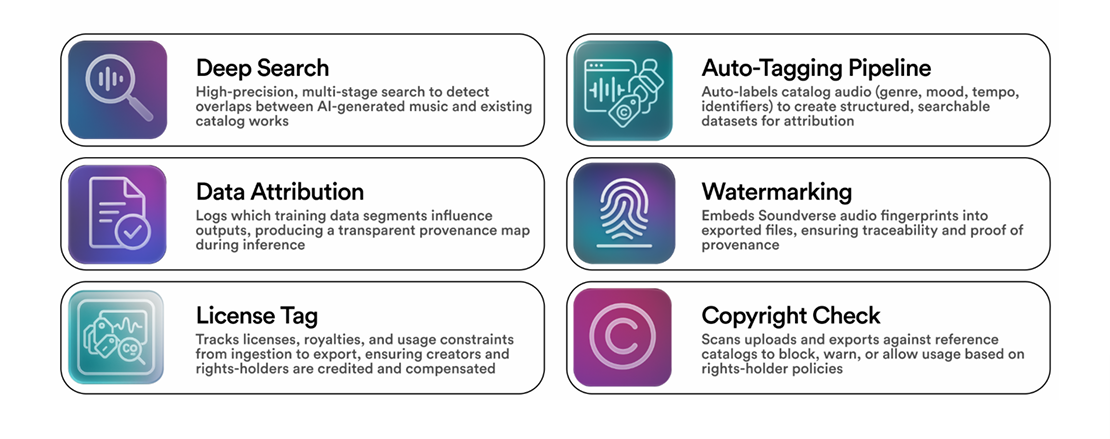
Soundverse Trace is a comprehensive trust layer designed specifically for ethical AI music creation. It embeds attribution, deep search, and rights protection throughout the entire lifecycle—from dataset creation to export. In practice, this means every AI-generated track comes with verifiable provenance.
Key Capabilities
- Deep Search: High-precision scanning (1:1 and 1:N) detects overlaps and ensures that AI outputs do not replicate copyrighted works.
- Data Attribution: Logs which datasets influenced generation, maintaining transparency for rights management.
- Audio Watermarking: Embeds inaudible fingerprints identifying origin and licensing data.
- License Tagging: Preserves metadata from ingestion to export so usage rights remain intact across platforms.
Primary Use Cases
Soundverse Trace empowers creators to prevent accidental infringement, automate royalty tracking, and validate the authenticity of AI-generated music. When combined with the Content Partner Program, rights-holders receive recurring royalties based on usage attribution—bridging ethical innovation and artist integrity. These tools form part of the Ethical AI Music Framework, ensuring every creator benefits from responsible technological progress.
For creators who want to explore advanced AI composition, learn how Soundverse revolutionizes music production through features like Generate AI Music with Soundverse Text-to-Music, Soundverse AI Revolutionizing Music Creation for New-Age Content Creators, and the Explore Tab walkthrough.
Start Creating with AI Music Today
Unleash your creativity with Soundverse's AI tools—generate royalty-free music tracks instantly, tailored to your mood, genre, or purpose. No licenses, no limits, just pure inspiration.
Related Articles
- How AI-Generated Music Is Transforming the Music Industry — Explore how artificial intelligence is revolutionizing music creation, production, and distribution across the industry.
- The Role of AI Music in Film and Television — See how filmmakers and TV producers are using AI-generated scores to elevate storytelling and reduce production costs.
- Navigating the World of Royalty-Free and Copyright-Free Music Using Soundverse AI — Learn how to find the right royalty-free soundtracks for your projects with the help of Soundverse's AI-powered tools.
- The Benefits of Composing with an AI Music Generator — Discover how using an AI music generator can speed up your creative process and open new musical possibilities.
Here's how to make AI Music with Soundverse
Video Guide

Here’s another long walkthrough of how to use Soundverse AI.
Text Guide
- To know more about AI Magic Tools, check here.
- To know more about Soundverse Assistant, check here.
- To know more about Arrangement Studio, check here.
Soundverse is an AI Assistant that allows content creators and music makers to create original content in a flash using Generative AI.
With the help of Soundverse Assistant and AI Magic Tools, our users get an unfair advantage over other creators to create audio and music content quickly, easily and cheaply.
Soundverse Assistant is your ultimate music companion. You simply speak to the assistant to get your stuff done. The more you speak to it, the more it starts understanding you and your goals.
AI Magic Tools help convert your creative dreams into tangible music and audio. Use AI Magic Tools such as text to music, stem separation, or lyrics generation to realise your content dreams faster.
Soundverse is here to take music production to the next level. We're not just a digital audio workstation (DAW) competing with Ableton or Logic, we're building a completely new paradigm of easy and conversational content creation.
TikTok: https://www.tiktok.com/@soundverse.ai
Twitter: https://twitter.com/soundverse_ai
Instagram: https://www.instagram.com/soundverse.ai
LinkedIn: https://www.linkedin.com/company/soundverseai
Youtube: https://www.youtube.com/@SoundverseAI
Facebook: https://www.facebook.com/profile.php?id=100095674445607
Join Soundverse for Free and make Viral AI Music

We are constantly building more product experiences. Keep checking our Blog to stay updated about them!
Image Steps: []