AI Music Prompt Mistakes to Avoid in 2026: Create Better Generative Tracks
Learn common AI music prompt errors to avoid and optimize your generative music workflow in 2026.
AI Music Prompt Mistakes to Avoid
Artificial intelligence is redefining music creation in 2026, but even the most advanced generative tools rely on human input—the prompt. While AI music generators like Soundverse can turn text into stunning instrumental tracks, many creators still struggle with poorly structured or vague AI music prompts that lead to unsatisfactory results. Understanding these prompt mistakes is essential for anyone looking to optimize their music AI workflow and craft professional-quality compositions efficiently.
Why do AI music prompts matter in generative composition?
AI music prompts act as the foundation for text-to-music generation. A well-written prompt guides the model to produce music that aligns with a creator’s intent, while unclear instructions often result in generic or mismatched soundscapes. With the growing adoption of AI composition tools in 2026—from indie producers crafting background loops for videos to professional studios integrating AI into production pipelines—knowing how to write precise prompts has become a core creative skill.

What are the most common prompt errors in AI music?
1. Vague Descriptions
One of the biggest mistakes is using overly broad terms such as “cool beat” or “ambient track.” AI models handle these ambiguities by generating generalized outputs, often lacking distinct genre identities. Instead, include descriptive adjectives, genre references, and instrumentation details: “slow ambient synth pad with soft piano tones for meditation” yields far richer results. For more inspiration on prompt clarity, explore Pro Tips for AI Music Prompts.
2. Overloading Prompts
On the opposite end, excessive input can confuse the AI. Prompts like “create upbeat electronic chillout jazz with orchestral strings and hip-hop drums” mix conflicting genres and tempo cues. Simplify and prioritize your main idea to ensure coherence.
3. Ignoring Context
A common AI composition mistake is not defining the purpose of the track—e.g., background music for a YouTube video, a game soundtrack, or a meditation loop. Context helps the model interpret the emotional and structural demands of the track. A prompt for game background music should emphasize steady rhythm and looping capability, while an ad soundtrack might focus on emotional cadence. For example, some creators use meditation prompt sets to structure ambient sessions.
4. Neglecting Duration and Structure
If you don’t specify length or looping requirements, you might end up with music that doesn’t align with your project. In 2026, most AI generators, including Soundverse, offer a Loop Mode for seamless repetition—always mention “loopable 60-second track” if you intend continuous use.
5. Forgetting to Mention Instruments or Mood
AI relies heavily on keywords related to mood (“uplifting,” “melancholic,” “cinematic”) and instruments (“guitar,” “violin,” “synth bass”) to structure compositions. Omitting these makes it harder for the generator to guess your desired emotional tone.
6. Overusing Technical Jargon
Music producers may use industry terms like “sidechain compression” or “mix bus,” which AI models might misinterpret. Keep the language artistic rather than engineering-heavy. Instead of technical directives, focus on texture and emotion.
7. Failing to Iterate
AI composition rarely works perfectly on the first attempt. Not iterating or fine-tuning prompts is a major workflow flaw. Creators who refine prompts based on listening feedback—adjusting genre, tempo, or instrumentation—achieve far better results. As many experts note, AI teams that iterate fast win.
8. Insufficient Genre Knowledge
Generative music engines thrive on genre clarity. If your prompt mixes incompatible genres (e.g., “punk ambient jazz”), the AI struggles to interpret structure. Studying genre conventions—through Soundverse’s AI genre guides—helps you create more compatible musical directions. For additional tool comparisons, check AI Prompt Music Generator reviews.

How to improve generative music prompt writing in 2026
Optimizing prompts requires deliberate design, reflection, and understanding of AI behavior.
- Start Simple: Begin with a concise prompt describing the genre, tempo, and mood: “chill lo-fi beat for study background.”
- Test and Listen: Generate multiple versions and compare tonal balance.
- Add Detail Gradually: Introduce additional instruments or structural cues only after achieving a solid core idea.
- Leverage Modifiers: Words like “ethereal,” “dark,” “acoustic,” and “cinematic” strongly influence output shape.
- Use Project Context: Tailor prompts for specific platforms—YouTube intros, ad jingles, podcasts, or game scenes.
For applied inspiration, creators can check Soundverse’s extensive repositories such as 100 text-to-music prompts for podcast intros to study how language precision leads to consistent quality across genres.
What do AI composition mistakes teach us about creativity?
Interestingly, prompt errors highlight how human creativity still drives generative systems. The AI doesn’t replace the artist—it reflects the clarity of their imagination. Good prompts merge human storytelling with machine interpretation. In 2026, as AI music tools become standard in production suites, prompt writing increasingly resembles the role of “composition scripting,” where text acts as the blueprint for sonic structure.
Mistakes help refine understanding of how models like Soundverse’s V4 and V5 interpret words and musical semantics. For instance, changing “soft acoustic guitar” to “muted acoustic guitar” alters timbre generation significantly. Learning this language will become a professional skill for AI musicians going forward.
To explore techniques for style-specific tracks, watch our guide on creating Deep House music or the Soundverse “How to Make Music” tutorial.
How to make better AI music prompts with Soundverse AI Music Generator
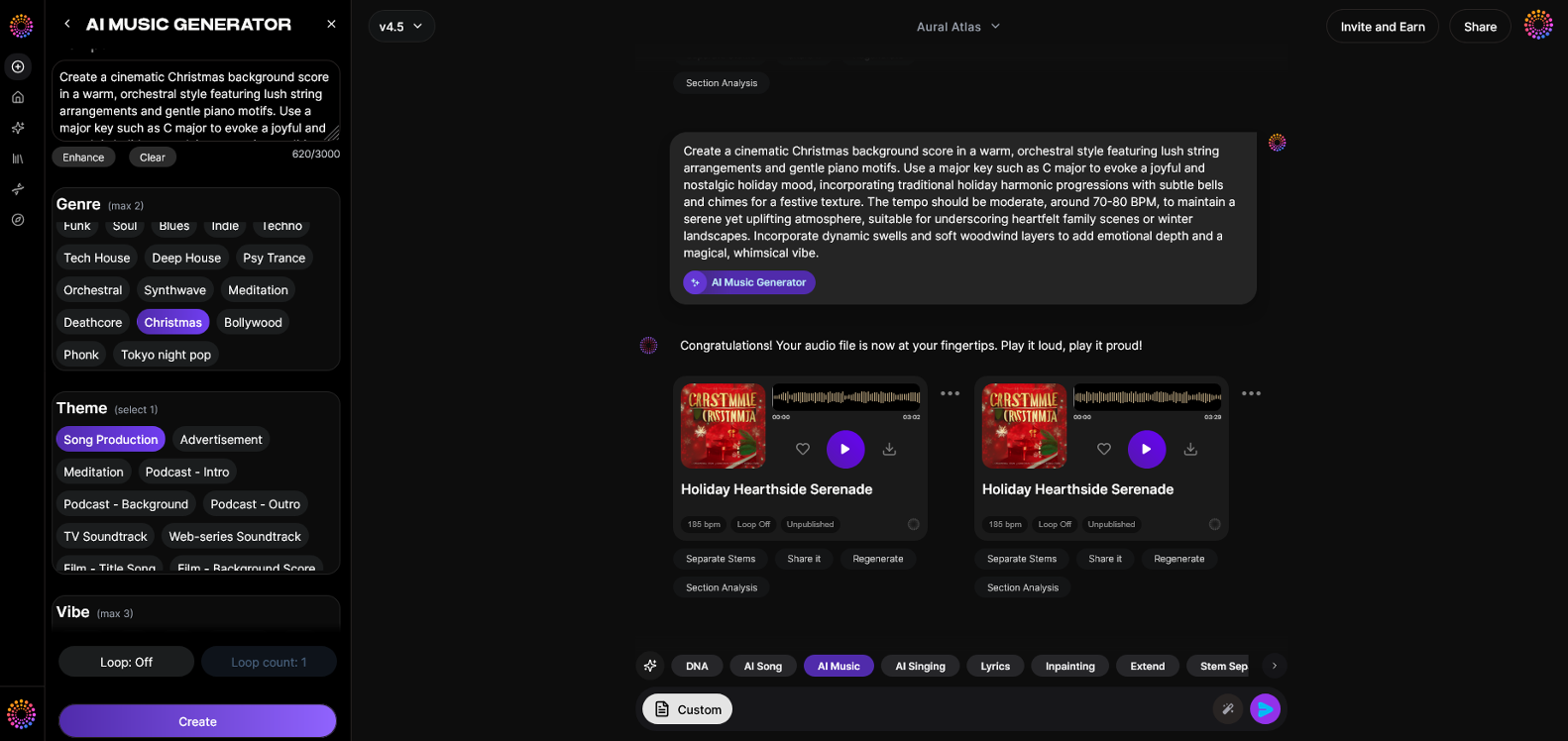
Soundverse provides a refined environment to test and improve prompts. Its AI Music Generator transforms your written descriptions into full instrumental music tailored to your needs.
Official Description: Soundverse’s AI Music Generator allows music creators to produce fully generated instrumental tracks directly from text prompts. It specializes in background tracks, beats, and soundscapes without vocals, and includes a Loop Mode for seamless repetition.
Core Capabilities include:
- Text-to-music conversion
- Controlled genre, mood, and instrument settings
- Loop Mode for seamless track playback
- Options to choose between advanced V4 and V5 models
Creators can use the tool for:
- Video background scoring
- Game soundtrack loops
- Meditation and wellness soundscapes
- Advertising and commercial themes
Combined with Soundverse Agent, users can also orchestrate multi-step workflows, such as generating instrumental music and then modifying structure automatically. Furthermore, Soundverse’s Ethical AI Music Framework ensures transparent model operations and fair artist attribution—an important consideration for creators maintaining integrity in their AI-assisted compositions. For more, see our “Explore” feature overview.
How Soundverse helps optimize your music AI workflow
Soundverse not only minimizes common AI prompt errors but also enhances overall workflow efficiency. By structuring prompts with genre filters, mood indicators, and instrument preferences, creators can achieve precise results faster. The asynchronous generation process ensures stability while allowing phase-wise adjustments.
For those exploring advanced integrations, the Soundverse Arrangement Studio further refines compositions, enabling users to manage stems and apply consistent mixing aesthetics. Together, these systems support the entire lifecycle—from prompt-writing to polished export.
In contrast to alternatives such as Mubert or Soundraw, Soundverse delivers greater prompt flexibility and transparency, empowering creators to iterate intelligently rather than relying on fixed preset models. A detailed comparison of such innovations can be found in Soundverse’s coverage of Mubert alternatives.
Start Creating Smarter AI Music Now
Avoid common AI music prompt mistakes and discover how Soundverse helps you craft more precise, beautiful compositions. Generate tracks instantly with genre, vibe, and emotion filters designed for creators just like you.
- 100 Text-to-Music Prompts That Will Help You Create Viral Music — Explore a collection of tested AI music prompts to spark creativity and produce viral-worthy tracks effortlessly.
- Generate AI Music with Soundverse Text-to-Music — Learn how Soundverse’s text-to-music capabilities transform written ideas into fully-produced songs in seconds.
- Best AI Music Generator: Top Picks and Review — Compare the leading AI music generation platforms and find out why Soundverse stands out for creators everywhere.
- What AI Can Generate Songs — Dive into the world of AI music tools capable of generating songs across genres, moods, and formats.
Here's how to make AI Music with Soundverse
Video Guide

Here’s another long walkthrough of how to use Soundverse AI.
Text Guide
- To know more about AI Magic Tools, check here.
- To know more about Soundverse Assistant, check here.
- To know more about Arrangement Studio, check here.
Soundverse is an AI Assistant that allows content creators and music makers to create original content in a flash using Generative AI. With the help of Soundverse Assistant and AI Magic Tools, our users get an unfair advantage over other creators to create audio and music content quickly, easily and cheaply. Soundverse Assistant is your ultimate music companion. You simply speak to the assistant to get your stuff done. The more you speak to it, the more it starts understanding you and your goals. AI Magic Tools help convert your creative dreams into tangible music and audio. Use AI Magic Tools such as text to music, stem separation, or lyrics generation to realise your content dreams faster. Soundverse is here to take music production to the next level. We're not just a digital audio workstation (DAW) competing with Ableton or Logic, we're building a completely new paradigm of easy and conversational content creation.
TikTok: https://www.tiktok.com/@soundverse.ai
Twitter: https://twitter.com/soundverse_ai
Instagram: https://www.instagram.com/soundverse.ai
LinkedIn: https://www.linkedin.com/company/soundverseai
Youtube: https://www.youtube.com/@SoundverseAI
Facebook: https://www.facebook.com/profile.php?id=100095674445607
Join Soundverse for Free and make Viral AI Music

We are constantly building more product experiences. Keep checking our Blog to stay updated about them!