AI Music for Ethical Creator Monetization in 2026: Building a Fair Economy for Artists
Discover ethical AI music monetization strategies empowering creators in 2026.
AI Music for Ethical Creator Monetization
The relationship between artificial intelligence and music creation has evolved dramatically since the early experiments of 2020. By 2026, AI music monetization has become a central topic in the creator economy—transforming how musicians, producers, and content creators earn from their art. However, the rapid adoption of generative models has also sparked ethical debates. How can AI-generated music be profitable and fair? And most importantly, how can independent creators ensure that their rights and identities are protected in an increasingly automated industry?
This article explores the evolution of AI music monetization in 2026, the ethical challenges facing the industry, and how tools like Soundverse’s Ethical AI Music Framework are leading the movement toward transparent and responsible creator income models.
What is AI music monetization and why does it matter in 2026?
AI music monetization refers to the process of generating income from music created with the assistance of AI systems. This income can come from streaming, licensing, sync deals, or even the usage of AI-trained models that replicate certain sonic identities. As AI-generated music becomes more prevalent, traditional royalty structures are being redefined.
For independent musicians and digital creators, ethical AI music monetization offers both opportunity and responsibility. The opportunity lies in scalability—AI can generate multiple compositions in minutes. But the responsibility lies in ensuring that the data, inspiration, and creativity that fuel these systems are credited and compensated fairly.
In 2026, the demand for music that aligns with ethical standards and copyright integrity has grown sharply. According to emerging music industry trends, audiences now value authenticity and transparency, prompting creators to choose AI platforms that align with those principles.

How did the AI music monetization landscape evolve since 2025?
Between 2024 and 2025, controversy surrounded many AI music tools that scraped copyrighted music without permission. This led to lawsuits, ethical concerns, and market mistrust. However, these challenges also motivated a shift toward consent-based AI systems. By 2026, ethical AI music frameworks became the standard for responsible innovation.
Platforms that failed to adapt lost credibility, while transparent solutions that emphasized attribution, data provenance, and recurring royalties gained trust from both creators and industry regulators. AI music monetization is no longer just a technical process—it’s now a financial ecosystem shaped by ethics, law, and technology.

What makes AI music monetization ethical?
Ethical AI music starts with consent. A system trained only on licensed data ensures that original artists are not exploited. It continues with traceability—so every generated track carries a clear record of influence, authorship, and usage. Finally, ethical AI music monetization guarantees recurring compensation for artists whenever their creative DNA fuels new works.
Key ethical practices include:
- Licensed training data – AI systems must use music with explicit permission from rights holders.
- Transparent attribution – Generated music should include metadata referencing contributing creators or styles.
- Recurring royalty models – Artists should receive proportional income for every use of their data in AI creation.
- Auditable systems – The AI’s output decisions must be explainable and traceable.
For creators exploring the AI revolution, understanding these elements is critical. Whether producing AI-generated music or collaborating with hybrid tools, ethical awareness builds long-term sustainability in the creator economy.
What challenges do creators face in monetizing AI-generated music?
Despite major advancements, challenges still exist for creators entering the AI music economy:
- Copyright ambiguity: Many jurisdictions are still updating intellectual property laws to properly classify AI-generated works.
- Royalty tracking: Without transparent watermarking and deep scanning capabilities, proper attribution remains difficult.
- Platform trust: Not all AI music platforms adhere to ethical standards, leaving creators vulnerable to unfair licensing.
- Income distribution: Because AI-generated music can scale rapidly, equitable revenue sharing models must evolve to match production speed.
These hurdles explain why many creators are now turning to trusted ecosystems like Soundverse, which bridge artistic integrity and monetization effectiveness.
How to make AI music monetization ethical with Soundverse The Ethical AI Music Framework
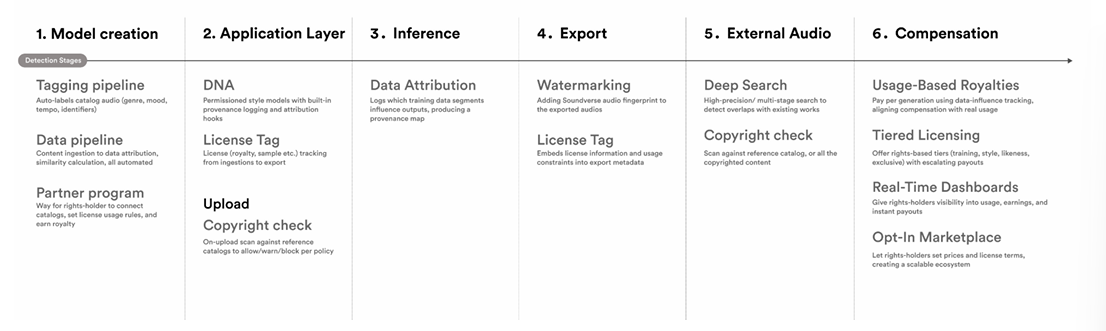
Soundverse’s Ethical AI Music Framework represents a transparent infrastructure built to unite innovation with creator integrity. Rather than operating as a black box, this framework follows a verified six-stage pipeline ensuring that every AI-generated track originates from consent, is attributed transparently, and rewards contributors fairly.
The Six Stages of Ethical AI Music Production
- Licensed Data Sourcing – Soundverse only uses legally licensed audio. There is no scraping or unauthorized dataset collection. This guarantees copyright safety for enterprise and independent creators alike.
- Permissioned Models (DNA) – The Soundverse DNA system enables AI music generation based on specific, permissioned sonic identities. Artists can train the AI to reflect their unique style while maintaining ownership and revenue rights.
- Explainable Inference (Attribution) – Every generated piece includes traceable metadata showing which sonic profiles or datasets contributed. This allows transparent crediting of artistic influence.
- Traceable Export (Watermarking) – Final exports are embedded with watermarks generated by Soundverse Trace, ensuring every track can be authenticated and verified for ownership.
- Deep Search (External Scanning) – Soundverse continuously scans the web and partner libraries to detect usage of AI-generated tracks and attribute rightful creators.
- Recurring Compensation (Partner Program) – Rights-holders participating in the Content Partner Program receive automated royalties whenever their licensed contributions fuel Soundverse AI outputs.
Through this process, creators, labels, and producers not only generate AI-powered tracks but also build an ongoing revenue model grounded in transparency.
For artists who want to explore creative applications, similar tools such as Soundverse AI Magic Tools or the advanced Text-to-Music Generator help artists design music ethically across genres—from EDM to jazz. For a deeper dive, watch our guide on creating Deep House music and our how to make music tutorial.
How can ethical AI music enhance creator income in 2026?
The financial empowerment of creators through ethical AI systems stems from a few key developments:
- Royalty Automation: With tools like Soundverse Trace, royalty payments are tied to verifiable data, eliminating under-credited work.
- Licensing Transparency: Brands and production studios increasingly prefer verified AI tracks to avoid legal disputes.
- Expanded Creative Output: Artists can use AI to multiply musical projects without diluting their brand, as their styles remain protected by DNA tagging.
- Stable Creator Economy: Ethical AI ecosystems create predictable, recurring income by aligning technological innovation with human value.
This shift toward transparent monetization parallels the broader ethical movements of AI across media industries, extending beyond music into visual and written art. By promoting responsibility and inclusivity, these systems help ensure longevity in creative careers.
How are creators using AI ethically in 2026?
Independent musicians are increasingly using AI to complement—not replace—their artistry. Many creators use platforms like Soundverse to design background tracks, melody prototypes, or sonic textures while retaining ownership of final compositions. Tutorials like How to Create Country Music with Soundverse AI and How to Create Jazz Music with Soundverse AI help users see how different genres adapt to AI-driven workflows.
Ethical AI also makes collaboration easier: international artists can securely exchange creative data without fear of misuse. The integrated watermarking system and explainable inference models give peace of mind for multi-contributor projects.
Why the music industry's future depends on ethics
2026 marks a turning point in how the music industry approaches AI adoption. Regulation and creator activism have aligned around a single principle: AI should augment, not exploit. Ethical AI music monetization will determine not only technical innovation but also who gets to thrive in the future creator economy.
Just as sustainability reshaped how fashion and film industries operate, transparency and accountability are redefining the soundscape. Creators who align early with these principles are best positioned to benefit from this new era.
Start Monetizing Your AI Music Ethically Today
Unlock the full potential of your AI-generated tracks with Soundverse. Build sustainable income streams while keeping ownership and ethical transparency intact.
Related Articles
- How AI-Generated Music Is Transforming the Music Industry — Discover how artificial intelligence is reshaping the landscape of music creation and commercialization for artists worldwide.
- Navigating the World of Royalty-Free and Copyright-Free Music Using Soundverse AI — Learn how to use AI tools to produce and monetize royalty-free music safely and efficiently.
- Soundverse AI Revolutionizing Music Creation for New Age Content Creators — Explore how Soundverse empowers modern artists with innovative AI tools for faster, ethical music production.
- Join the Soundverse Affiliate Program — Earn by sharing Soundverse—help creators discover ethical and powerful AI music monetization tools while you grow your income.
Here's how to make AI Music with Soundverse
Video Guide

Here’s another long walkthrough of how to use Soundverse AI.
Text Guide
- To know more about AI Magic Tools, check here.
- To know more about Soundverse Assistant, check here.
- To know more about Arrangement Studio, check here.
Soundverse is an AI Assistant that allows content creators and music makers to create original content in a flash using Generative AI.
With the help of Soundverse Assistant and AI Magic Tools, our users get an unfair advantage over other creators to create audio and music content quickly, easily and cheaply.
Soundverse Assistant is your ultimate music companion. You simply speak to the assistant to get your stuff done. The more you speak to it, the more it starts understanding you and your goals.
AI Magic Tools help convert your creative dreams into tangible music and audio. Use AI Magic Tools such as text to music, stem separation, or lyrics generation to realise your content dreams faster.
Soundverse is here to take music production to the next level. We're not just a digital audio workstation (DAW) competing with Ableton or Logic, we're building a completely new paradigm of easy and conversational content creation.
TikTok: https://www.tiktok.com/@soundverse.ai
Twitter: https://twitter.com/soundverse_ai
Instagram: https://www.instagram.com/soundverse.ai
LinkedIn: https://www.linkedin.com/company/soundverseai
Youtube: https://www.youtube.com/@SoundverseAI
Facebook: https://www.facebook.com/profile.php?id=100095674445607
Join Soundverse for Free and make Viral AI Music

We are constantly building more product experiences. Keep checking our Blog to stay updated about them!