AI Music for Education: How Artificial Intelligence is Transforming Learning and Skill Development in 2026
Explore how AI music tools like Soundverse enhance learning and skill development in 2026.
AI Music as a Tool for Learning and Skill Development
Artificial intelligence has moved far beyond novelty in 2026—it’s now integrated into classrooms, music studios, and online learning platforms worldwide. Among its most transformative applications is AI music for education, a field redefining how students learn theory, composition, and performance techniques. With advanced tools such as Soundverse’s Agent, educators and students are discovering new, immersive ways to create, understand, and refine their musical skills.
What is AI Music for Education?
AI music for education refers to the use of machine learning and generative AI systems to teach and develop musical skills. This includes everything from real-time music theory feedback to automated composition analysis and interactive songwriting exercises. Unlike early generation AI tools introduced in 2023–2024, which mostly focused on sound generation, the 2026 landscape emphasizes interactive learning and skill development.
Modern AI platforms now function as co-creators and coaches rather than mere generators. AI in music learning bridges the gap between theory and practice—allowing students to immediately apply theoretical concepts within engaging, practical environments.
Why is AI Music Important for Learning in 2026?
Music education has always combined creativity with discipline. However, the digital age introduced challenges like limited access to one-on-one mentorship and inconsistent practice opportunities. AI systems are addressing these challenges by:
- Providing Personalized Feedback – AI-assisted platforms analyze compositions or performances and highlight specific improvements in pitch, rhythm, and harmonic structure.
- Offering Adaptive Learning Paths – Music education technology can now adjust difficulty levels or focus areas based on learner performance.
- Enabling Global Collaboration – Students across continents can co-compose tracks via cloud-based AI music tools, creating cross-cultural learning experiences.
- Increasing Engagement – Gamified AI lessons make complex topics like counterpoint or modulation accessible and fun for younger learners.
You can see how different platforms are evolving in The Ultimate Guide - Best AI For Music Education 2026. For educators developing AI literacy, check out Building AI Literacy: A New Era for Music Educators.
How Does AI Support Skill Development Through Music?
Skill development through AI music focuses on making the learning process iterative and reflective. For instance, an AI assistant might generate multiple chord progressions for a melody, encouraging students to experiment and compare tonal variations. It also allows non-musicians to explore creativity without technical barriers.
When teachers incorporate artificial intelligence music tools in their classrooms, they foster experimentation. Students can visualize waveforms, separate song stems, and reimagine arrangements through intuitive interfaces—processes once reserved for professional producers.
If you’re curious about how AI innovation has transformed music creation, our analysis of AI-generated music in the industry explores similar applications. For practical tutorials, watch our Soundverse Tutorial Series - How to Make Music or Soundverse Tutorial Series - Explore Tab on YouTube.
What Roles Do Artificial Intelligence Music Tools Play in Modern Classrooms?
AI-driven music tools have a broad spectrum of educational applications:
- Music Theory Assistance: AI provides instant explanations for intervals, harmony, and modes, allowing learners to visualize music concepts.
- Song Deconstruction: Students can use tools like Soundverse’s Section Analysis to identify verses, choruses, and bridges with timestamp precision.
- Composition Coaching: With features similar to the AI Lyrics Writer, learners practice lyric structure and storytelling.
- Creative Autonomy: Learners use AI-assisted music composition systems to convert text prompts into melodies, harmonies, or even full arrangements.
These tools change the traditional student-teacher dynamic—empowering both groups to focus on creativity rather than repetitive tasks. Explore more structured frameworks in Guiding Principles, Frameworks, and Applications for AI in Music Education.
What Trends Are Shaping AI in Music Education in 2026?
As we move through 2026, three key trends stand out in music education technology:
- Conversational Learning Models: AI agents that communicate naturally with users are dominating the space. Students prefer asking questions (“Can you explain why this chord works?”) to typing commands or reading complex manuals.
- Ethically Trained AI Systems: Following the data transparency debates from 2024–2025, education platforms now prioritize ethically licensed training data. Platforms like Soundverse DNA offer copyright-safe content creation.
- Voice and Sound Immersion: While AI still processes uploads asynchronously, advanced synthesis allows for voice-based feedback and emotional tone training—essential tools for vocal students and producers alike.
For a deeper look at similar innovations, see our post on Soundverse’s AI Magic Tools, which explains how automation enhances learning creativity.
How to Make AI Music for Education With Soundverse Agent
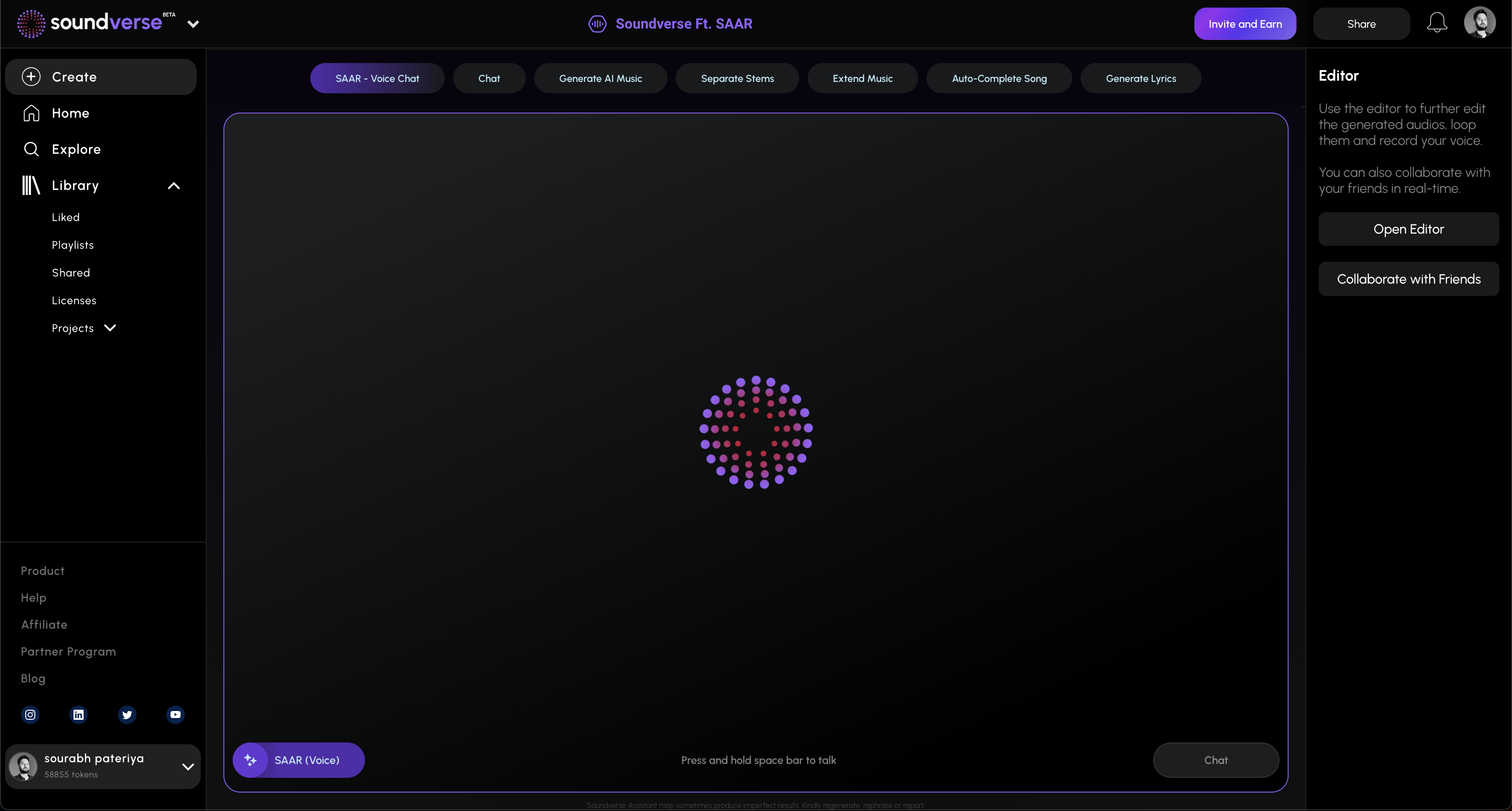
Soundverse’s Agent feature exemplifies the next frontier of interactive, AI-powered learning. It’s not just a tool—it’s a collaborative assistant designed to help educators and learners create, analyze, and refine music.
What is the Soundverse Agent?
Agent is Soundverse’s conversational AI music assistant. It orchestrates various Soundverse modules through natural language interaction. You might say, “Create a jazz study piece, then separate the piano and drums,” and Agent will interpret and execute this multi-step workflow automatically. Its contextual memory ensures continuity across sessions, allowing teachers and students to build projects iteratively.
Core Capabilities Include:
- Multi-step Tool Orchestration: Automate tasks like generation, stem separation, or remixing without switching interfaces.
- Contextual Memory: The assistant remembers prior instructions, useful for lesson continuity.
- Voice Input Support: Users can speak commands directly to the assistant.
- Cross-tool Workflow Automation: Integrates seamlessly with features like AI Lyrics Writer, Section Analysis, and Soundverse DNA.
Educational Use Cases of Soundverse Agent
- For Beginners: Introduces concepts interactively (e.g., understanding chord progressions or rhythmic layering).
- For Teachers: Automates repetitive tasks such as stem analysis or structure labeling so instructors can focus on feedback.
- For Producers and Advanced Students: Allows testing multiple music prototypes swiftly, integrating theory with production practice.
Using Agent, educators can develop lesson modules tailored to student performance, reinforcing theoretical principles through active music creation.
To view how similar automation supports genre learning, explore guides such as How to Create Jazz Music with Soundverse AI or How to Create Country Music with Soundverse AI.
What Are the Benefits of Using AI Music in Education?
- Inclusivity and Accessibility: AI eliminates the need for expensive instruments or software, opening music education to all economic backgrounds.
- Enhanced Creativity: Real-time composition exploration encourages creativity through feedback loops.
- Efficiency: Teachers automate technical demonstrations while focusing on conceptual understanding.
- Data-Driven Progress: AI tracks individual performance trends, helping institutions measure educational outcomes objectively.
- Ethical and Legal Assurance: Thanks to systems like Soundverse DNA, learners engage with copyright-safe materials—vital for academic settings.
Future Outlook: Where is AI Music Learning Going?
Between 2026 and 2030, expect AI in music learning to evolve into fully modular education ecosystems. These environments will blend real-time audio interaction with project-based learning experiences. Educators will create interactive assignments where students compose or remix AI-assisted pieces and receive analytical feedback instantly.
Through constant development, AI music for education will redefine creative literacy. Students will graduate with not just instrumental skills but technical expertise in AI-assisted production and composition—skills increasingly sought after across the global entertainment and education industries.
Start Creating Educational Music with AI Today
Empower your students—or yourself—to learn through creativity. Use Soundverse’s AI music tools to compose, experiment, and teach the art and science of sound effortlessly.
Try Soundverse Free
Related Articles
- How AI-Generated Music is Transforming the Music Industry – Discover how AI is redefining the creative process and the education landscape for emerging musicians.
- The Benefits of Composing with AI Music Generator – Learn how AI-assisted composition boosts skill development, creativity, and workflow efficiency for all creators.
- AI Music Generator and Human Composers: A Future Together – Explore how educators and composers collaborate with AI tools to expand musical understanding and creativity.
- The Role of AI Music in Film and Television – See how AI music creation supports storytelling and audiovisual education across media studies.
Here's how to make AI Music with Soundverse
Video Guide

Here’s another long walkthrough of how to use Soundverse AI.
Text Guide
- To know more about AI Magic Tools, check here.
- To know more about Soundverse Assistant, check here.
- To know more about Arrangement Studio, check here.
Soundverse is an AI Assistant that allows content creators and music makers to create original content in a flash using Generative AI.
With the help of Soundverse Assistant and AI Magic Tools, our users get an unfair advantage over other creators to create audio and music content quickly, easily and cheaply.
Soundverse Assistant is your ultimate music companion. You simply speak to the assistant to get your stuff done. The more you speak to it, the more it starts understanding you and your goals.
AI Magic Tools help convert your creative dreams into tangible music and audio. Use AI Magic Tools such as text to music, stem separation, or lyrics generation to realise your content dreams faster.
Soundverse is here to take music production to the next level. We're not just a digital audio workstation (DAW) competing with Ableton or Logic, we're building a completely new paradigm of easy and conversational content creation.
TikTok: https://www.tiktok.com/@soundverse.ai Twitter: https://twitter.com/soundverse_ai Instagram: https://www.instagram.com/soundverse.ai LinkedIn: https://www.linkedin.com/company/soundverseai Youtube: https://www.youtube.com/@SoundverseAI Facebook: https://www.facebook.com/profile.php?id=100095674445607
Join Soundverse for Free and make Viral AI Music

We are constantly building more product experiences. Keep checking our Blog to stay updated about them!